Ardha Chandrasana with Pada Hastasana: Bikram Half Moon and Hands to Feet Pose Step by Step

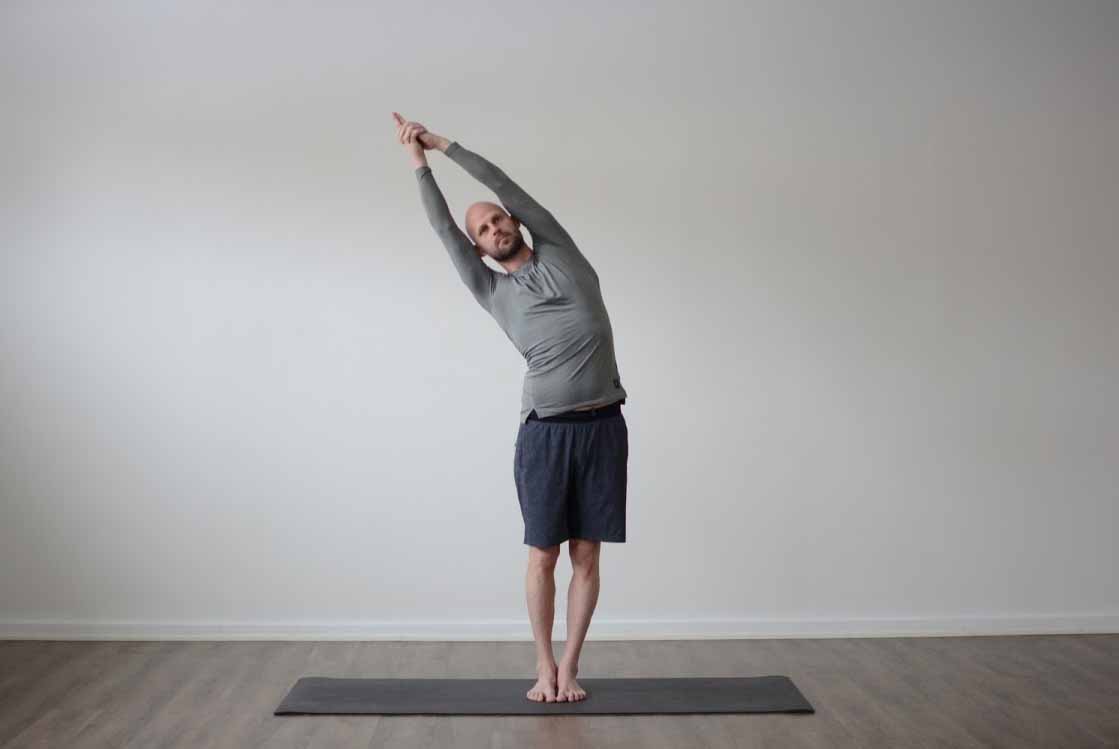
Ardha Chandrasana with Pada Hastasana (Half Moon Pose with Hands to Feet Pose) is the second exercise of the Bikram yoga sequence: a standing side bend to each side, a standing backbend, and then a deep forward fold with the hands holding the heels. Done in that order, it moves the spine in three directions within a few minutes, which is why Bikram uses it as the warm-up after the opening breathing exercise. Padahastasana on its own means Hand to Foot Pose, a standing forward bend.
Pose type: standing sequence of side bend, backbend and forward bend. Level: beginner, level 1. Props: none, a mirror helps.
What the names mean
Ardha means half, chandra moon and asana seat or posture: the arms and the curved side of the body draw a half moon. Pada means foot and hasta hand, so Padahastasana is Hand to Foot Pose. The backbend in the middle has no Sanskrit name in Bikram's own teaching. Some teachers call it Anuvittasana.
The same names mean different poses in other schools. In Iyengar, Hatha and Vinyasa yoga, Ardha Chandrasana is a balance on one leg and one hand, which we explain in our guide to Ardha Chandrasana, the balancing Half Moon. In Iyengar's system, Padahastasana is a forward fold with the hands slid under the feet, palms up. This guide follows the Bikram form, the one you meet in a Hot 26 class. Our overview of the 26 Bikram yoga poses shows where it sits in the whole sequence.
How to do Half Moon Pose (the side bend), step by step
- Stand with your feet together, big toes and heels touching or as close as they will go. Arms down by your sides, eyes forward.
- Sweep your arms out to the sides and up over your head. Interlace your fingers, release the index fingers so they point up, and cross your thumbs.
- Stretch up toward the ceiling with the arms close to your ears. You should feel one line from your fingertips down to your heels.
- Firm your thighs and glutes and draw the belly in. The lower body is the base that holds the bend.
- On an inhale, reach up. On the exhale, bend to the right: push your hips to the left and your arms to the right, so the body curves in one plane, as if you stood between two panes of glass.
- Go only as far as you can keep that line and breathe without strain. You feel the stretch along the whole left side, from the outer hip up to the armpit.
- Hold for about 10 breaths, or as long as your teacher counts. If you start to sink, come up a few degrees and hold there.
- Inhale back to the centre, stretch up, and repeat to the left.

Beginner cues for the side bend
- Chin up. The chin tends to drop toward the chest. Keep the head between the arms, neck long.
- Bottom shoulder forward. The lower shoulder tends to roll back. Bring it in line with the top shoulder.
- Hips square. When you move the shoulder forward, check that the opposite hip does not roll back. Both hip bones face the front.
- Straight arms and legs. Bending an elbow or a knee lets you go deeper, but the pose is lost. Come back to where the line holds.
How to do the standing backbend, step by step
After both sides of Half Moon, stay in the same grip.
- Stretch up toward the ceiling with the arms by your ears.
- Inhale deeply. Let your head drop back and look at the floor behind you only as far as your neck is comfortable.
- Take the arms back and bend backward from the tailbone up through the whole spine, so the curve is spread along the back and not only in the lower back.
- Keep the weight in your heels and the legs straight and firm. Press the hips and thighs forward.
- Lift the chest toward the ceiling. The lift in the upper back protects the lower back.
- Hold for about 10 breaths, then inhale and come back up with the arms and head together.

How to do Padahastasana (Hands to Feet Pose), step by step
- From standing, fold forward with bent knees and put your hands on the floor. Sway your hips gently from side to side for 10-15 seconds to let the lower back and the backs of the legs soften.
- Shift your weight toward your toes. Take hold of your heels from behind, fingers under the heels and little fingers touching, and tuck your elbows behind your calves.
- Keep your belly on your thighs. Pull on your heels and slowly straighten your legs as far as you can without the belly lifting off.
- Lengthen down along the spine, the face on the shins below the knees and the crown of the head toward the feet.
- Draw the elbows further behind the calves and let the shoulders move away from the ears.
- Breathe normally. Hold for about 10 breaths, then release the heels and inhale up with the arms and head together.

If you cannot reach your heels, hug the backs of your legs with your arms instead, or hold your ankles. The belly on the thighs matters more than straight legs.
Breathing in the sequence
In the side bend and the backbend, Bikram teaches a way of breathing he called 80-20 breathing: fill the lungs fully, then keep breathing in and out through the nose using only the top part of the breath, so the chest stays lifted. In the forward fold the breath is normal, since the folded belly leaves little room for a full breath. The 80-20 figure is a teaching image. No study measures it, but the cue does keep the ribs lifted in the bends.
Benefits of Half Moon with Hands to Feet Pose
What the sequence does well is move the spine through three directions in a few minutes, from standing:
- Side bend: stretches the side of the body, the obliques, the latissimus dorsi, the quadratus lumborum in the lower back and the outer hip. The arms overhead work the shoulders.
- Backbend: stretches the front of the body, the hip flexors, belly and chest, and works the back muscles and legs that hold you.
- Forward fold: stretches the hamstrings, calves and the muscles along the spine. Our guide to hamstrings and yoga explains why they are often tight.
The old text on this page said the side bend is perfect for lower back pain and that the fold is good for digestion and stress. We could not find studies on this sequence that support those claims. A gentle side bend can feel good in a stiff lower back, but acute back pain needs a physiotherapist, not a deeper bend.
Who should skip or modify this sequence
- Neck problems: in the backbend, keep the chin slightly tucked and look up and back, not down at the floor behind you.
- Lower back pain, disc problems: keep the backbend small and bend the knees in the forward fold. Skip the deep versions if they bring pain down a leg.
- High or low blood pressure, dizziness: come out of the forward fold slowly and keep the backbend small. In a heated room, the head rush when you stand up is stronger.
- Glaucoma or eye pressure: skip the deep forward fold, as the head is below the heart.
- Pregnancy: widen the feet and keep the backbend and the fold gentle, and follow your midwife's or doctor's advice. Hot yoga in pregnancy is a question for them first.
- Recent hamstring strain: keep the knees bent in Padahastasana.
For more on practising without injury, read our 10 tips to avoid yoga injuries.
Common mistakes
- Bending forward in the side bend. The chest turns toward the floor and the stretch leaves the side. Stay in one plane.
- Bent elbows. The arms stay straight and the grip firm. Less depth, better line.
- Throwing the head back. The neck is the least stable part of the spine. Let the curve start in the upper back and let the head follow.
- Collapsing into the lower back. Lift the chest in the backbend. If the bend is all in one spot at the waist, go less far.
- Straightening the legs first in the fold. The belly lifts off the thighs and the lower back rounds. Keep the belly down and straighten the legs as far as that allows.
- Locking the knees. Bikram teachers say "lock the knee" and mean firm thigh muscles. If your knees push backward past straight, keep a small bend.
Preparatory poses
- Tadasana (Mountain Pose): the feet-together stance and the long line the sequence starts from.
- Trikonasana (Triangle Pose): a side stretch with the feet apart, easier to control.
- Prasarita Padottanasana (Wide-Legged Forward Bend): a forward fold with a wider base, kinder to tight hamstrings.
- Padangusthasana (Big Toe Pose): a standing fold holding the big toes, a step before holding the heels.
Follow-up poses
In the Bikram sequence, the next pose is Awkward Pose, a set of squats close to Utkatasana (Chair Pose), followed by Garudasana (Eagle Pose). The backbend prepares for the deeper ones later in the class: Ustrasana (Camel Pose) and Dhanurasana (Bow Pose). The fold leads on to Paschimottanasana (Seated Forward Bend).
Variations
- Palms together: in some Hot 26 classes the palms press together overhead instead of interlacing the fingers.
- Hands on the hips: for the backbend, if the arms overhead strain the shoulders or the lower back.
- Iyengar's Padahastasana: slide the hands under the feet, palms up, toes reaching to the wrists.
- Uttanasana (Standing Forward Bend): the same fold with the hands on the floor or on blocks, an easier start.
To practise the sequence with a teacher, follow Lauren Matters' 30-minute Hot 26 Standing Series (level 1), or learn the alignment pose by pose in Hot 26 Breakdown, part 1.
Frequently asked questions
What is Ardha Chandrasana with Pada Hastasana?
It is the second exercise in Bikram yoga: a standing side bend to the right and left with the arms overhead, a standing backbend, and a forward fold holding the heels. It follows the opening breathing exercise and warms up the spine in three directions.
What are the benefits of Padahastasana?
Padahastasana stretches the hamstrings, calves and the muscles along the back of the spine, and it teaches you to fold from the hips with the belly on the thighs. Claims that it improves digestion or relieves stress come from tradition, not from studies of the pose.
Who should avoid Padahastasana?
People with glaucoma, uncontrolled blood pressure, a disc problem that gives pain down a leg, or a recent hamstring or back injury should skip the deep fold or keep the knees well bent. If you get dizzy, come up slowly. Pregnant women should ask their midwife or doctor first.
What is the difference between Padahastasana and Uttanasana?
Both are standing forward folds. In Uttanasana the hands rest on the floor or blocks. In Padahastasana the hands hold the feet: in Bikram yoga they grip the heels from behind, in Iyengar's form they go under the feet, palms up.
What is the English name for Padangusthasana?
Padangusthasana is Big Toe Pose: a standing forward fold with the first two fingers hooked around the big toes. In Bikram yoga a similar name, Padangustasana, is used for Toe Stand, a balance on the toes of one foot.
Why is it called Half Moon Pose in Bikram yoga?
With the arms overhead and the body bent sideways, the body draws a curve like a half moon. In most other styles, Half Moon Pose is a one-legged balance with one hand on the floor, so check which one a class means.
How long do you hold each part?
Bikram classes usually do the whole sequence twice, holding each part for about 10 breaths the first time and a little shorter the second. At home, hold as long as you keep the line and breathe calmly.
Practise it with a teacher
Over 600 online yoga classes and programs for $4.99 a month. Cancel any time.
Become a member