Core and Yoga: Core Muscles and the Best Yoga Poses for Core Strength


Your core is the group of muscles that wraps the trunk between the ribs and the pelvis: the abdominal wall, the deep back muscles, the diaphragm on top and the pelvic floor underneath. In yoga its main job is to hold the spine and pelvis steady while the arms and legs move. You work it in poses such as Plank, Side Plank, Boat, Warrior III and Crow, and in any pose where you have to hold your shape against gravity.
What is the core?
There is no single agreed definition. The one most sports medicine papers use describes the core as a box. The abdominals form the front and sides, the paraspinal muscles and the glutes form the back, the diaphragm is the lid and the pelvic floor and hip muscles are the floor (Huxel Bliven and Anderson, 2013, building on earlier work by Akuthota and Nadler). On that definition the core is much more than the abs you can see.

The muscles usually counted in it:
- Rectus abdominis. The long strap down the front of the belly, from the lower ribs to the pubic bone. It curls the spine forward, as in a sit-up or the rounded back of Boat Pose.
- Internal and external obliques. The side walls of the waist. They rotate the trunk and bend it sideways, and they stop it from twisting or tipping when you hold a pose on one arm.
- Transversus abdominis. The deepest layer, running around the belly like a wide belt. It draws the belly in and stiffens the abdominal wall. It is also active when you breathe out hard.
- Erector spinae and multifidus. The long and short muscles along the spine. They extend the back and keep each vertebra steady on the next.
- Quadratus lumborum. A deep muscle between the lowest rib, the lumbar spine and the pelvis. It bends the trunk to the side and holds the pelvis level.
- Diaphragm and pelvic floor. The top and bottom of the box. Together with the abdominal wall they set the pressure inside the belly.
- Psoas and iliacus, the glutes. The hip muscles that connect the trunk to the legs. See hip flexors and psoas in yoga and the glutes in yoga.
Some teachers also count the latissimus dorsi and serratus anterior, because they tie the arms to the trunk. In Plank and Crow you feel them working with the belly.
What the core does in yoga
The core does three kinds of work on the mat.
- It holds still. In Plank the abdominals stop the hips from sagging toward the floor. In Side Plank the obliques and quadratus lumborum stop the waist from dropping. This is isometric work: the muscle works hard and the body does not move.
- It passes force through. When you step a foot forward from Downward Dog or jump back to Chaturanga, the push starts in the arms or legs and travels through the trunk. A steady trunk lets it arrive where it should.
- It moves you. Curling into Boat, twisting in a seated twist, lifting the chest in Locust. Here the core muscles move the spine instead of holding it.
Most yoga poses ask for the first two far more than the third. That is one reason yoga core work feels different from a set of crunches.
How to engage your core in yoga
"Engage your core" is one of the most common cues in a class and one of the least clear. These are the ones that work on the mat:
- Hug your lower ribs toward your hip bones. This closes a flaring rib cage and switches on the front of the belly without rounding your back. Use it in Plank, Downward Dog and arm-overhead poses.
- Draw the lower belly in and up, gently. Think of the area below the navel moving a little toward the spine. Keep it light enough that you can still breathe into your ribs.
- Keep breathing. If you hold your breath to stay in a pose, the pose is too hard for now. Choose an easier version and breathe slowly.
- Stay long through the spine. Core work in yoga means holding a neutral or long spine, not curling up. Imagine the crown of your head and your tailbone moving away from each other.
Yoga poses for core strength
Pick three or four of these and hold each for five to eight breaths. Rest, then repeat once or twice. As it gets easier, hold longer or move to the harder variation. That is what makes a muscle stronger over time.
Phalakasana (Plank Pose)
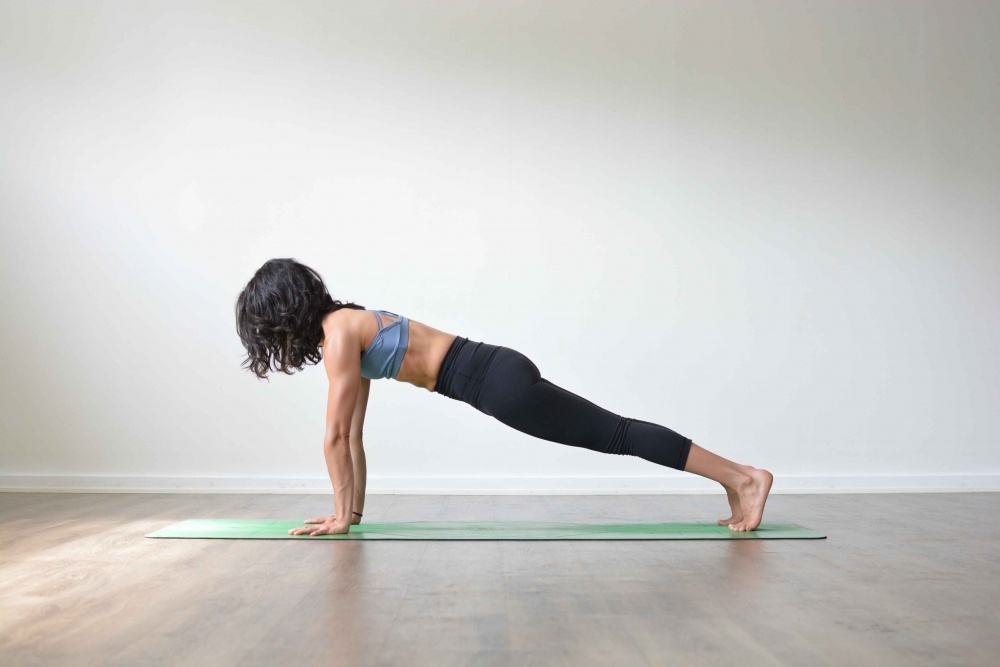
- From hands and knees, place your hands under your shoulders and spread your fingers.
- Step your feet back one at a time until your body makes a line from head to heels.
- Hug your lower ribs toward your hip bones and press the floor away with your hands.
- Stay for five breaths. If your lower back sags, lower your knees and keep the same line from head to knees.
Full guide: how to do Plank Pose step by step.
Vasisthasana (Side Plank)
From Plank, roll onto the outer edge of your right foot and stack the left foot on top. Lift your left arm. Press the right hand down and lift the lower side of your waist away from the floor. Now the obliques and the quadratus lumborum hold you up. For a gentler version, lower the right knee to the mat. Steps and variations in Vasisthasana (Side Plank).
Paripurna Navasana (Boat Pose)

- Sit with knees bent and feet on the floor. Hold the backs of your thighs.
- Lean back until you balance on your sitting bones, chest lifted and spine long.
- Lift your feet so your shins are parallel to the floor. Reach your arms forward.
- Straighten the legs only if your back stays long. A rounded lower back means the legs are too high for now.
This is the one core pose on the list where the hip flexors do much of the lifting. More in Paripurna Navasana (Boat Pose).
Purvottanasana (Upward Plank)
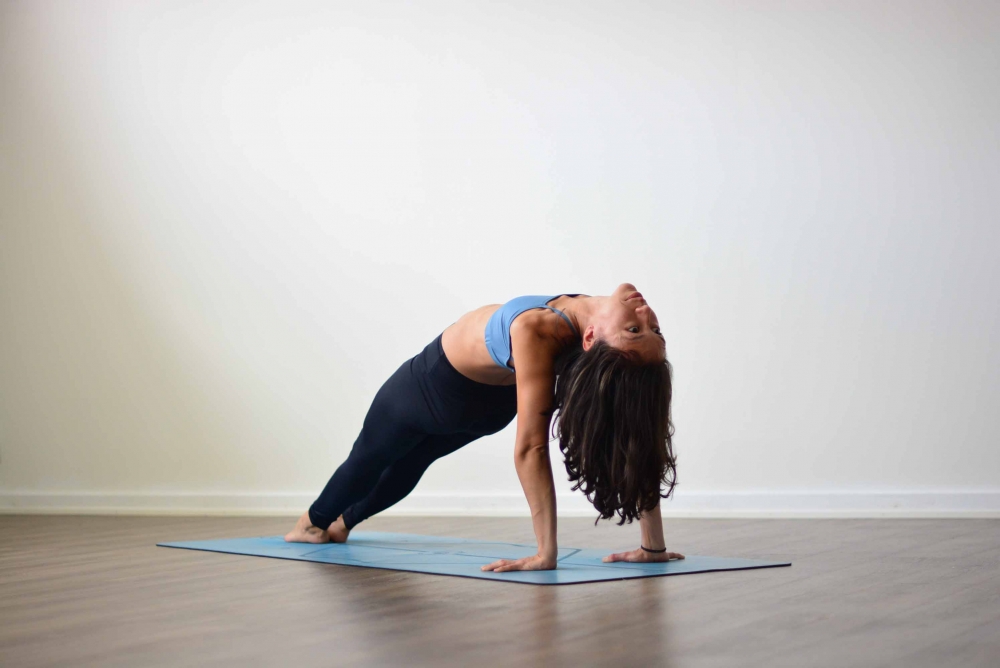
Sit with your legs long and your hands behind your hips, fingers toward your feet. Press into your hands and heels and lift your hips until your body makes a line. The back of the body does most of the work here: glutes, hamstrings and the muscles along the spine. It balances the front-body work of Plank and Boat. Bend the knees and keep the feet flat for the tabletop version.
Virabhadrasana III (Warrior III)
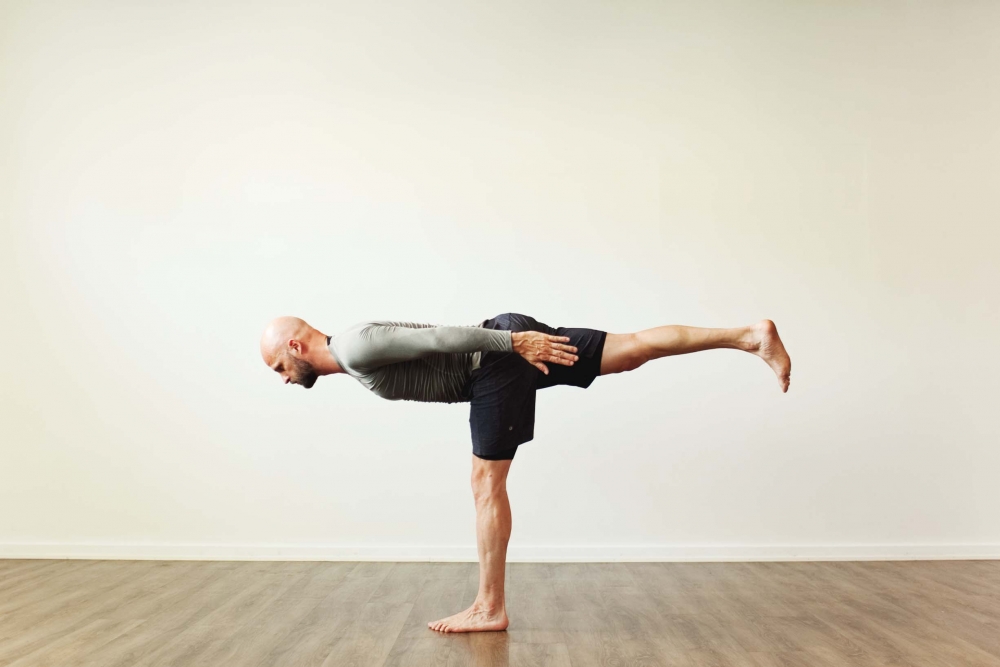
Balancing on one leg with your body parallel to the floor, the core has to stop the trunk from twisting and the pelvis from tipping. Keep the toes of the lifted leg pointing down and reach through your heel. Fingertips on blocks make it easier. Step-by-step: Virabhadrasana III (Warrior III).
Chaturanga Dandasana (Four-Limbed Staff Pose)
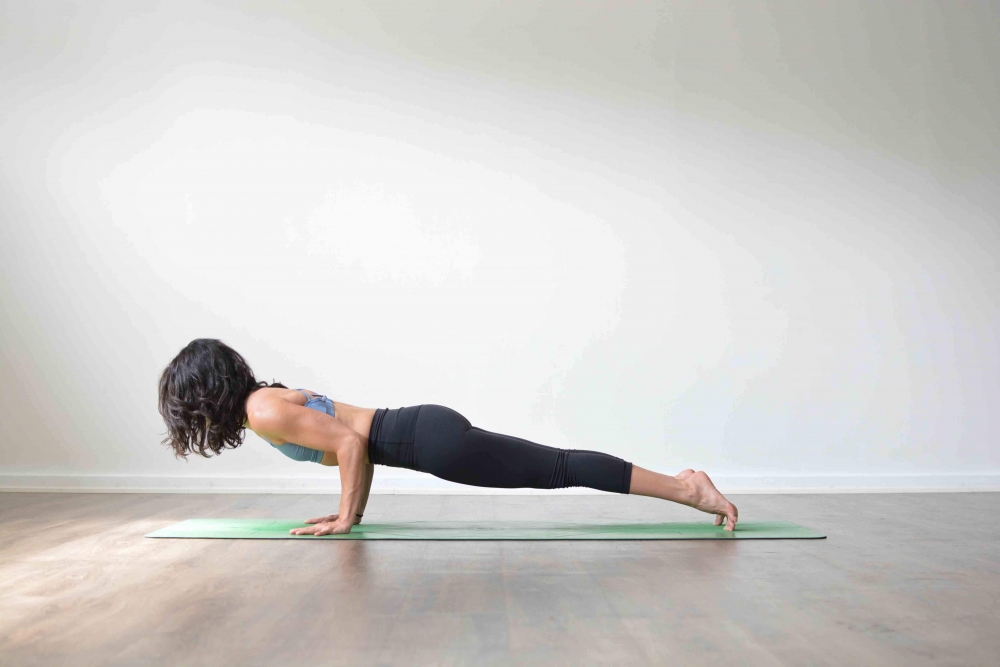
A Plank lowered halfway, elbows bent close to the ribs. The arms and chest work hard and the core keeps the body in one line so the hips neither sag nor lift. Start with the knees down. See how to do Chaturanga Dandasana.
Bakasana (Crow Pose) and Lolasana (Pendant Pose)

Arm balances where the core pulls the knees and hips up and in. In Crow, round the upper back, draw the knees high onto the upper arms and look a little forward. Lolasana lifts the whole body off the floor with the legs crossed and tucked in, and it asks for strong abdominals and hip flexors. Both are level 2 and up. Guides: Bakasana (Crow Pose) and Lolasana (Pendant Pose).

Breath and bandhas
The diaphragm is part of the core, so how you breathe changes how the core works. A slow, full breath moves the belly, the lower ribs and the pelvic floor together. A strong exhale, as in Kapalabhati, uses the abdominal wall, including the transversus abdominis, to push the air out.
In the yoga tradition, bandha means a lock or a bind. Mula Bandha, the root lock, is described as a lift at the base of the pelvis, and Uddiyana Bandha as a drawing in and up of the belly. Many modern teachers link these to the pelvic floor and the deep abdominal wall. The older texts describe them in terms of prana, not muscles, so the anatomical reading is a modern one.
Who should go easy or modify
- During pregnancy and after giving birth. Skip hard front-body work such as full Boat and long Planks, especially with a gap between the two sides of the rectus abdominis (diastasis recti). A pelvic floor physiotherapist can tell you when to start again.
- With a hernia or recent abdominal surgery. Ask your doctor before loading the belly.
- With low back pain. Start with Plank on the knees, Bridge and Bird Dog on hands and knees. Stop if pain spreads down a leg.
- With high blood pressure. Keep breathing in every hold. Avoid holding your breath while you strain.
- With sore wrists. Do Plank on your forearms and leave arm balances for later.
Common mistakes
- Holding the breath. It makes a pose feel steadier for a moment. It also means the pose is too hard. Choose a version you can breathe in.
- Sagging or piking hips in Plank. Both shift the load away from the abdominals. Check the line from head to heels in a mirror, or ask a teacher.
- Gripping the belly all the time. A belly held tight through a whole class stops the breath from moving. Engage as much as the pose needs, then let go.
- Only training the front. Plank and Boat work the front of the body. Add Locust, Bridge and Upward Plank for the back.
- Chasing the hardest version. Straight legs in Boat with a rounded lower back work less than bent knees with a long spine.
Where sources disagree
Draw in or brace? In the 1990s Paul Hodges and colleagues found that the transversus abdominis switched on later in some people with low back pain. That led to a wave of "draw your navel to your spine" training. The back researcher Stuart McGill argued the other way: brace the whole abdominal wall evenly, as if someone were about to poke your belly. Later reviews found that exercises aimed at the deep muscles help back pain about as much as general exercise, not more. For a yoga student, both cues have a place. A light draw-in for slow poses, a firmer brace under heavy load.
Can yoga build a strong core on its own? Yoga loads the core with body weight and long holds, and for most beginners that is enough to get stronger. Past a point, strength coaches would add load or harder progressions. We look at that in why yogis need strength training.
Does a strong core fix back pain? The old version of this post promised it would. The evidence says exercise in general helps many people with long-term low back pain, and no single type of core work stands out. A stronger core is one reasonable part of that, not a cure.
Six-pack abs. The visible ridges come from the rectus abdominis and its tendon bands. Whether you can see them depends mostly on how much fat lies over the belly, which exercise alone does not target. Yoga can make the muscles stronger. It will not decide whether they show.
Where the idea of the core comes from
Nobody knows who first called it "the core". Three twentieth-century teachers shaped how yoga teachers talk about it, and only one of them taught yoga.
- Joseph Pilates called the trunk the "powerhouse" and built his method around controlling it. Many yoga classes have borrowed his cues.
- Ida Rolf, who created the bodywork method known as Rolfing, described the body as a deep core and an outer sleeve, with the psoas as part of the core that connects the spine to the legs.
- T. Krishnamacharya, the teacher behind much of modern posture yoga, taught the bandhas as part of practice. The link between his bandhas and the muscles Pilates and Rolf described is an interpretation later teachers made.
For a guided class, 15 Minute Core is a Vinyasa core class, level 1-2, no props, and the 45-Min Core Class works the front and sides of the abdomen at level 2-3. More in yoga strength classes.
Frequently asked questions
Can you strengthen your core with yoga?
Yes. Poses such as Plank, Side Plank, Boat and Warrior III make the abdominal and back muscles hold the trunk steady against gravity, which builds strength and endurance. Hold each for five to eight breaths and make them harder over time with longer holds or tougher variations.
Which yoga is best for core strength?
Styles that hold poses and move through Plank and Chaturanga often, such as Vinyasa, Ashtanga and power yoga, load the core the most. Many teachers also offer dedicated core classes. A slow Hatha class works the core too, with less load.
What are the top 3 core strengthening exercises?
There is no fixed top three. Many physiotherapists start with three that McGill popularised: a curl-up, a side plank and the bird dog on hands and knees. In yoga terms, Plank, Side Plank and a balance such as Warrior III cover the front, the sides and the back.
What muscles make up the core?
The rectus abdominis, the internal and external obliques, the transversus abdominis, the erector spinae and multifidus along the spine, the quadratus lumborum, the diaphragm and the pelvic floor. Many definitions add the hip muscles, such as the psoas and the glutes.
Can yoga give you a six-pack?
Yoga can strengthen the rectus abdominis, the muscle that forms a six-pack. Whether it shows depends mostly on how much body fat covers the belly, which comes down to diet, genes and overall activity rather than any single exercise.
How do I engage my core in yoga?
Hug your lower ribs toward your hip bones, draw the lower belly gently in and keep the spine long. Keep breathing. If you have to hold your breath to stay in a pose, choose an easier version.
How often should I do core yoga?
Two or three sessions a week of 15-20 minutes is enough for most people to feel a difference within a few weeks. The core also works in almost every standing pose and balance, so a regular practice trains it on the other days too.
Former member
Lizette
Former member