Yoga Body Parts: The Anatomy Words Teachers Use in Class

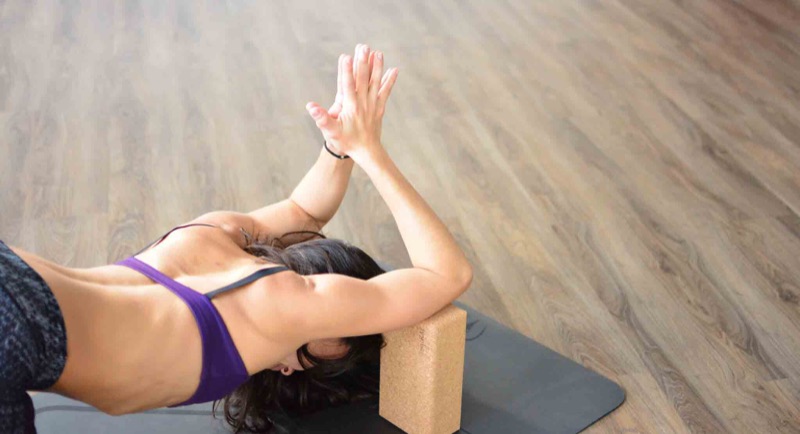
Yoga body parts are the anatomy words teachers use to cue you in class: sternum, sitting bones, scapula, sacrum, hamstrings, hip flexors, core. Knowing them turns a cue like "lift your sternum" or "root through your sitting bones" into a clear instruction you can act on. This glossary gives each term in plain English, where to find it on your own body, and the cues it shows up in.
In Sanskrit, a limb or part of the body is an anga, the same word used for the limbs of yoga. Teachers still mostly use the English and Latin names, so those are the ones below.
Bones and landmarks
These are the fixed points teachers use to describe alignment. Most of them you can touch.
Sternum
The breastbone: the flat, narrow bone down the centre of your chest, where the ribs meet at the front. Place your fingertips there. The cue: "lift your sternum" means raise the front of your chest a little, so the upper back extends instead of rounding. You hear it in Tadasana (Mountain Pose) and in backbends.
Collarbones (clavicles)
The two long bones running from the top of the sternum out to the shoulders. The cue: "broaden across the collarbones" means widen the front of the chest, the opposite of hunching.
Scapula
The scapula, or shoulder blade: the flat triangular bone on the back of each side of the ribcage. It slides up, down, apart and together, and it tilts as you lift your arms. The cue: "draw your shoulder blades down your back" or "hug them onto your ribs".

Pelvis and hip points
The pelvis is the bony bowl that connects the spine to the legs. The hip points are the two bony knobs at the front of the pelvis, where your hands land if you put them on your hips. Anatomists call them the anterior superior iliac spines. The cue: "square your hip points to the front of the mat" in lunges and Warrior I (Virabhadrasana I).
Sitting bones
The two bony bumps on the underside of the pelvis, the ischial tuberosities. Sit on a hard chair and rock side to side: you will feel them. The hamstrings attach here. The cue: "root through your sitting bones" in seated poses, or "lift your sitting bones" in Adho Mukha Svanasana (Downward-Facing Dog), which lengthens the back of the legs.
Sacrum
The triangular bone at the base of the spine, made of five vertebrae that fuse in adulthood. It sits between the two halves of the pelvis. Put a hand flat on your lower back, above the buttocks, and you are touching it.
Tailbone (coccyx)
The small bones at the tip of the spine, below the sacrum. Usually three to five small vertebrae, partly fused. The cue: "lengthen your tailbone toward the floor" or "tuck your tailbone". More on that cue below, because teachers do not agree on it.
Torso
The trunk of the body: chest, abdomen and back, without the head, arms and legs.
Muscles
Glutes (gluteus maximus)
The glutes are the muscles of your buttocks. The gluteus maximus is the largest, and it is the main muscle that extends the hip: it pulls the thigh back and lifts the pelvis in Setu Bandha Sarvangasana (Bridge Pose). Two smaller ones, gluteus medius and minimus, sit on the side of the hip and keep the pelvis level when you stand on one leg.
Hamstrings
The hamstrings are three muscles on the back of the thigh, not one. They run from the sitting bones to the top of the shin bones, below the knee, so they cross both joints: they bend the knee and extend the hip. That is why a forward fold like Paschimottanasana (Seated Forward Bend) stretches them, and why bending the knees makes the fold easier.

Quadriceps
The quads are the four muscles on the front of the thigh. All four straighten the knee. One of them, rectus femoris, also crosses the hip and helps lift the thigh. The cue: "lift your kneecaps" means firm the quads so the knee straightens without locking back.
Hip flexors (iliopsoas)
The hip flexors lift the thigh toward the belly. The deepest and strongest is the iliopsoas, two muscles that share a tendon: the psoas runs from the lower spine and the iliacus lines the inside of the pelvis, and both attach to the top of the thigh bone. You feel them stretch at the front of the hip of the back leg in Anjaneyasana (Low Lunge).
Obliques
The external and internal obliques (obliquus externus abdominis and obliquus internus abdominis) are the muscles on the sides of the abdomen. They rotate and side-bend the trunk, and they work in twists and side planks. The cue: "hug your lower ribs toward your hip bones".
Lats (latissimus dorsi)
The lats are the broadest muscles of the back. They start low, from the spine of the mid and lower back and the back of the pelvis, sweep up along the sides of the ribs and attach to the front of the upper arm bone, close to the armpit. They pull the arm down and back. When they are tight, lifting your arms overhead is hard, which you notice in Downward-Facing Dog.
Trapezius
The trapezius is the large, flat muscle of the upper back and neck. It runs from the base of the skull and the spine, down to the middle of the back, and out to the collarbones and shoulder blades. Together the two sides form a trapezoid, which gave it its name. The upper part lifts the shoulders toward the ears, and the lower part draws the shoulder blades down.
Systems and ideas
Core
Your core is more than the six-pack. Most teachers mean the group of muscles that hold the trunk steady: the deep abdominal muscle (transversus abdominis), the obliques, the rectus abdominis, the muscles along the spine, the diaphragm above and the pelvic floor below. Some teachers use the word more widely, for all the deep stabilising muscles from the head down to the arches of the feet. The cue: "engage your core" usually means firm the belly gently toward the spine without holding your breath.

Pelvic floor
The sheet of muscle that closes the bottom of the pelvis, between the pubic bone, the tailbone and the sitting bones. It carries the pelvic organs and works with the diaphragm when you breathe. In yoga it is linked to Mula Bandha, the root lock.
Fascia
Fascia is connective tissue. It wraps and separates muscles and organs, and links them to each other. You have seen it as the thin white film on a cut of chicken.
Cues where teachers disagree
Most of the words above are plain anatomy. Some of the cues built on them are argued about, and it helps to know which.
"Tuck your tailbone." For years this was a standard cue in standing poses and backbends. Many teachers now prefer "lengthen the tailbone" or a neutral pelvis, because a hard tuck flattens the natural curve of the lower back and grips the glutes. Others still use it in backbends, where a slight tuck can move the bend out of the lower back. Both camps are describing something real. The question is how much, and in which pose.
"Shoulders down your back." A good cue with the arms by your sides or in Bhujangasana (Cobra Pose). With the arms overhead it can backfire: to lift the arm fully, the shoulder blade has to rotate up. Forcing it down can pinch the top of the shoulder. Many teachers now say "let the shoulder blades move with the arms" in overhead poses.
"Engage your core." Heard in almost every class, rarely explained. Some teachers want a firm brace, others a light draw-in. For most poses a gentle, steady tone that still lets you breathe freely is enough.
Claims about fascia. Fascia research has grown fast, and yoga marketing has run ahead of it. That fascia connects muscles into long chains is well supported. Claims that a class "releases" stored emotion or trauma from the fascia are not backed by good evidence, so we do not make them.
For the Sanskrit words you hear next to these English ones, see our guide to 50 Sanskrit yoga terms.
To hear these cues used in a real class, start with our Hatha classes, where teachers take time to name what moves.
Frequently asked questions
What does "lift your sternum" mean in yoga?
Raise the breastbone, the flat bone in the centre of your chest, a little toward the ceiling or forward. It lengthens the upper back and stops you slumping. Keep the lower ribs soft so the lift does not turn into an arched lower back.
Where are my sitting bones?
On the underside of your pelvis. Sit on a hard chair and rock from side to side: the two bony points you feel pressing into the seat are the sitting bones. Anatomists call them the ischial tuberosities, and the hamstrings attach to them.
What is the difference between the sacrum and the tailbone?
The sacrum is the larger triangular bone at the base of the spine, between the halves of the pelvis. The tailbone, or coccyx, is the small set of bones below it, at the tip of the spine.
What muscles does yoga work?
It depends on the pose. Standing poses work the quadriceps, glutes and the muscles that steady the ankles. Forward folds stretch the hamstrings. Lunges stretch the hip flexors. Arm balances and planks work the core, shoulders and arms. A balanced class moves through all of them.
What does "engage your core" mean?
Firm the muscles around your trunk, mainly the deep belly muscle, so your spine is supported. Draw the belly gently in toward the spine and keep breathing. It should not feel like holding your breath or sucking in hard.
Should I tuck my tailbone in yoga?
Not as a general rule. Many teachers now cue a neutral pelvis or "lengthen the tailbone" instead, because a strong tuck flattens the lower back. A slight tuck can help in some backbends. Follow what feels steady in your lower back.
Practise it with a teacher
Over 600 online yoga classes and programs for $4.99 a month. Cancel any time.
Become a member