Scapula and Yoga: Shoulder Blade Anatomy, Movements and Stability Poses


The scapula, or shoulder blade, is the flat triangular bone on the back of the ribcage that the arm hangs from. It is held to the trunk almost only by muscles, so it can glide up, down, apart, together and rotate. In yoga, a healthy shoulder needs both: the scapula has to move freely when you lift your arms overhead, and it has to stay steady on the ribs when you bear weight in Plank, Downward Dog or Handstand.
Scapula anatomy
Bend one elbow and reach the hand behind you to the upper back. The bony edge you touch is the scapula. It lies over the back of roughly the second to the seventh rib, one on each side of the spine.
A few landmarks help when you read about the shoulder:
- Spine of the scapula. The ridge that runs across the back of the bone. You can feel it below the top of the shoulder.
- Acromion. The outer end of that ridge, the bony tip of the shoulder. The collarbone meets it here.
- Glenoid fossa. The shallow socket on the outer corner that holds the head of the upper arm bone, the humerus.
- Coracoid process. A small hook at the front, under the collarbone, where the pectoralis minor and two arm muscles attach.
- Medial border and inferior angle. The inner edge next to the spine, and the bottom tip. Watch these two when you look for winging.
Together with the collarbone (clavicle), the scapula forms the shoulder girdle. The girdle is the link between the arms and the trunk, and the only bony connection is where the collarbone meets the breastbone. Everything else is muscle.
The joints around the scapula
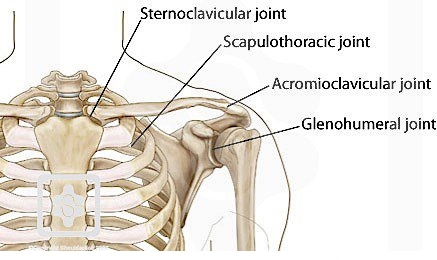
- Glenohumeral joint. The shoulder joint proper, where the head of the humerus sits in the glenoid fossa. The socket is small and shallow. A ring of cartilage, the labrum, deepens it, and the rotator cuff muscles hold the head of the humerus centred.
- Acromioclavicular (AC) joint. Where the collarbone meets the acromion. Slide a finger along the collarbone from the breastbone out to the shoulder and you reach it.
- Sternoclavicular (SC) joint. Where the collarbone meets the breastbone at the base of the neck.
- Scapulothoracic joint. Not a true joint. It is the gliding surface between the scapula and the ribcage, padded by muscles. The scapula moves over the ribs here, steered by the AC and SC joints.
The six movements of the scapula
Three pairs, and yoga uses all of them.
Elevation and depression
Elevation lifts the shoulder blades toward the ears, driven mainly by the upper trapezius and the levator scapulae. Depression draws them down toward the waist, with the lower trapezius and the pectoralis minor. In Urdhva Mukha Svanasana (Upward-Facing Dog) you depress the shoulder blades so the shoulders do not sink toward the ears.
Protraction and retraction
Protraction spreads the shoulder blades apart and around the ribs, the job of the serratus anterior. Retraction draws them toward the spine, with the rhomboids and the middle trapezius. The top of a Plank and the rounding phase of Cat are protraction. In Bhujangasana (Cobra Pose) the shoulder blades retract as the chest lifts.
Upward and downward rotation
Upward rotation turns the socket of the scapula to face up, so the arm can go overhead. The serratus anterior and the upper and lower trapezius do it together. Downward rotation brings it back as the arms lower, with the rhomboids, the levator scapulae and the pectoralis minor. Every Sun Salutation starts with this pair: arms up in Urdhva Hastasana (Upward Salute), arms down as you fold.
Anatomy texts add small tilts and turns of the scapula on the curved ribs. You do not need to cue them. They come along when the six main movements work.
Scapulohumeral rhythm: why the arm needs the shoulder blade
The arm cannot reach overhead on the shoulder joint alone. As you lift the arm, the humerus moves in the socket and the scapula rotates upward on the ribs at the same time. The classic textbook ratio is about two degrees of arm movement for every one degree of scapula movement, measured over the full lift. Newer studies find the ratio varies a lot between people and through the range, so treat it as a rough picture.
The practical point holds: if the shoulder blade is held down and back while the arms go up, the arm runs out of room. That is why a stiff upper back or a habit of clamping the shoulder blades together can make Downward Dog and Handstand feel blocked in the shoulders.
Scapular stability: the muscles that hold it
About 17 muscles attach to the scapula. For yoga, four groups do most of the work.
- Serratus anterior. From the outer surface of the upper eight or nine ribs to the inner border of the scapula, running under it. It protracts and upwardly rotates the scapula and holds it flat against the ribs. This is the muscle you feel when you push the floor away in Plank.
- Trapezius. Upper fibres lift, middle fibres retract, lower fibres depress, and upper and lower fibres rotate upward together. More in trapezius and yoga.
- Rhomboids. From the spine at roughly C7 to T5 to the inner border of the scapula. They retract and downwardly rotate it, and you feel them in Locust and Camel.
- Rotator cuff. Supraspinatus, infraspinatus, teres minor and subscapularis run from the scapula to the head of the humerus and keep the ball centred in the socket.
The latissimus dorsi and the pectoralis minor pull the shoulder the other way, down and forward. Tight lats are a common reason arms will not go straight overhead.
Stability here means control. The scapula should move where you ask it to and stay put when the arm is loaded. A shoulder blade held rigid all the time is stuck, and that is a different thing.
Yoga poses for the scapula
Plank Pose with scapular push-ups

- Start on all fours, wrists under the shoulders, knees a little behind the hips.
- Keep the arms straight. Let the chest sink between the shoulder blades so they draw together.
- Push the floor away so the shoulder blades spread apart and the upper back rounds slightly.
- Move between the two slowly, eight to ten times. Then hold the pushed position for five breaths.
- When this is easy, do the same from full Plank Pose with the knees lifted.
This trains the serratus anterior, the muscle that keeps the shoulder blades flat on the ribs in Chaturanga Dandasana and in arm balances.
Adho Mukha Svanasana (Downward-Facing Dog)
Here the arms are overhead and bearing weight, so the scapula has to rotate upward and stay steady. Press through the base of the index fingers, let the upper arms turn slightly outward, and let the shoulder blades move up and wide with the arms. Keep space between shoulders and ears without forcing the shoulders down. The full pose is in Adho Mukha Svanasana (Downward-Facing Dog).
Salabhasana (Locust Pose)
- Lie on your belly, arms by your sides, palms down, forehead on the mat.
- On an inhale, lift the chest and arms a little off the floor. Look at the floor ahead of you.
- Draw the shoulder blades toward each other and down toward the waist. Reach the fingertips back.
- Stay for three to five breaths, lower on an exhale, repeat three times.
Locust works the retractors: the middle trapezius and the rhomboids. More in Salabhasana (Locust Pose).
Purvottanasana (Upward Plank Pose)

- Sit with the knees bent and the feet flat. Place the hands on the mat a hand's length or so behind the hips, fingers pointing toward the feet.
- Draw the shoulder blades toward each other before you lift, so the chest opens and the shoulders do not roll forward.
- On an exhale, press into the hands and feet and lift the hips to a tabletop. Stay here, or straighten the legs one at a time and lift the hips higher.
- Keep the chin toward the chest, or let the head go back only if the neck is comfortable. Stay for three to five breaths.
Upward Plank stretches the front of the shoulders and the chest, the pectoralis major and minor, and works the shoulder in the opposite direction to Plank and Chaturanga. Skip it with a painful shoulder or wrist.
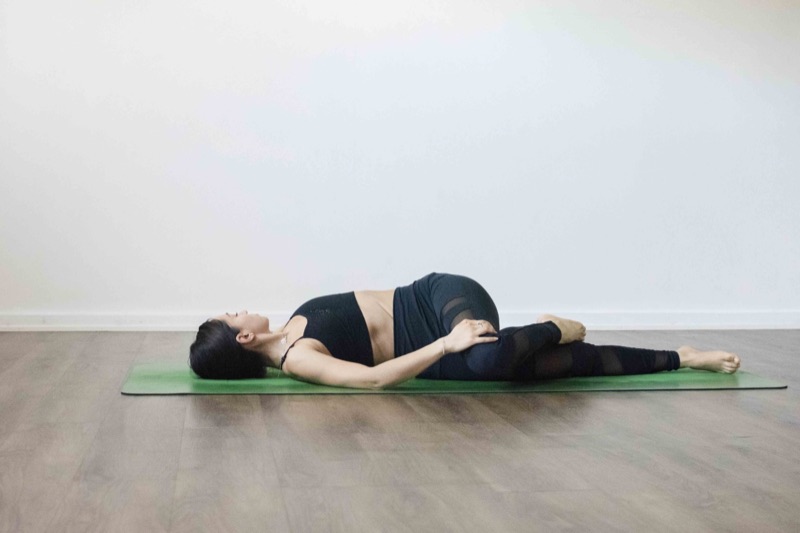
Jathara Parivartanasana (Revolved Abdomen Pose)
Lie on your back with the arms out in a cactus shape, elbows bent, backs of the hands on the floor. Lift the knees over the hips, shins parallel to the floor. On an exhale, lower the knees to the right, only as far as the left shoulder stays heavy on the mat. Inhale back to centre, exhale to the left. Five to ten times each side. The floor supports the shoulder blades, so this is a gentle option when the shoulder is sore and weight-bearing is not.
Other poses that use the scapula
- Garudasana (Eagle Pose) arms spread the shoulder blades apart and stretch the rhomboids and middle trapezius.
- Vasisthasana (Side Plank) asks one scapula to stay flat on the ribs under body weight.
- Adho Mukha Vrksasana (Handstand) needs full upward rotation plus a stable base. Build it on Plank and Downward Dog first.
Scapula problems: dyskinesis, winging and impingement
Scapular dyskinesis means the shoulder blade moves in an altered way: it lifts too early, tips forward, or its inner edge pulls away from the ribs as the arm moves. The old version of this post said poses such as Downward Dog can cause it. Dyskinesis is a movement pattern, often linked to weakness, stiffness or pain elsewhere in the shoulder. Overhead poses show it; they do not create it.
Winging is when the inner border stands out from the back like a small wing. Mild winging is common when the serratus anterior is weak or tired. Marked winging, especially after an injury or with weakness that came on suddenly, can come from a nerve problem (the long thoracic nerve drives the serratus). That needs a doctor, not a yoga class.
Impingement describes pain when the arm is lifted, often in an arc between shoulder and head height, from irritation of the rotator cuff tendons or the bursa under the acromion. The shape of the acromion varies from person to person, and a hooked acromion was long thought to cause it. Today most clinicians see shoulder pain in this area as a load problem in the tendon more than a pinch, and treat it with graded strengthening. If lifting the arm hurts, reduce the load and see a physiotherapist.
Where sources disagree
"Shoulders down and back." A common cue in yoga and in posture advice. It suits Cobra and Upward-Facing Dog. With the arms overhead it works against the scapulohumeral rhythm: the shoulder blades must rotate upward, so the tops of the shoulders rise a little. Many anatomy teachers now cue "let the shoulder blades turn up with the arms" in Downward Dog and Upward Salute. Both camps agree on the goal: no shrugging that crowds the neck, no forcing the shoulders down.
Does dyskinesis cause shoulder pain? Physiotherapists who follow Ben Kibler's work treat scapular control as a key part of shoulder rehab, and it is linked to shoulder pain in many studies. But dyskinesis is also common in people with no pain at all, including athletes, and a link does not show which came first. What holds up: exercises that strengthen the serratus anterior and the trapezius help many people with shoulder pain, whether or not the scapula looks different afterwards.
Alignment first or strength first? The old post said to perfect alignment before building strength. Current rehab thinking leans the other way: the shoulder adapts to load, and a joint that is used with care and a gradual increase in load tends to do better than one that is protected. The two are not rivals. Learn where the shoulder blade is in simple poses, then load it progressively. Past a point, body-weight poses are not enough load, as covered in why yogis need strength training.
Can you see your scapula in the mirror? Not easily. The old post suggested filming yourself, and that still works. A teacher's hand on the shoulder blade, or a partner watching it as you lift the arms, is often clearer.
For a guided class, Find Your Downward Dog Shoulders works shoulder strength, mobility and the serratus muscles at level 1-2, and Shoulder Stability is 15 minutes of Vinyasa with two blocks, building toward Forearm Stand and Handstand.
Frequently asked questions
How do you stabilize the scapula?
Train the muscles that hold it on the ribs, mainly the serratus anterior and the middle and lower trapezius. In yoga that means scapular push-ups on all fours, Plank with the floor pushed away, Locust with the shoulder blades drawn back, and Downward Dog with the shoulder blades moving up with the arms. Add load gradually.
What muscles to strengthen for poor scapular stability?
The serratus anterior, which holds the scapula flat and rotates it upward, and the middle and lower trapezius, which draw it back and down. The rhomboids and the rotator cuff support them. Plank variations work the serratus; Locust and prone Y raises work the trapezius.
What causes a weak scapula?
Usually weak or tired stabilizing muscles, stiffness in the upper back or chest, or pain elsewhere in the shoulder that changes how you move. Less often a nerve injury, such as to the long thoracic nerve, weakens the serratus anterior. Sudden weakness or marked winging needs a medical check.
What are the symptoms of scapular instability?
The inner edge of the shoulder blade lifts off the back, the shoulder feels weak or tires fast when you hold the arms up or bear weight, and there may be pain or clicking at the shoulder. Many people with altered scapular movement feel nothing at all.
What are the six movements of the scapula?
Elevation and depression (up and down), protraction and retraction (apart and together), and upward and downward rotation (turning the socket up as the arm lifts, and back as it lowers).
Should I squeeze my shoulder blades together in yoga?
In backbends such as Cobra and Camel, drawing the shoulder blades toward each other helps open the chest. With the arms overhead or bearing weight, as in Downward Dog and Plank, let them spread and rotate upward instead. Holding them squeezed all the time limits how far the arms can move.
Is yoga good for shoulder blade pain?
It can help pain from stiffness or weak muscles, because it both moves and loads the shoulder. Start with floor-supported poses and all-fours work, and build up to Plank and Downward Dog. Sharp pain, pain after a fall, or numbness in the arm are reasons to see a clinician first.