Surya Namaskar B (Sun Salutation B): How to Do It Step by Step

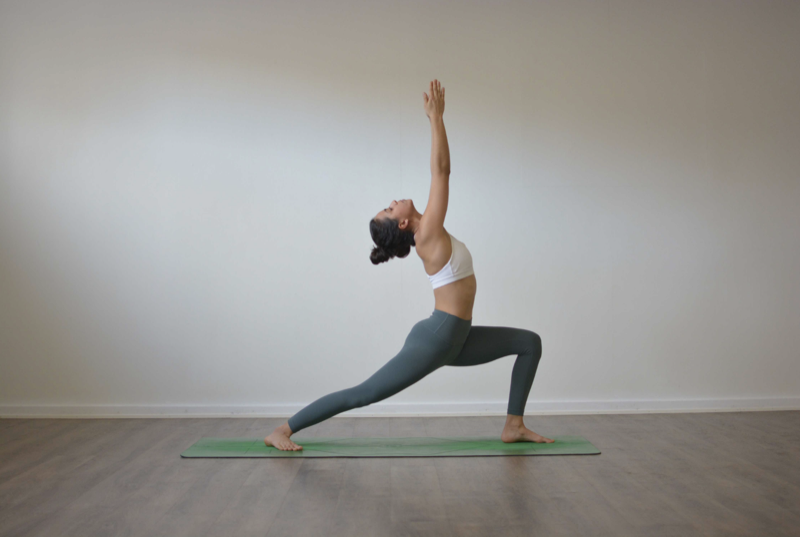
Surya Namaskar B (Sun Salutation B) is a flowing sequence of 17 breath-linked movements from Ashtanga Vinyasa yoga. It starts and ends in Utkatasana (Chair Pose) and adds Virabhadrasana I (Warrior I) on each side, so you pass through Chaturanga and the two dogs three times in one round. In the Ashtanga tradition you practise it after five rounds of Surya Namaskar A, usually three to five rounds.
Sequence type: flowing warm-up, standing poses and arm support. Level: level 1-2 with modifications, level 2-3 as taught in Ashtanga. Props: none. A mat that does not slip helps.
What Surya Namaskar B means
Surya is the sun in Sanskrit and namaskar means a bow or salutation, from namas, to bow. The "B" comes from the Ashtanga system taught by K. Pattabhi Jois in Mysore, where the two salutations are called Surya Namaskara A and B. Other schools use other shapes. The twelve-pose Sun Salutation many Hatha classes teach, with a lunge and Ashtanga Namaskara (knees, chest and chin to the floor), is a different sequence. If a guide lists twelve poses and calls it Sun Salutation B, it has mixed the two up.
How to do Sun Salutation B, step by step
Each number is one vinyasa: one movement on one breath. Traditionally the teacher counts them in Sanskrit (ekam, dve, trini and so on). Breathe through the nose with Ujjayi, the soft, audible breath, and let the breath set the pace.
Start in Samasthitih: stand with your big toes together, arms by your sides, weight even between the heels and the balls of the feet. It is the Ashtanga name for Tadasana (Mountain Pose).
- Inhale, Utkatasana. Bend your knees and sit back as if into a chair, and sweep your arms overhead, palms together. Look up at your thumbs.
- Exhale, Uttanasana. Straighten your legs and fold forward from the hips. Hands beside your feet, bend your knees as much as you need.
- Inhale, half lift. Lengthen your spine, fingertips on the floor or shins, and look forward.
- Exhale, Chaturanga Dandasana. Step or jump back and lower into Chaturanga, elbows over wrists and hugging the ribs.
- Inhale, Urdhva Mukha Svanasana. Roll over your toes into Upward-Facing Dog. Press the floor away and lift the chest between the arms.
- Exhale, Adho Mukha Svanasana. Roll back over the toes into Downward-Facing Dog, hips high.
- Inhale, Virabhadrasana I, right side. Turn your left heel down, step your right foot between your hands, bend the right knee and lift the torso and arms. Palms meet overhead, gaze up to the thumbs.
- Exhale, Chaturanga. Hands to the floor either side of the front foot, step back and lower.
- Inhale, Upward-Facing Dog.
- Exhale, Downward-Facing Dog.
- Inhale, Virabhadrasana I, left side. Turn the right heel down and step the left foot forward.
- Exhale, Chaturanga.
- Inhale, Upward-Facing Dog.
- Exhale, Downward-Facing Dog. Stay here for five breaths. Gaze toward your navel.
- Inhale, half lift. At the end of the fifth exhale, bend your knees, step or jump your feet between your hands, and lift halfway on the inhale.
- Exhale, Uttanasana. Fold.
- Inhale, Utkatasana. Bend the knees and sweep the arms up.
Exhale, straighten your legs and lower your arms back to Samasthitih. That is one round. The only place you hold is the last Downward Dog. Everywhere else, one breath, one movement.
Surya Namaskar A and B: the difference
Sun Salutation A has nine vinyasas and moves from standing to Downward Dog and back. B keeps that frame and adds two things: Utkatasana at the start and end, and a Warrior I on each side, each followed by another Chaturanga and Up Dog. The result is three Chaturangas per round instead of one, which is why B is where the arms and legs start to burn.
What Sun Salutation B does for you
The honest answer is: the same things any steady, repeated sequence of lunges, squats and push-up shapes does, linked to slow breathing.
- Legs: Utkatasana and Warrior I load the thighs and glutes in a bent-knee position. Three rounds is a lot of squatting.
- Arms and shoulders: three Chaturangas per round work the chest, triceps and the muscles around the shoulder blades.
- Hip flexors and calves: Warrior I stretches the front of the back hip. Downward Dog stretches the calves and hamstrings.
- Heat: moving continuously raises your heart rate and body temperature, which is the job the salutations do at the start of an Ashtanga practice.
Studies on sun salutations put a continuous practice somewhere in the light to moderate intensity range, depending on pace and on how many rounds you do. That makes it good movement. It is not a replacement for all other exercise, and claims that it balances hormones or fixes digestion come from marketing, not from research.
Who should skip or modify it
- Wrist or shoulder pain: three Chaturangas a round puts a lot of weight on the hands. Lower with the knees down, or come to Plank and lower all the way to the floor.
- Knee problems: keep Utkatasana shallow and make the Warrior I stance shorter. The front knee stays over the ankle.
- Lower back pain: bend your knees in the folds and swap Upward Dog for a low Cobra.
- High blood pressure, dizziness or pregnancy: move slower, keep your head above your heart for longer, and talk to your doctor or midwife before a fast, hot practice. Pregnant students often widen the feet and skip Chaturanga.
- New to yoga: learn the poses one at a time before you link them. Step back and forward instead of jumping.
Common mistakes
- Breath running behind the movement. If you run out of inhale before you reach Warrior I, slow down or do fewer rounds.
- Lifting the back leg to step forward. From Downward Dog, turn the back heel down first, then step. Lifting the back leg high first is a habit from Vinyasa flow classes and adds a movement the count does not have.
- Back heel lifted in Warrior I. In the Ashtanga version the back heel is down and turned in about 45 degrees. If that pulls the hip too much, shorten the stance.
- Swinging the arms into Utkatasana. Bend the knees and lift the arms together, in one breath.
- Collapsing in Chaturanga. Shoulders dipping below the elbows puts the strain in the front of the shoulder. Stop higher, or put the knees down.
- Knees splaying in Utkatasana. Keep the knees together and let the hips go back, not the knees forward.
Preparatory poses
Learn these on their own, with a few breaths in each, before you string them together:
- Utkatasana (Chair Pose): the start and end of every round.
- Virabhadrasana I (Warrior I): the heel, the hips and the arms.
- Plank Pose: the base for a controlled Chaturanga.
- Urdhva Hastasana (Upward Salute): arms overhead without squeezing the neck.
- Surya Namaskar A: the frame B is built on.
Follow-up poses
In the Ashtanga sequence, B leads straight into the standing poses: Padangusthasana and Padahastasana, then Utthita Trikonasana and Parsvakonasana. Our overview of the Ashtanga Primary Series postures lists them in order. Outside Ashtanga, a few rounds of B work as the warm-up for any standing practice.
Variations
- Stepping instead of jumping: step back one foot at a time and step forward the same way. Same count, less load on the wrists.
- Knees down: lower from Plank with the knees on the mat and use Cobra instead of Up Dog.
- Slow B: stay three to five breaths in each Warrior I and in Utkatasana to learn the alignment before you flow it.
- Jumping back and through: the classic Ashtanga transitions. The jump through tutorial breaks them down.
Two more pieces of the Ashtanga method make the sequence feel steadier: the drishti, or gaze point, for each pose, and Mula Bandha, the root lock.
Where it comes from, and where the stories differ
Old versions of this post called the Sun Salutation a centuries-old ritual. The honest picture is more mixed. Worshipping the sun is ancient in India, and prostrations to Surya have a long devotional history. The flowing sequence is younger. The Raja of Aundh, Bhawanrao Pant Pratinidhi, promoted a Surya Namaskar routine as daily exercise in the 1920s and 1930s, and it is not described in the classic Hatha texts such as the Hatha Yoga Pradipika. T. Krishnamacharya taught in Mysore in the same years, and his student Pattabhi Jois fixed the A and B forms we use in Ashtanga yoga today. Both readings are true at once: an old devotion, practised in a twentieth-century shape. Teachers also disagree on how many rounds of B belong in a practice. Some Mysore teachers say three, many say five. Pick one and keep it the same so you can see your progress.
To learn it with a teacher, Sofia Soori's 30-minute class Sun Salutation B goes through all 17 vinyasas and the first standing postures, and Amaranta Aguilar's Energetic Sun Salutation B breaks it down with modifications in 15 minutes.
Frequently asked questions
What is Sun Salutation B yoga?
Sun Salutation B, Surya Namaskar B, is a warm-up sequence of 17 breath-linked movements from Ashtanga Vinyasa yoga. It combines Chair Pose, forward folds, Chaturanga, Upward and Downward Dog and Warrior I on both sides. It is practised after Sun Salutation A to build heat before the standing poses.
What's the difference between Sun Salutation A and B?
Sun Salutation A has nine movements and goes from standing to Downward Dog and back. Sun Salutation B has 17: it starts and ends in Chair Pose instead of standing with arms up, and adds Warrior I on each side, each followed by an extra Chaturanga and Upward Dog. That makes B longer and harder on the legs and arms.
How many rounds of Surya Namaskar B should I do?
In Ashtanga, the usual practice is five rounds of A followed by three to five rounds of B. At home, one or two slow rounds of B are a good start. Add rounds when you can keep the breath smooth and your Chaturanga holds its shape.
Can I do Sun Salutation B every day?
Yes, many Ashtanga students practise it six days a week. The limit is usually the wrists and shoulders, which take weight in three Chaturangas per round. If they get sore, drop the knees, do fewer rounds, or take a rest day.
What are common mistakes in Sun Salutation B?
Rushing ahead of the breath, lifting the back heel in Warrior I, sagging shoulders in Chaturanga, swinging the arms into Chair Pose and letting the knees spread in Utkatasana. Most of them disappear when you slow down and let each movement take one full breath.
Is Sun Salutation B good for beginners?
It can be, with modifications. Step instead of jumping, put your knees down in Chaturanga and use a low Cobra instead of Upward Dog. Learn Sun Salutation A first, then add B.
Practise it with a teacher
Over 600 online yoga classes and programs for $4.99 a month. Cancel any time.
Become a member