The 7 Chakras: A Beginner's Guide to Names, Order and Meaning

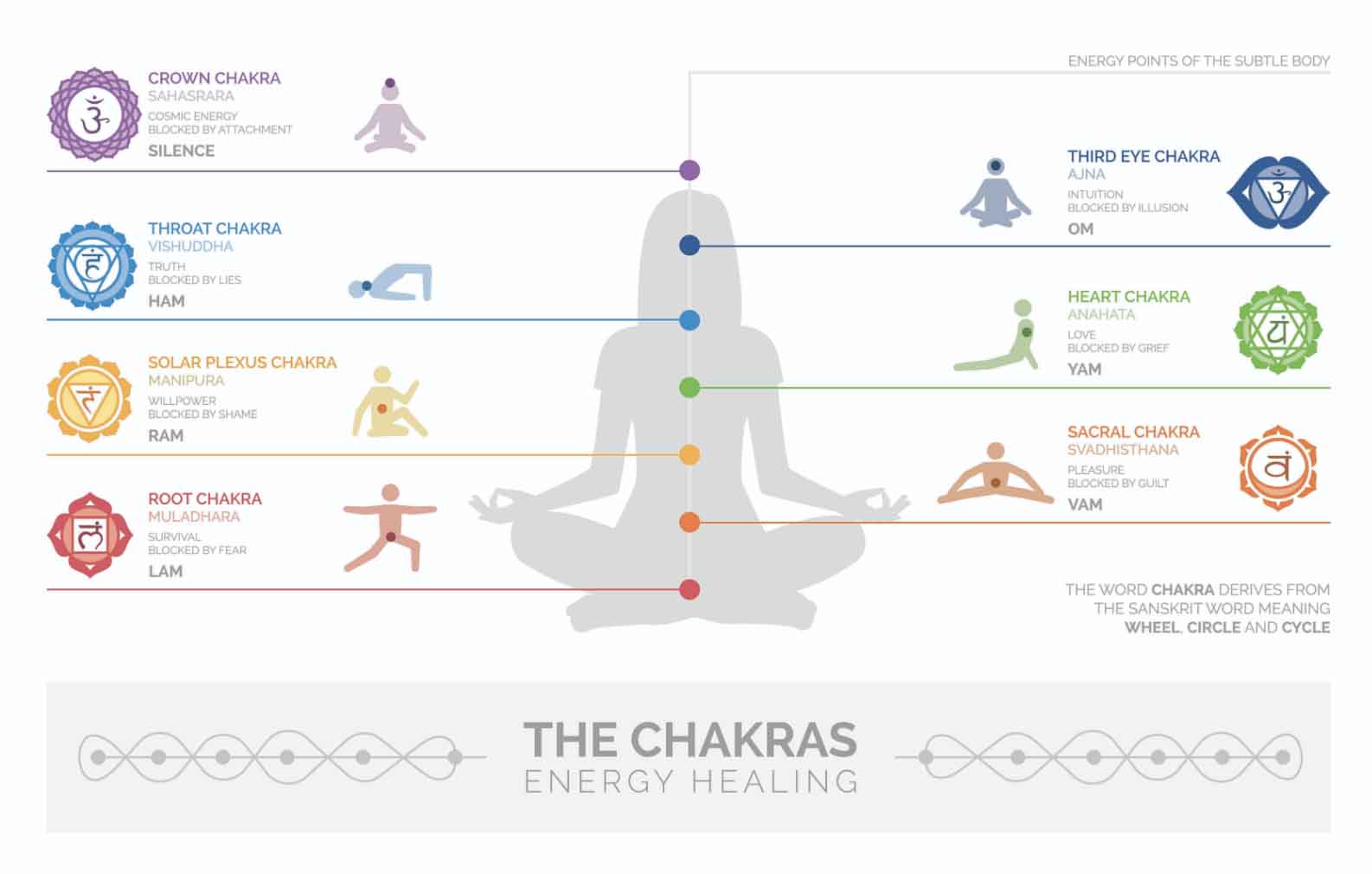
The seven chakras are energy centres that the yoga tradition places along the spine, from the base of the spine to the crown of the head: Muladhara (root), Svadhisthana (sacral), Manipura (solar plexus), Anahata (heart), Vishuddha (throat), Ajna (third eye) and Sahasrara (crown). Chakra is Sanskrit for "wheel". They belong to the subtle body, a map used in meditation, and they do not correspond to any structure an anatomist can find.
What is a chakra?
The word chakra (चक्र, cakra) means a wheel or a disc. In the tantric and hatha yoga traditions the chakras are points where the subtle channels of the body meet. The main channel, sushumna, runs up the centre of the spine, and the chakras sit on it like knots on a string. The channels themselves are called nadis, the channels prana is said to move through.
The texts describe each chakra as a lotus with a set number of petals, a seed sound (bija), an element, a shape and a deity. These are pictures to hold in the mind while you meditate. You place your attention on one area of the body, repeat its sound and see its image. That is what the chakras were for in the tradition they come from.
Most modern books go further and give each chakra a colour, an emotion, a gland and a list of problems it causes when "blocked". Much of that is recent, and we mark it as such below.
The 7 chakras in order
From the bottom up, with the details the older sources give and the colour modern books add:
- Muladhara (root chakra). Base of the spine, the pelvic floor. Four petals, element earth, seed sound LAM. Modern colour: red.
- Svadhisthana (sacral chakra). The genital area, a little above the root; modern books often place it a hand's width below the navel. Six petals, element water, seed sound VAM. Modern colour: orange.
- Manipura (solar plexus chakra). The navel in the classical texts, the soft area under the breastbone in many modern ones. Ten petals, element fire, seed sound RAM. Modern colour: yellow.
- Anahata (heart chakra). Centre of the chest. Twelve petals, element air, seed sound YAM. Modern colour: green.
- Vishuddha (throat chakra). The throat. Sixteen petals, element space or ether (akasha), seed sound HAM. Modern colour: blue.
- Ajna (third eye chakra). Between the eyebrows. Two petals, the seat of the mind, seed sound OM. Modern colour: indigo.
- Sahasrara (crown chakra). At or above the top of the head. A thousand petals. Modern colour: violet or white.
A note on the crown: some guides put it on the forehead. It sits at the top of the head. The forehead point between the eyebrows is Ajna.
What the Sanskrit names mean
- Muladhara: mula (root) + adhara (support, base). "Root support."
- Svadhisthana: sva (one's own) + adhisthana (seat, abode). "One's own place."
- Manipura: mani (jewel) + pura (city). "City of jewels."
- Anahata: "unstruck", from the idea of a sound that is heard without anything striking anything.
- Vishuddha: "especially pure".
- Ajna: "command". In the tradition, this is where the teacher's guidance is received.
- Sahasrara: "thousand-spoked", the thousand-petalled lotus.
Our list of 50 Sanskrit yoga terms covers more of the words you hear in class.
What each chakra stands for
This is the part most guides lead with. The qualities below are how the chakras are taught in most Western yoga and meditation classes today. They are symbolic readings, useful as a focus for meditation. They are not diagnoses.
- Muladhara: stability, safety, the feeling of the ground under you.
- Svadhisthana: creativity, pleasure, emotion, sexuality. Water is its element, and teachers link it to flow and change.
- Manipura: will, drive, the heat to get things done. In hatha yoga the navel is also the seat of the digestive fire. Our guide to Manipura, the solar plexus chakra goes into it in depth.
- Anahata: love, compassion, connection with other people.
- Vishuddha: speech and self-expression. Its element is space, and sound travels through space.
- Ajna: insight, intuition, concentration.
- Sahasrara: in the tradition, the goal: the meeting of Shiva and Shakti, consciousness and energy, and the end of the sense of a separate self.
Where the chakra system comes from
Chakras appear in Hindu and Buddhist tantric texts from roughly the 8th century onward. Those texts do not agree on a number. Different traditions work with four, five, six, nine, twelve or more centres, and the details change from text to text.
The seven-chakra system most of us know comes from one Sanskrit text, the Sat-Chakra-Nirupana ("Description of the Six Centres"), written by Purnananda in the 16th century. It describes six chakras plus the thousand-petalled lotus above them. In 1919 Arthur Avalon (Sir John Woodroffe) translated it into English in The Serpent Power, and Western yoga took its chakra picture from that book. The same book brought the idea of kundalini rising through the centres to English readers.
Much of what came after is Western. The Theosophists linked chakras to nerve plexuses and glands in the early 20th century. The rainbow colours, red at the root to violet at the crown, became standard in the 1970s, in books on the new age and energy work. The idea that each chakra governs one set of emotions, and that a "blocked" chakra causes particular problems, grew out of American psychology and energy-work books of the 1980s and 1990s.
The Hatha Yoga Pradipika, the classic 15th-century hatha manual, talks about kundalini, sushumna and the locks that move prana, and it is the practical side of the same world.
Where sources disagree
Are chakras real? There is no anatomical evidence for them. Nobody has found a wheel of energy at the navel in a dissection or a scan. Some authors point out that the chakra points sit close to large nerve plexuses and to glands such as the thyroid and the adrenals, and read that as a match. Others say the match is loose and was drawn after the fact. Both are right in part: the locations are near real structures, and the claim that the chakras are those structures has no support. The honest position is that chakras are a meditative map. You can use a map without believing it is the ground.
Can a chakra be blocked? Many teachers and websites say so, with long lists of symptoms. The older texts do not describe chakras this way. They speak of granthis, knots along the central channel that meditation and breath practice are meant to loosen, which is a different idea. We do not use symptom lists here. If you feel anxious, flat or unwell, see a doctor or a therapist. Crystals and colour charts do not replace that.
Where exactly is each one? Classical sources put Manipura at the navel; many modern books move it up to the solar plexus. Svadhisthana moves between the genitals and the lower belly depending on the book. Neither is wrong. They are different maps.
What does meditation on them do? Research on meditation in general shows effects on attention and on the stress response; our overview of the benefits of meditation covers the studies. Chakra meditation in particular has little research of its own. What it gives you on the mat is concrete: a point to rest your attention on, and a sound to repeat.
How the chakras are used in practice
In a class you will meet the chakras in a few ways.
- Guided meditation. The teacher moves your attention up the spine, one centre at a time, often with the seed sounds LAM, VAM, RAM, YAM, HAM and Om. Sit tall, close your eyes and feel the area the teacher names. That is enough.
- Breath and locks. Mula Bandha, the root lock, is a gentle lift of the pelvic floor, the area of Muladhara. Bhramari, the humming bee breath, lets you feel the buzz of sound in your throat and skull, which teachers link to Vishuddha and Ajna.
- Postures as themes. Some teachers build a class around one chakra: standing poses like Tadasana (Mountain Pose) for the root, chest openers like Ustrasana (Camel Pose) for the heart, Matsyasana (Fish Pose) for the throat. This is a modern way of teaching. The pose opens the front of the chest; the chakra gives the class a theme.
A simple start: sit comfortably, rest your attention at the base of your spine for five slow breaths, then move up one chakra at a time until you reach the crown. Feel the body in each spot. If an image or a colour helps you stay there, use it.
If you want to try it with a teacher, Vinay Jesta's 20-minute Root Chakra Meditation and Sacral Chakra Meditation start from the bottom, and our meditation classes have more.
Frequently asked questions
What are the 7 chakras in order?
From the base of the spine up: Muladhara (root), Svadhisthana (sacral), Manipura (solar plexus), Anahata (heart), Vishuddha (throat), Ajna (third eye) and Sahasrara (crown).
What does chakra mean?
Chakra is Sanskrit for "wheel" or "disc". In yoga it names a centre in the subtle body where channels of prana meet, pictured in the texts as a lotus with petals.
How do you awaken all 7 chakras?
In the tradition, the chakras are worked with through meditation, breath practice and the bandhas, usually over years and with a teacher. For a beginner, a guided chakra meditation is a good start: attention on one centre at a time, from the root up, with a slow breath. Be wary of anyone who promises fast awakening.
What happens when your 7 chakras are open?
In the tantric tradition, the energy called kundalini rises through all the centres to the crown, and the result is liberation, the end of the separate self. That is a spiritual goal described in the texts. There is no measurable test for it, and modern claims about specific effects of "open" chakras are not supported by research.
Are the 7 chakras in the Bible?
No. The chakras come from Hindu and Buddhist tantric traditions in India. The Bible does not mention them. Some Christians practise yoga and leave the chakra teachings aside; others are uneasy with them for that reason.
Are chakras scientifically proven?
No. There is no anatomical or physiological evidence that chakras exist as physical structures. Their locations sit near nerve plexuses and glands, but that is a loose match. They are best understood as a map for meditation.
What colours are the chakras?
In most modern books: red, orange, yellow, green, blue, indigo and violet, from root to crown. The rainbow scheme became common in the 1970s. The older Sanskrit texts give different colours for the lotuses.
Practise it with a teacher
Over 600 online yoga classes and programs for $4.99 a month. Cancel any time.
Become a member
Former member