Tuladandasana (Balancing Stick Pose): How to Do It Step by Step

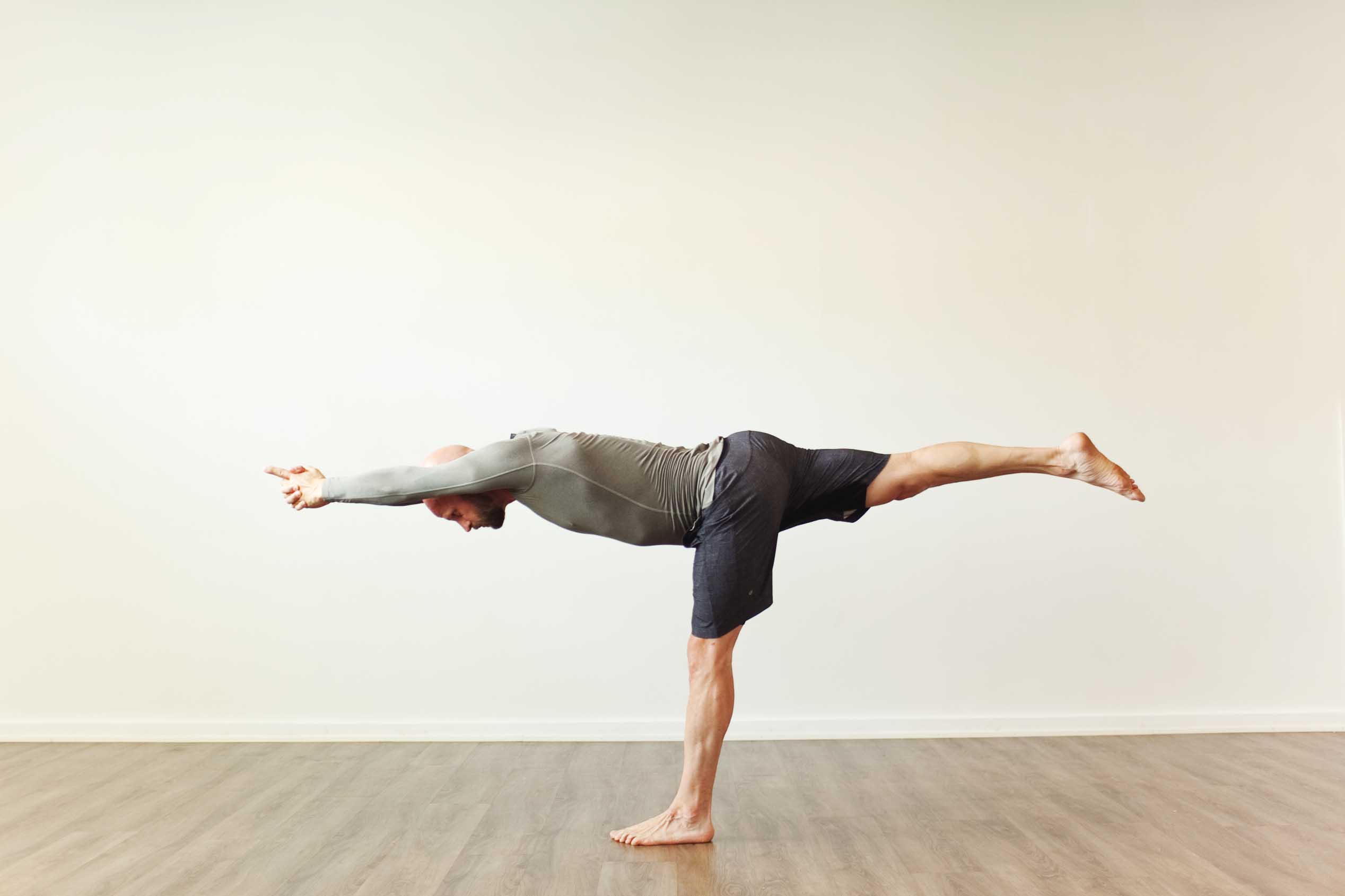
Tuladandasana (Balancing Stick Pose) is a standing balance in which you tip forward on one leg until your arms, torso and lifted leg form one straight line parallel to the floor, like the letter T. It is the seventh posture of the 26-posture Bikram or Hot 26 sequence, held for about 10 seconds on each side. The shape is close to Virabhadrasana III (Warrior III), with the arms stretched forward and the palms pressed together.
Pose type: standing balance, strength. Level: intermediate. Props: none, or a wall or the back of a chair to learn it.
What Tuladandasana means
The name has three Sanskrit parts: tula, a balance or a pair of scales, danda, a staff or stick, and asana, posture. The body becomes the beam of a scale, balanced on the standing leg. The name is best known from Bikram Choudhury's hot yoga sequence, which spread from the 1970s. B.K.S. Iyengar's Light on Yoga (1966) teaches almost the same shape under the name Virabhadrasana III. You will also hear it called Balancing Staff Pose.
How to do Balancing Stick Pose, step by step
This is the Hot 26 version. Warm up first: a few Sun Salutations or the standing poses that come before it in the sequence.
- Stand in Tadasana (Mountain Pose) with your feet together.
- Inhale and raise your arms overhead, as in Urdhva Hastasana (Upward Salute). Interlace your fingers, cross the thumbs and release the index fingers so they point up. Press the palms together and keep the arms straight, upper arms beside your ears.
- Step your right foot forward, about the length of your own foot. Rest the toes of the left foot on the floor behind you, the leg straight.
- Firm the right thigh so the kneecap lifts. The leg is straight and strong, without pressing the knee backward.
- Keep the arms glued to your ears. Tip forward from the hip as one piece while the left leg lifts behind you. Arms, head, torso and left leg move together, like a see-saw.
- Stop when everything is parallel to the floor. Point the left toes, turn the left hip down so both hip bones face the floor, and reach the fingers forward and the left foot back, away from each other.
- Look at the floor a little in front of you and keep your eyes still. Breathe in and out through the nose. Hold for 10 seconds, or 3-5 breaths.
- Come up the same way you went down, in one piece, and step back to Tadasana. Repeat on the left leg.
In a Hot 26 class you do two sets, each about 10 seconds a side. That is short on purpose: the pose is meant to be held at full stretch, not endured.
The cue that matters most
Think of length, not height. Stretch from the fingertips to the toes as if two people were pulling you in opposite directions. When the stretch goes, the arms drop, the back rounds, and the balance goes with them.
Benefits of Tuladandasana
The main work is holding a long, straight body level on one leg. That asks for:
- Standing leg strength: the quadriceps keep the knee straight and the glutes and the small muscles around the hip hold the pelvis level.
- Back of the body: the back extensors, the glutes and the hamstrings of the lifted leg hold it in line with the torso. Read more in our guide to glutes and yoga.
- Core control: the deep abdominal muscles keep the lower back from sagging. Our article on core and yoga goes through which muscles do the work.
- Shoulders: the arms stay straight beside the ears for the whole hold, which works the shoulders and the upper back.
- Balance: standing on one leg while the body tilts trains the feet, ankles and the sense of where you are in space.
Your heart rate climbs while you hold it. Many large muscles work at once, and the arms are held forward at the level of the head. The Bikram tradition says the pose clears blocked arteries and helps the liver, the spleen and varicose veins. No study supports that, and we have left it out.
Who should skip or modify it
- High blood pressure or heart problems: the long, strong hold raises blood pressure for a moment. Keep it short, keep breathing, and ask your doctor if your blood pressure is not under control.
- Shoulder injury: put your hands on your hips or stretch the arms back beside the body.
- Lower back pain: lift the back leg lower and keep the belly firm. Stop if the pain grows.
- Hamstring strain on the standing side: bend the standing knee a little or skip the pose until it has settled.
- Pregnancy, dizziness or poor balance: practise with your hands on a wall or a chair, so a lost balance ends in a step, not a fall.
Common mistakes
- Locking the knee backward. "Lock the knee" in Bikram classes means firming the thigh. If your knee bends backward (hyperextends), keep a slight bend instead.
- Arms dropping below the head. The head slides forward between the arms and the neck bends. Keep the upper arms at the ears.
- Lifted hip turning up. The pelvis opens to the side and the body twists. Turn the hip of the lifted leg down toward the floor.
- Leg higher than the torso. Stop at parallel. Higher tips you forward and folds the lower back.
- Holding the breath. Breathe through the nose, even if the breath is short.
- Rushing in and out. Tipping down fast works for a second and then collapses. Move in one slow piece.
Preparatory poses
- Vrksasana (Tree Pose): learn to stand steady on one leg first.
- Virabhadrasana I (Warrior I): strength in the front leg with the arms overhead.
- Padahastasana (Hand to Feet Pose): stretches the hamstrings you need to tip forward on a straight leg.
- Dandayamana Janushirasana (Standing Head to Knee Pose): the balance two poses earlier in the Hot 26 sequence, on the same locked standing leg.
Follow-up poses
- Dandayamana Bibhaktapada Paschimotthanasana (Standing Separate Leg Stretching): the next pose in Hot 26, a wide-legged forward fold that lets the back release.
- Ardha Chandrasana (Half Moon Pose): the same one-legged balance with the body turned to the side.
- Urdhva Prasarita Eka Padasana (Standing Split): the torso folds down and the back leg lifts higher.
Variations
- At the wall: stand facing a wall at arm's length and press your palms into it as you tip forward. You learn the line without the fall.
- Hands on a chair: rest the hands on the back of a chair at hip height and lift the leg.
- Arms back: stretch the arms back beside the body, palms facing in. Easier for the shoulders, harder for the balance.
- Hands on the hips: for beginners and sore shoulders.
- Virabhadrasana III (Warrior III): the same shape from a lunge, with the arms apart or in prayer and a softer standing knee.
Balancing Stick keeps your gaze on one point on the floor the whole time. Our guide to drishti, the yoga gaze, explains why a still gaze helps a still body.
Lauren Matters' class Hot 26 Standing Series takes you through Balancing Stick and the rest of the standing poses, and our overview of the 26 Bikram yoga poses shows where it sits in the sequence.
Frequently asked questions
What is Tuladandasana in yoga?
Tuladandasana, or Balancing Stick Pose, is a standing balance where you tip forward on one straight leg until your arms, torso and lifted leg form a line parallel to the floor. It is the seventh pose of the Bikram or Hot 26 sequence and is close to Warrior III.
How long should I hold Tuladandasana?
In a Hot 26 class you hold it for about 10 seconds on each side, two times. Outside that sequence, 3-5 slow breaths is a good start. Build up to 30 seconds only when you can keep the whole body in one straight line.
What are the benefits of Balancing Stick Pose?
It strengthens the standing leg, the glutes, the back and the shoulders, trains balance on one leg, and asks the core to keep the lower back level. Your heart rate rises while you hold it. Claims that it clears arteries or helps organs are not supported by research.
Is Balancing Stick the same as Warrior III?
The shape is almost the same. Balancing Stick uses the Bikram grip with the palms pressed together and a firmly straightened standing leg, and is held short. Warrior III is often entered from a lunge, with the arms in different positions and a softer standing knee.
What are the benefits of practising balancing poses?
Standing on one leg trains the muscles of the foot, ankle and hip that keep you upright, and the sense of where your body is in space. Research on older adults links regular balance training to better balance and fewer falls.
Is Balancing Stick Pose hard?
Many students find it one of the hardest poses in the Hot 26 sequence, because it combines balance, strength and a long stretch in a short, intense hold. Start at a wall or with your hands on a chair, and lower the leg until you can keep the back straight.