Virabhadrasana I (Warrior I): How to Do It Step by Step

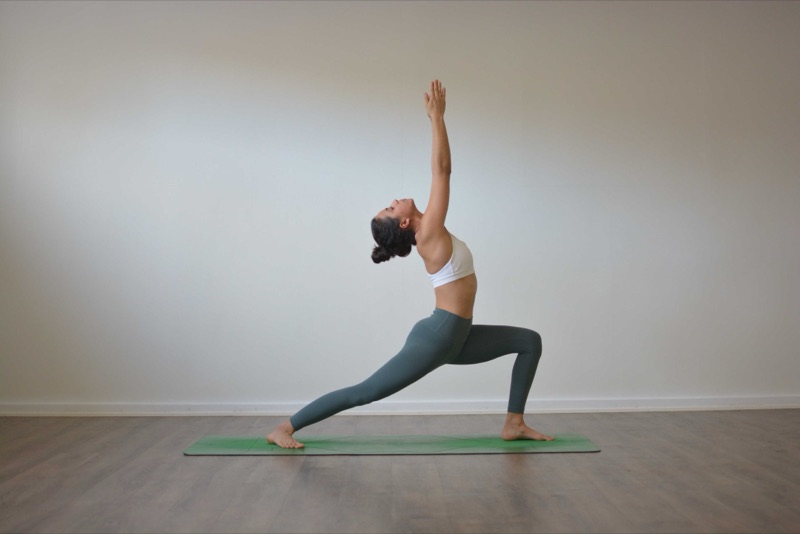
Virabhadrasana I (Warrior I) is a standing yoga pose in a long lunge: the front knee bent over the ankle, the back leg straight with the heel on the floor, the hips facing forward and the arms reaching overhead. It strengthens the front leg and stretches the front of the back hip and the calf. You meet it in most Vinyasa and Ashtanga classes, often inside the Sun Salutation B.
Pose type: standing, lunge, mild backbend. Level: beginner, though the details take years. Props: none needed; a wall or a block helps if your balance is shaky.
What Virabhadrasana means
The name joins three Sanskrit words: vira, hero or warrior, bhadra, auspicious or friend, and asana, seat or posture. Virabhadra is a fierce form of Shiva. In the Puranas, Shiva's wife Sati dies at the fire sacrifice of her father Daksha, who had insulted Shiva. In his grief and rage Shiva tears out a lock of his hair, and from it rises Virabhadra, who storms the sacrifice. Many teachers read the three Warrior poses as three moments of that story: Warrior I is Virabhadra rising up out of the earth, arms lifted.
Warrior I is sometimes called Veerabhadrasana, the same name spelt the way it is often said in India. In Ashtanga Yoga it is Virabhadrasana A, and Warrior II is Virabhadrasana B.
How to do Warrior I, step by step
- Stand in Tadasana (Mountain Pose) at the top of your mat. Place your hands on your hips.
- Step your left foot back about one leg length, roughly 1 to 1.2 metres for most adults. Keep your feet about hip-width apart from side to side, as if each foot stood on its own rail of a train track. A narrow stance makes it hard to face forward.
- Turn the back foot out 30 to 45 degrees and press the whole outer edge and heel into the floor. The front foot points straight ahead.
- Draw the left hip forward and the right hip back until the pelvis faces the front of the mat as far as it comfortably goes. Lengthen your tailbone down so the lower back does not arch.
- Breathe out and bend the right knee until it sits over the ankle. The shin is vertical, the thigh moves toward parallel with the floor. Keep the back leg straight and firm.
- Breathe in and reach both arms up alongside your ears, shoulder-width apart, palms facing each other. Lift your ribs away from your pelvis. If your shoulders allow it, bring the palms together.
- Look forward, or tip the head back gently and look up at your hands. Stay for 5 breaths, up to a minute.
- To come out, breathe in, press into the back heel and straighten the front knee. Lower your arms, step forward to Tadasana and repeat with the left foot in front.
In a Vinyasa flow you usually step into Warrior I from Adho Mukha Svanasana (Downward-Facing Dog): step the right foot forward between the hands, spin the back heel down, then rise.
Benefits of Warrior I
Warrior I is a strength pose for the legs and a stretch for the front of the back hip.
- Front leg: the quadriceps and the glutes hold you in the lunge, and they work harder the deeper you bend.
- Back hip: with the back leg straight and the pelvis turned forward, the hip flexors of the back leg lengthen. That is the psoas and the rectus femoris, the muscles that shorten when you sit all day. Our article on the hip flexors, the psoas and yoga explains the anatomy.
- Back calf and ankle: keeping the back heel down stretches the calf and asks the ankle to bend.
- Shoulders and upper back: the arms overhead ask for full shoulder flexion, and the upper back works to lift the chest.
You also balance on a long, narrow base with your eyes forward, which trains steadiness in the feet and ankles. Older texts and many websites add claims about the lungs, the belly and the organs. We leave those out: no one has shown a mechanism for them.
Who should skip or modify Warrior I
- Knee pain: bend the front knee less and keep it pointing over the second toe. Stop if you feel pain inside the joint.
- Shoulder injury or a stiff neck: keep the hands on the hips or at the heart, and look forward instead of up.
- Lower back pain or sacroiliac pain: shorten the stance, widen the feet and let the back hip stay a little behind. Forcing the hips square twists the pelvis.
- Poor balance, dizziness or high blood pressure: keep the arms lower, look forward and stand near a wall.
- Pregnancy: a wider, shorter stance gives room for the belly and a steadier base. Follow the advice of your midwife or doctor.
Our 10 tips to avoid yoga injuries apply here too.
Common mistakes
- Feet on one line. Heel to heel, like on a tightrope, the pelvis cannot turn forward and you wobble. Widen the stance.
- Front knee past the ankle or falling in. Step the back foot further away and point the knee toward the middle toes.
- Back heel lifting or outer foot rolling in. Shorten the stance or turn the back foot out a little more. If the heel still lifts, you are in a high lunge, which is fine, but it is another pose.
- Arching the lower back to lift the chest. The lift should come from the ribs and upper back. Draw the lower ribs in and lengthen the tailbone down.
- Shoulders up by the ears. Keep the arms wide enough that the shoulder blades can slide down the back.
- Back knee soft. Press the back thigh up and straighten the leg. The stretch in the hip is lost when the knee bends.
Preparatory poses
- Anjaneyasana (Low Lunge): the same hip flexor stretch with the back knee on the floor.
- Adho Mukha Svanasana (Downward-Facing Dog): stretches the calves so the back heel reaches the floor.
- Utkatasana (Chair Pose): builds the thigh strength and the arms-overhead shape with both feet together.
- Gomukhasana (Cow Face Pose): opens the shoulders for the overhead reach.
- Vrksasana (Tree Pose): balance and steady feet.
Follow-up poses
- Virabhadrasana II (Warrior II): open the hips to the side and the arms to shoulder height.
- Virabhadrasana III (Warrior III): from Warrior I, tip forward and lift the back leg to balance on one foot.
- Utthita Parsvakonasana (Extended Side Angle): from Warrior II, lower the forearm to the thigh or the hand to the floor.
- Ustrasana (Camel Pose): a deeper backbend for the same front line of the body, once the hips are warm.
Warrior I variations
- Hands on the hips: easier on the shoulders and the best way to feel what the pelvis is doing.
- Cactus arms: elbows bent at 90 degrees, upper arms at shoulder height. Opens the chest without the overhead reach.
- Hands clasped behind the back: interlace the fingers behind you, draw the hands away from the back and lift the chest. Fold forward inside the front knee and you are in Humble Warrior.
- High lunge: back heel lifted, hips square, back foot pointing forward. Easier for tight calves and ankles.
- Short stance at the wall: back heel against the wall for feedback, feet closer together.
Where teachers disagree
Ask five teachers how square the hips should be in Warrior I and you get several answers. The Iyengar tradition asks for the pelvis turned fully forward and the front heel in line with the arch of the back foot. Many teachers today set the feet hip-width apart and let the back hip stay slightly behind, because a long stance, a heel on the floor and fully square hips together ask more of the hip and ankle than many bodies have. Both can be right. The more your back hip trails, the less you stretch the hip flexors, and the more you force it forward, the more the knee and the lower back take the twist. Turn as far as you can without the back heel lifting or the lower back arching, and stop there.
The age of the pose is another point. Warrior I is not described in the medieval hatha texts such as the Hatha Yoga Pradipika. It spread in the 20th century through the students of T. Krishnamacharya, above all B.K.S. Iyengar's Light on Yoga (1966) and Pattabhi Jois' Ashtanga Yoga, where it sits in the Sun Salutation B. The myth behind the name is old. The pose is modern.
To practise Warrior I with a teacher, start with the four-week Yoga for Beginners program, or learn it inside the Sun Salutations in Ashtanga Fundamentals.
Frequently asked questions
What is Virabhadrasana and its benefits?
Virabhadrasana, Warrior Pose, is a family of standing lunges named after Virabhadra, a fierce form of Shiva. Warrior I strengthens the thighs and glutes of the front leg, stretches the hip flexors and calf of the back leg, and asks the shoulders to reach fully overhead.
What is another name for Virabhadrasana?
In English it is Warrior Pose, and Virabhadrasana I is Warrior I. It is also spelt Veerabhadrasana. In Ashtanga Yoga, Warrior I is called Virabhadrasana A and Warrior II Virabhadrasana B.
What is the myth of Virabhadrasana?
In the Puranas, Shiva's wife Sati dies at the fire sacrifice of her father Daksha. In rage and grief Shiva pulls out a lock of his hair and creates the warrior Virabhadra, who destroys the sacrifice. Warrior I is often read as Virabhadra rising from the ground with his arms raised.
What is the difference between Warrior I and Warrior II?
In Warrior I the hips and chest face forward, the back foot turns out 30 to 45 degrees and the arms reach up. In Warrior II the hips and chest open to the side, the back foot turns out about 90 degrees and the arms stretch out at shoulder height, one forward and one back.
Should the hips be square in Warrior I?
Turn them toward the front as far as your hip and ankle allow, with the back heel down and the lower back long. For most people that is close to square but not fully. Forcing the pelvis round usually lifts the heel or twists the knee and the lower back.
How long should you hold Warrior I?
In a flow class you usually hold it for one to five breaths. For strength and alignment practice, stay 30 seconds to a minute on each side, as long as the back heel stays down and the breath stays steady.