Level 1-2
14 Programs
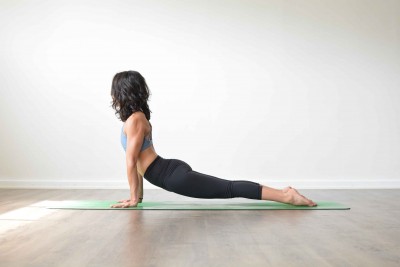
Vinyasa Fundamentals
Whether you are new to yoga or new to Yogateket, the basics of every style are a strong foundation for your practice. Vinyasa Fundamentals is a short beginners program to get your practice right from the start.
Learn to practise Vinyasa in a safe and strong way, so you can move through a full class with confidence and a better understanding of the postures. Each day you work on something new, in 15 to 20 minutes:
- Day 1, Vinyasa Fundamentals Day 1: Ujjayi breathing, length through the spine in Tadasana, and a stable Downward-Facing Dog.
- Day 2, Vinyasa Fundamentals Day 2: weight on the hands, from Plank Pose to a safe Chaturanga and Upward-Facing Dog.
- Day 3, Vinyasa Fundamentals Day 3: the standing postures, Warrior II, High Lunge and Warrior I, with the hips and feet in place.
- Day 4, Vinyasa Fundamentals Day 4: stepping forward from Down Dog, then a short flow that puts it all together.
This is a good place to start if you feel unsure, or a bit overwhelmed by what a full class asks of you. It is the beginning, and the more you practise the easier it gets. Bring your mat and a couple of blocks. Level 1-2, with Lizette Pompa.

Pranayama Program Level 1
Pranayama works mainly on the nervous system. A slow, trained breath helps you meet stress, brings a calmer mind and gives you more energy. Like any practice, it needs regular work before you really feel it.
This eight week program is a good place to begin your relationship with Pranayama. Each week has a short information video with the new techniques and themes, and one practice class. Ideally you do the practice class every day that week, or on as many days as you can. Start with When and How.
- Week 1: relaxation, belly breathing and a double length exhale. Week One Practice
- Week 2: the first classical techniques, Nadi Shodhana and Bhramari. Week Two Practice
- Week 3: Uddiyana Bandha Kriya and Kapalabhati. Week Three Practice
- Week 4: Agni Sara, Sitali and Ujjayi. Week Four Practice
- Week 5: Simha Mudra, Jivha Bandha and Brahma Mudra for the face, jaw and neck. Week Five Practice
- Week 6: the bandhas, Mula Bandha and Uddiyana Bandha. Week Six Practice
- Week 7: a traditional practice with more silence. Week Seven Practice
- Week 8: Surya Bhedana and refined Kapalabhati. Week Eight Practice
When you are done, Continuing With Practice shows you how to keep going. Level 1-2. Uddiyana Bandha Kriya, Agni Sara and Kapalabhati are not for pregnancy or during your menstrual cycle, and the videos tell you what to do instead.

Ladder Fit Flow
Ladder flows differ from a regular Vinyasa class in their sequencing. We begin with two or three postures and add one or two new movements each round, with a vinyasa or sun salutation linking the rounds. We do five rounds. By the fifth you have memorised a complete flow and feel more comfortable in every posture, trying to do it better each time. It challenges the mind as much as the body.
Ladder Fit Flow is a full body workout that balances strength and flexibility and becomes a moving meditation. Two classes a week, 45 to 60 minutes each:
- Week 1: Yoga Roll for the arms and back, and Twisted Twist for the hips, towards Hanumanasana.
- Week 2: Dive to Starfish Pose with Side Plank and Half Moon, and Impossible Possible Warrior from Chair Pose to Warrior III.
- Week 3: Twisted Plank with Wild Thing, and Crunching the Core for the core, front and back.
- Week 4: Fly As a Bird of Paradise with Dancer's Pose, and Legs of Steel for the hips and legs.
Level 1-2, no props needed. Join Amaranta on the mat.

Yoga Therapy
Accessible for everyone. This program is for you who live with postural problems, a stiff neck or back, or long days at the computer. It is also a good place for beginners to start, or for anyone who wants to go back to the foundation of their practice.
We use a lot of simple spinal twists and bends. The aim is to work on the mobility of the spine and to start to correct postural imbalances, so the spine can move freely. Core strength comes in step by step, because posture problems often go together with a weak core.
- Week 1: Intro Talk, then Our Practice Starts Here and Physiotherapy Movements, a mix of yoga and physiotherapy movements.
- Week 2: Strong and Stable House and Developing Appropriate Core Strength, with more time on strength.
- Week 3: Letting Go of Poor Posture and We Bring it Together, where we stabilise the spine and tie everything together.
The classes are 30 to 45 minutes, level 1-2, with no props. Afterwards, repeat the classes that helped you most. If you have pain, check with your doctor or physiotherapist before you start.

Trust Your Foundation
In today's society there is a lot of talk about finding balance, as if it were some mystical state in a galaxy far, far away that we can only reach with much effort.
The truth is that balance is our natural state. If we could clear away the clutter we have piled on top of the body's own wisdom, and listen better to what it tells us, we would notice what throws us out of that state of ease, and let it go instead of burying it under more distractions.
Finding physical balance is about learning not to hold on for dear life, but to trust yourself enough to expand into the space around you. Start with the Introduction.
- Week 1, the feet and the standing postures: Breath and Tadasana, Connect to your Roots, Expand into Space and Let go of Grasping.
- Week 2, weight into the hands: Hands, Wrists, Core, Crow Pose, Back to Standing and Remain Centred through Twists and Turns.
- Week 3, balance and going upside down: Trust the Space, Headstand, Pranayama and Bringing it all Together.
Level 1-2, no props needed. Grounded and rooted, yet light.

Ashtanga Fundamentals
Welcome to Ashtanga Fundamentals, a four week course in Ashtanga Vinyasa for beginners with Sofia Soori.
The goal is to build a self-practice you can use as the base for an everyday yoga practice at home. You learn the basics of the Ashtanga method and get the tools and inspiration to practise more often. Each week has one theory lesson and two practice classes. Do the practice classes twice a week, and you stand on your mat four times a week. Start with Welcome to This Course.
- Week 1: Ashtanga Yoga, Ujjayi meets Sun Salutation A and Sun Salutation B.
- Week 2: the Yamas in A Healthy Relationship with the World, Complete All the Standing Postures, The Finishing Sequence and Opening and Closing Mantra.
- Week 3: Let's Start with Some Seated Postures, Standing and Seated Postures and the Niyamas in Build Self-discipline and Inner Strength.
- Week 4: The Last Part Of the Seated Postures, Key Postures in Primary Series, Can We Reach Total Bliss? and My Best Advice to You Dear Yogi.
Level 1-2, no props needed. Practice, practice, practice.
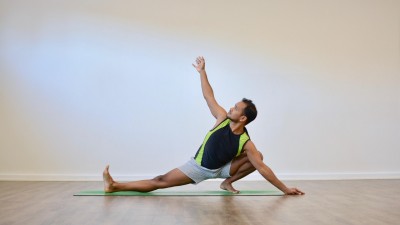
Five Elements
In this Vinyasa program we bring the qualities of the Pancha Mahabhutas, the five elements of earth, water, fire, air and space, into the practice. In the yoga tradition each element has its own qualities, and we all carry all of them. When they are in balance, we feel in harmony.
Vinyasa is mainly a fire practice. Being aware of the other elements, and bringing them in, gives you a more balanced body and mind.
- Earth Element: standing and balancing holds for strong legs and a grounded feeling.
- Water Element: fluid hips, with space around the hip joint.
- Fire Element: core strength, arm balances and inversions.
- Air Element: an open chest and shoulders, and a strong back.
- Space Element: all four elements in one flow, with a little pranayama.
Each class is 45 to 50 minutes, level 1-2, no props needed. Ready for more? Try Five Elements Intermediate.

Whole30 Yoga Practice Program
Want to bring more movement into your life? This program gives you 30 days of yoga, movement, breathing and mindfulness, one class a day. It started as a companion to the Whole30 timeline, but anyone can start it on any day.
The classes come from across Yogateket's library and teachers, so you get to try a bit of everything:
- Week 1 mixes a steady Vinyasa flow like A Well Rounded Class with an evening wind-down in Halftime: Winding Down, the Loving Kindness Meditation and your first Simple Breathing Practice.
- Week 2 brings standing work in Yoga 20: Stand Tall, passive backbends in Lean Back and Relax: Passive Backbends, the first strength workout, Let's Begin, and Yoga for the Face.
- Week 3 goes from the gentle Easy Flow to Short Ashtanga Practice and Deep Relaxation Practice.
- Week 4 builds strength with 15 Minute Core and Strengthen Your Hamstrings, and slows down with Meditation for A Restless Mind.
- Week 5 ends with Jump into Malasana and Hips and Shoulders.
The classes are 10 to 60 minutes long, mostly level 1-2. Keep a pair of blocks nearby.

Prenatal Yoga Program
This prenatal program is for all mothers to be. Pregnancy is a time full of changes, in your body and in your mind. A yoga practice through your pregnancy gives you time and space to notice those changes, and to feel physically and emotionally steady.
Each class is twenty minutes, so it fits into your day:
- Week 1: All Around Prenatal Class and Wake Up Practice.
- Week 2: A Well Rounded Pregnancy Practice and Lower Body Class, to keep your legs strong as your belly grows.
- Week 3: Front, Side and Back Body and Hips, Hamstrings and Stability.
Use the props as you need to support your practice. Two blocks and a bolster or pillow are enough. Modify whenever you need to, and always listen to your body. If you are unsure about practising, check with your midwife or doctor first. Level 1-2.

Todos Los Días, Todas Las Veces Que Quieras
Este programa tiene 8 sesiones, cada una dedicada a una parte del cuerpo: cuello, hombros, caderas, espalda y omóplatos, muñecas, pies, cuádriceps e isquiotibiales, y caja torácica. Empieza con Bienvenidos.
El objetivo es activar y calentar el cuerpo por grupos musculares y prepararlo para la práctica. Está pensado para antes de la práctica, pero también puedes hacerlo durante la práctica o por separado. Según tu energía y tu tiempo, haz todos los movimientos de cada grupo muscular o solo algunos.
- Semana 1: Cuello, Hombros, Caderas y Espalda y Omóplatos.
- Semana 2: Muñecas, Pies, Cuádriceps e Isquiotibiales y Caja Torácica.
Las sesiones duran entre 10 y 35 minutos. Nivel 1-2, sin accesorios. Combínalas como quieras y crea tus propias rutinas.

Ashtanga Para Principiantes
Este programa de Ashtanga Yoga es una guía para quienes quieren empezar con la práctica de Ashtanga. Ve despacio e incorpora posturas a medida que avanza tu práctica.
La práctica de Ashtanga empieza siempre con los Saludos al Sol (Surya Namaskara en sánscrito). Muchas tradiciones yóguicas creen que el Sol no solo está en el espacio, sino también en el corazón de cada uno de nosotros. Los Saludos al Sol calientan el cuerpo, relajan la musculatura y abren las articulaciones, y te enseñan a sincronizar la respiración, el cuerpo y la mente.
- Semana 1: ¿Qué es Ashtanga Yoga?, Saludo al Sol A, Saludo al Sol B y las primeras posturas de pie.
- Semana 2: el resto de las posturas de pie y ¿Qué es el estilo Mysore?.
- Semana 3: el equilibrio, las primeras posturas de suelo, Mantras y Posturas de Pie Primera Serie de Ashtanga.
- Semana 4: las flexiones y torsiones de suelo, Navasana, Posturas de Suelo Primera Serie y Los 8 Miembros del Yoga.
- Semana 5: Posturas Finales Para Principiantes, Posturas Finales Practicantes Avanzados y Vinyasa, Drishti y Bandha.
Cada vídeo explica el significado de la postura, las respiraciones, el drishti y los posibles riesgos. Nivel 1-2, sin accesorios.

Weekly Pranayama Program
Interested in learning pranayama, deepening a practice you already have, or getting more regular with it? This program gives you a breathing practice for each day of the week.
Each class uses two techniques chosen to suit the day, and ends with a good Savasana. Do any day as a single class, or cycle through the whole week. Start with the Information.
- Beat the Monday Blues: Nadi Shodhana and Sitali.
- Tune Into Tuesday: Ujjayi and Nadi Shodhana.
- Wander in Peace Wednesday: Nadi Shodhana and Bhramari.
- Turn on Thursday: Surya Bhedana and Sitali.
- That Friday Feeling: Surya Bhedana and Sitkari.
- Soothing Saturday: Chandra Bhedana and Bhramari.
- Settle into Sunday: Ujjayi and Chandra Bhedana.
Level 1-2, no props needed. If you are pregnant or on your cycle, change Surya Bhedana to Chandra Bhedana.

From Flexibility to Mobility
It is easy to mix up mobility and flexibility. Mobility is the ability to take a joint through its full range of motion with control. Flexibility is part of the base for it.
This program has five classes that work through different parts of the body. Together we take flexibility into mobility, working hard to control our full range of motion, and find stability in our joints along the way. Start with Welcome to This Program.
- Hip Mobility: internal and external rotation, with control.
- Shoulder Mobility: the full range of the shoulder, without help from the spine.
- Spine Mobility: flexion, extension, side bending and rotation, one part at a time.
- Wrist Mobility: strength and mobility for the wrists, especially in extension.
- Knees and Ankles Mobility: the tibia and ankle, to prepare for squats.
Each class is 10 to 20 minutes, level 1-2, with two blocks.

The Power of Four
Whether you want more strength or more flexibility, this program helps you bring different kinds of training into your week.
The Power of Four has four classes a week, each week for one area of the body. Lizette guides you through a yoga class, a weight workout, a mobility class and a full class that brings it all together. Mix and match the classes as you like, and discover what variety and new ways of moving bring to your practice.
- Week 1, shoulders: Shoulders Yoga Class, Shoulder Workout, Shoulder Mobility: Explore and Shoulders: Full Class.
- Week 2, spine and core: Spine/Core Yoga Class, Core Workout, Spine: Mobility and Spine/Core Full Class.
- Week 3, glutes, hips and hamstrings: Glutes, Hips and Hamstrings Yoga Class, Glutes, Hips and Hamstrings Workout, Glutes, Hips and Hamstrings Mobility and Glutes, Hips and Hamstrings Full Class.
- Week 4, feet, ankles and legs: Feet, Ankles and Legs Yoga Class, Leg Workout, Feet, Ankles and Legs Mobility and Feet, Ankles and Legs Full Class.
You need a set of dumbbells (Lizette uses 2 kg), an 8 kg kettlebell, a resistance band, a dowel, two yoga blocks and some wall space. Level 1-2.


