Vinyasa flow
Deliberate breathing in flowing postures
Vinyasa Flow or Vinyasa Yoga describes how you practice yoga more than a single yoga practice. Examples of yoga schools included in the Vinyasa family are Ashtanga Vinyasa, Jivamukti, and Baptiste Yoga. The basis of Vinyasa is the traditional Hatha Yoga postures (asanas), but there is a difference between the two in the name.
The word “vinyasa” derives from Sanskrit and approximately translates to “to place deliberately, in a special way.” As such, the common denominator for the Vinyasa yoga practices is moving deliberately in the postures and from posture to posture, combining breathing and movement into a flow. That is to say, poses are sequenced to be performed one after another, and you breathe deliberately in and out with particular movements or whole postures. In this way, postures and breath are combined into a dynamic flow.
“As such, the common denominator for the Vinyasa yoga practices is moving deliberately not only in the postures but also from posture to posture, combining breathing and movement into a flow.”
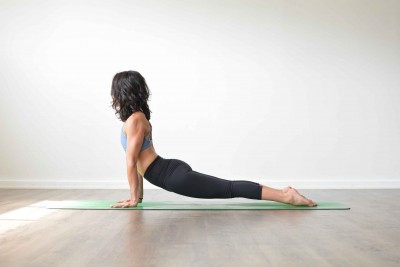
What sets Vinyasa flow apart from particular schools, such as Ashtanga Vinyasa, is that the postures and sequencing of the class are very much up to the instructor. The only limitation is that the class must be a flow of Hatha Yoga postures in harmony with the breath. Consequently, Vinyasa flow is excellent for those looking for a dynamic yoga class with lots of variation. However, a few flows are generally included in a Vinyasa class. One is the “vinyasa,” which is the sequence chaturanga dandasana – upward facing dog (urdvha mukha svanasana) or cobra (bhujangasana) – downward facing dog (adho mukha svanasana).
The other is the sun salutation, which has a few variations but usually includes mountain pose (tadasana) – upward salute (urdvha hastasana) – forward fold (uttanasana) – half forward fold (ardha uttanasana) – vinyasa (as described above) – half forward fold – forward fold – upward salute – mountain pose. At Yogateket yoga online, our instructors construct their Vinyasa flow classes to their own interests and expertise, which offers variation among the classes. In other words: there is a Vinyasa flow for every occasion and mood!
9 Programs
Vinyasa Fundamentals
Whether you are new to yoga or new to Yogateket, the basics of every style are a strong foundation for your practice. Vinyasa Fundamentals is a short beginners program to get your practice right from the start.
Learn to practise Vinyasa in a safe and strong way, so you can move through a full class with confidence and a better understanding of the postures. Each day you work on something new, in 15 to 20 minutes:
- Day 1, Vinyasa Fundamentals Day 1: Ujjayi breathing, length through the spine in Tadasana, and a stable Downward-Facing Dog.
- Day 2, Vinyasa Fundamentals Day 2: weight on the hands, from Plank Pose to a safe Chaturanga and Upward-Facing Dog.
- Day 3, Vinyasa Fundamentals Day 3: the standing postures, Warrior II, High Lunge and Warrior I, with the hips and feet in place.
- Day 4, Vinyasa Fundamentals Day 4: stepping forward from Down Dog, then a short flow that puts it all together.
This is a good place to start if you feel unsure, or a bit overwhelmed by what a full class asks of you. It is the beginning, and the more you practise the easier it gets. Bring your mat and a couple of blocks. Level 1-2, with Lizette Pompa.

Ladder Fit Flow
Ladder flows differ from a regular Vinyasa class in their sequencing. We begin with two or three postures and add one or two new movements each round, with a vinyasa or sun salutation linking the rounds. We do five rounds. By the fifth you have memorised a complete flow and feel more comfortable in every posture, trying to do it better each time. It challenges the mind as much as the body.
Ladder Fit Flow is a full body workout that balances strength and flexibility and becomes a moving meditation. Two classes a week, 45 to 60 minutes each:
- Week 1: Yoga Roll for the arms and back, and Twisted Twist for the hips, towards Hanumanasana.
- Week 2: Dive to Starfish Pose with Side Plank and Half Moon, and Impossible Possible Warrior from Chair Pose to Warrior III.
- Week 3: Twisted Plank with Wild Thing, and Crunching the Core for the core, front and back.
- Week 4: Fly As a Bird of Paradise with Dancer's Pose, and Legs of Steel for the hips and legs.
Level 1-2, no props needed. Join Amaranta on the mat.

Trust Your Foundation
In today's society there is a lot of talk about finding balance, as if it were some mystical state in a galaxy far, far away that we can only reach with much effort.
The truth is that balance is our natural state. If we could clear away the clutter we have piled on top of the body's own wisdom, and listen better to what it tells us, we would notice what throws us out of that state of ease, and let it go instead of burying it under more distractions.
Finding physical balance is about learning not to hold on for dear life, but to trust yourself enough to expand into the space around you. Start with the Introduction.
- Week 1, the feet and the standing postures: Breath and Tadasana, Connect to your Roots, Expand into Space and Let go of Grasping.
- Week 2, weight into the hands: Hands, Wrists, Core, Crow Pose, Back to Standing and Remain Centred through Twists and Turns.
- Week 3, balance and going upside down: Trust the Space, Headstand, Pranayama and Bringing it all Together.
Level 1-2, no props needed. Grounded and rooted, yet light.

Yoga for Beginners
Yoga for Beginners is for everyone. It is made for you who want to start doing yoga and need some guidance before your first full class.
Over four weeks we look at the foundational postures of a Vinyasa class: Downward-Facing Dog, Plank, Chaturanga and more. The classes are twenty minutes long. We stop here and there so you understand how to do a posture, and still get time to practise it.
- Week 1: Welcome to Your Practice, Move Into Plank and Chaturanga Dandasana.
- Week 2: Salute the Sun, Find Your Inner Warrior and Let’s Practice, your first flow without stops.
- Week 3: Repetition is Key, Reviewing Plank and Chaturanga Dandasana Take Two, because quality comes from repetition.
- Week 4: Stand Strong, Move into Backbends and Today We Flow.
Move at your own pace and take your time. You need a mat and two blocks. Books from your shelf work too. Level 1, with Lizette Pompa.
Five Elements
In this Vinyasa program we bring the qualities of the Pancha Mahabhutas, the five elements of earth, water, fire, air and space, into the practice. In the yoga tradition each element has its own qualities, and we all carry all of them. When they are in balance, we feel in harmony.
Vinyasa is mainly a fire practice. Being aware of the other elements, and bringing them in, gives you a more balanced body and mind.
- Earth Element: standing and balancing holds for strong legs and a grounded feeling.
- Water Element: fluid hips, with space around the hip joint.
- Fire Element: core strength, arm balances and inversions.
- Air Element: an open chest and shoulders, and a strong back.
- Space Element: all four elements in one flow, with a little pranayama.
Each class is 45 to 50 minutes, level 1-2, no props needed. Ready for more? Try Five Elements Intermediate.

Whole30 Yoga Practice Program
Want to bring more movement into your life? This program gives you 30 days of yoga, movement, breathing and mindfulness, one class a day. It started as a companion to the Whole30 timeline, but anyone can start it on any day.
The classes come from across Yogateket's library and teachers, so you get to try a bit of everything:
- Week 1 mixes a steady Vinyasa flow like A Well Rounded Class with an evening wind-down in Halftime: Winding Down, the Loving Kindness Meditation and your first Simple Breathing Practice.
- Week 2 brings standing work in Yoga 20: Stand Tall, passive backbends in Lean Back and Relax: Passive Backbends, the first strength workout, Let's Begin, and Yoga for the Face.
- Week 3 goes from the gentle Easy Flow to Short Ashtanga Practice and Deep Relaxation Practice.
- Week 4 builds strength with 15 Minute Core and Strengthen Your Hamstrings, and slows down with Meditation for A Restless Mind.
- Week 5 ends with Jump into Malasana and Hips and Shoulders.
The classes are 10 to 60 minutes long, mostly level 1-2. Keep a pair of blocks nearby.

Progressive Backbends
In this program we work with progressive backbends. A backbend has two parts: strength in the back of the body and opening in the front. When one of them is missing, the lower back often takes the load and feels it.
The program builds back body strength and opens the front body step by step, so your backbends come with more ease:
- Week 1, strength in the back body: Back Strength, with the pelvis aligned, and Back Strength 2, the next step.
- Week 2, strength towards Wheel Pose: Supine Back Strength Class lying on your back, and Dynamic Backbends with active flexibility.
- Week 3, the shoulders and the drop back: Shoulder Mobility for Backbends and Dropping Back at the wall.
Warm up before each class with the Rise and Shine class or a few rounds of sun salutations. The classes are 15 to 30 minutes. Level 2-3, so come with a regular practice. You need a block, a strap and some wall space.
Be patient and find your way up progressively.
Five Elements Intermediate
In this Vinyasa Yoga program we bring the qualities of the five elements into the practice. In the yoga tradition, when these qualities are in balance we feel in harmony.
Vinyasa is mainly a fire practice. Being aware of the other elements, and bringing them in, gives you a more balanced body and mind. This is the intermediate version, with longer classes and more demanding postures:
- Earth Element Intermediate: standing and balancing strength.
- Water Element Intermediate: active and passive flexibility in the hips.
- Fire Element Intermediate: core, arm balances and inversions.
- Air Element Intermediate: an open chest and shoulders and deeper backbends.
- Space Element Intermediate: all the elements in one flow, with a little pranayama.
Each class is 60 minutes, level 2-3, no props needed. New to the elements? Start with Five Elements.

The Power of Four
Whether you want more strength or more flexibility, this program helps you bring different kinds of training into your week.
The Power of Four has four classes a week, each week for one area of the body. Lizette guides you through a yoga class, a weight workout, a mobility class and a full class that brings it all together. Mix and match the classes as you like, and discover what variety and new ways of moving bring to your practice.
- Week 1, shoulders: Shoulders Yoga Class, Shoulder Workout, Shoulder Mobility: Explore and Shoulders: Full Class.
- Week 2, spine and core: Spine/Core Yoga Class, Core Workout, Spine: Mobility and Spine/Core Full Class.
- Week 3, glutes, hips and hamstrings: Glutes, Hips and Hamstrings Yoga Class, Glutes, Hips and Hamstrings Workout, Glutes, Hips and Hamstrings Mobility and Glutes, Hips and Hamstrings Full Class.
- Week 4, feet, ankles and legs: Feet, Ankles and Legs Yoga Class, Leg Workout, Feet, Ankles and Legs Mobility and Feet, Ankles and Legs Full Class.
You need a set of dumbbells (Lizette uses 2 kg), an 8 kg kettlebell, a resistance band, a dowel, two yoga blocks and some wall space. Level 1-2.
2 Challenges

Step Out Of Your Yoga Comfort Zone
This one week yoga challenge is a tool to grow and to step out of your yoga comfort zone.
If you don't try new classes and teachers regularly, this might be a challenge, and a rewarding one. In seven days you try six teachers and five different styles of yoga:
- Slow Strength, slow Hatha strength with Daniel Scott.
- Varying Variations, a playful Vinyasa flow with Lauren Matters.
- En-light-enment, the air element with Linnea Ahlgren.
- Ashtanga Vinyasa Intro, your first taste of Ashtanga with Sofia Soori.
- Yin Hips Practice, long Yin holds with Sofia Soori.
- Lower Body Love, legs and balance with Lizette Pompa.
- Back to Balance with Pranayama, a breathing practice with Guy Powiecki.
The classes are 20 to 45 minutes, level 1-2. "When was the last time you did something for the first time?"

Despierta tu Cuerpo
En este reto de yoga de 10 días hacemos ejercicios y rutinas pequeñas y sencillas que despiertan tu cuerpo y lo preparan para el resto del día. Nos centramos sobre todo en abrir las caderas, estirar las piernas y los hombros, y soltar los músculos tensos de la espalda.
- Semana 1: Abriendo las Caderas, Activa tu Espalda, Shot de Energía, Abriendo el Corazón y Estira el Cuerpo, clases de 20 a 30 minutos.
- Semana 2: Despiértate, Siente tu Balance, Flow de la Mañana, Desenrolla tu Cuerpo y Abdomen Fuerte, clases de 15 minutos para las mañanas con poco tiempo.
Una clase al día, nivel 1-2, sin accesorios. Solo necesitas tu esterilla y unos minutos por la mañana.