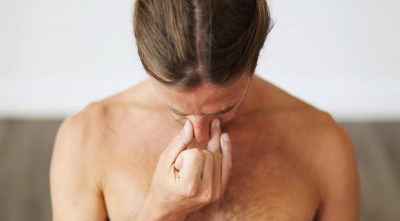
Guy Powiecki

Guy discovered pranayama through Paul Dallaghan and is now a dedicated and senior student of, classical pranayama master, Sri O.P. Tiwari having been authorized to teach pranayama by him. Guy has studied Ashtanga Vinyasa, Iyengar and Traditional Hatha. In learning meditation, he spent time with a number of Buddhist teachers, from both Tibetan and Theravadan traditions, but more recently with a focus on Vipassana. Guy’s knowledge of the breath has been broadened by his interest in free diving. 

Guy first encountered spirituality studying for a Theology degree specializing in Indian religions and Buddhism. Before working with yoga he was a personal trainer and nutritional adviser. In his learning journey, Guy lived on and off for many years in India and South East Asia. Spending time in monasteries and institutions. As a practitioner, he sees the importance of practicing asana, pranayama, and meditation as mutually supporting forms for spiritual growth.  His classes do just this, and the aim is to use the body as a tool for psychological, energetic and spiritual development.  He hopes the classes will truly benefit those who take them.

Guy shares a website with his wife Sara Granström.

Guy Powiecki

4 Programs

8 weeks
pranayama

Pranayama Program Level 1

Pranayama works mainly on the nervous system. A slow, trained breath helps you meet stress, brings a calmer mind and gives you more energy. Like any practice, it needs regular work before you really feel it.

This eight week program is a good place to begin your relationship with Pranayama. Each week has a short information video with the new techniques and themes, and one practice class. Ideally you do the practice class every day that week, or on as many days as you can. Start with When and How.

When you are done, Continuing With Practice shows you how to keep going. Level 1-2. Uddiyana Bandha Kriya, Agni Sara and Kapalabhati are not for pregnancy or during your menstrual cycle, and the videos tell you what to do instead.

3 weeks
Updog in nature Uppsala Pranayama breathing

Yoga Therapy

Accessible for everyone. This program is for you who live with postural problems, a stiff neck or back, or long days at the computer. It is also a good place for beginners to start, or for anyone who wants to go back to the foundation of their practice.

We use a lot of simple spinal twists and bends. The aim is to work on the mobility of the spine and to start to correct postural imbalances, so the spine can move freely. Core strength comes in step by step, because posture problems often go together with a weak core.

The classes are 30 to 45 minutes, level 1-2, with no props. Afterwards, repeat the classes that helped you most. If you have pain, check with your doctor or physiotherapist before you start.

2 weeks
Meditation program from Yogateket

Two Week Meditation Program

Guided meditation for beginners and experienced meditators alike. Begin a meditation practice or deepen the one you have.

Meditation, or mindfulness practice, connects you to the present moment, and that is good for both the mind and the body. We begin right now, right where you are. Start with the Info Video.

The sessions are 15 to 20 minutes. The Completion Video gives you ideas for how to keep going. Level 1, no props needed.

1 week
pranayama

Weekly Pranayama Program

Interested in learning pranayama, deepening a practice you already have, or getting more regular with it? This program gives you a breathing practice for each day of the week.

Each class uses two techniques chosen to suit the day, and ends with a good Savasana. Do any day as a single class, or cycle through the whole week. Start with the Information.

Level 1-2, no props needed. If you are pregnant or on your cycle, change Surya Bhedana to Chandra Bhedana.

2 Challenges

3 weeks
Yogi Guy Powiecki in easy pose

21 Day Meditation

This 21 day meditation is a good yoga challenge to give yourself. It is accessible and no experience is needed. We start right at the beginning and build it up gradually. Ever thought about meditating? Now is the time. Be kind to yourself and meditate for ten minutes a day.

Meditation can help you concentrate, be present, calm your mind and sleep better. Start with the Information Video.

Ten minutes a day, level 1, no props needed. A small habit that can last a lifetime.

3 weeks
start free trial for beginner pranayama yoga practice or start a yoga challenge on your trial, vinyasa yin , core and more

21-Day Pranayama Breathing Challenge

Our first and last actions in this world are a breath. Breathing is one of our most vital processes and affects how we feel, in body and mind. Yet few of us are aware of how we breathe, let alone train the breath.

Now is the time to start. This challenge uses simple movements and breathing exercises to create an easier, more efficient breath. Each day builds on the last, letting go of poor breathing patterns and developing good ones. Start with the 21 Day Challenge Info.

The classes are 15 minutes a day, level 1-2, no props needed. Completion tells you how to keep going.

45 Classes

10 min
Pranayama practice at Yogateket Uppsala

Ujjayi Tutorial

Ujjayi translates as victorious. The chief characteristic of this pranayama is the soft hissing sound you make by partially closing the glottis in the throat, familiar to many yoga practitioners.

Full Ujjayi pranayama is more than the sound, though, and involves a further technique. In Ayurveda it is used to balance vata, and the slow breath calms the nervous system.

Skill in Ujjayi helps with all other pranayamas.

10 min
Yogi is practising yoga on a burgundy coloured yoga mat on white background

Office Breathing Break

This is a short ten-minute breathing exercise that is easy to do in the office. You don't have to be in the office to benefit from it, though. It is simple and accessible to anyone.

We work with breathing into the belly, developing the belly breath. Then we move on to the three-part breath, finding space and expansion through the whole breathing mechanism.

Calming and energising at the same time. Let go of bad breathing habits and find your best breath.

45 min
a photo shoot from a online yoga class at yogateket Uppsala

Spine Therapy

Do you have pain in your neck, shoulders or back? Do you want to care for your spine and your posture? Or maybe you want to relax? This could be the class for you. We do simple twists and spinal movements that suit everyone.

Release tension in the neck, shoulders, back and pelvis while relaxing deeply. The class brings together therapeutic movements and simple stretches from Hatha yoga and physiotherapy. Easy to do and soft.

Small movements, big benefits.

15 min
a photo shoot from a online yoga class at yogateket Uppsala

Bandhas Tutorial

Bandhas are one of the essential parts of Hatha yoga, and they are challenging to master. Bandha translates as lock or seal. There are three main bandhas: mula, uddiyana and jalandhara. We use bandhas to channel and direct energy.

In this tutorial, we learn how to begin developing control of Mula Bandha and Uddiyana Bandha. They are situated around the pelvic floor and the belly, and we discover how to connect with them. To grow in pranayama and yoga, you develop control of these muscular locks. Level 1-2, no props needed.

5 min
Yoga teacher performing yoga posture on green yoga mat on white background

Jivha Bandha Tutorial

As we explore our pranayama practices, we learn techniques and preparatory exercises that bring us to a deeper connection. Jivha Bandha is the counteraction to Simha Mudra (Lion's Breath): we stretch the tongue down instead. We are doing yoga with our tongue.

Jivha Bandha reduces tension and gripping around the mouth, jaw and neck, and helps you develop more inner awareness. It also makes it easier to stay still, with less need to swallow.

Jivha means tongue, and bandha means internal lock.

5 min
Yoga teacher performing simha mudra on green yoga mat on white background

Simha Mudra Tutorial

A large part of pranayama practice is preparing the body and mind to let energy flow freely. We learn techniques to let go of tension in the essential parts of the body. We often hold tension around the face, jaw and neck, in the many small and sensitive muscles there.

This pranayama practice releases tension from the face, jaw and neck and wakes up the muscles of the face. Soothing and energising at the same time, and easy to do.

Simha means lion, and mudra means gesture.

10 min
Yogi is practising yoga on a blue yoga mat on white background

Agni Sara - Tutorial

Agni Sara is one of the Shat Kriyas, the six classical kriyas of Hatha yoga. It is the counteraction to Uddiyana Bandha Kriya, or Nauli. Agni means fire, and in the yoga tradition this practice stokes the digestive fire.

The belly expands on an exhale, with the breath held out, giving space to the organs of the abdomen. Traditionally it is used to support digestion.

Contraindication: do not practise Agni Sara if you are pregnant or on your menstrual cycle.

15 min
Pranayama

Kapalabhati - Tutorial

Kapalabhati means skull shining. Strictly it is a kriya, one of the classical Hatha yoga techniques, rather than a pranayama, and it is the preparation for Bhastrika.

It is a fundamental Hatha yoga technique. It is traditionally used to clear the airways and wake up your energy.

Contraindication: do not practise Kapalabhati if you are pregnant or on your menstrual cycle.

10 min
Yoga teacher performing yoga posture on green yoga mat on white background

Uddiyana Bandha Kriya - Tutorial

Uddiyana Bandha Kriya, called Nauli in its full form, is one of the classic exercises of Hatha yoga. It works the abdominal muscles and massages the belly, and in the yoga tradition it is used to help digestion and the flow of energy.

Full Nauli is a difficult technique that takes time and patience. In this tutorial we also work through the Pre-Nauli stages. We make the practice accessible, give you the information to start in a simple way, and help you grow your control stage by stage towards the full form, often called the king of Hatha yoga.