Yoga Sanskrit Glossary: 50 Terms Explained

This yoga Sanskrit glossary explains the 50 words you are most likely to hear in a class or read in a yoga book, from asana (posture) and pranayama (breath work) to samadhi, prana and chakra. Each entry gives the literal meaning of the Sanskrit, what the word means in yoga, and where it comes from when that matters. The names of individual poses have their own list, linked below.
How to read a Sanskrit yoga word
Most yoga terms are built from a short verbal root plus prefixes and suffixes. Once you know a few pieces, long words fall apart into parts you recognise. Pratyahara is prati (back, against) and ahara (food, what you take in). Ashtanga is ashta (eight) and anga (limb).
Three things cause most of the confusion:
- Spelling. Sanskrit is written in Devanagari script, and there is more than one way to write it in Latin letters. Scholars use marks such as ś and ṣ. Studios write sh. So śauca, saucha and shaucha are the same word, and so are cakra and chakra.
- Sound changes. When two words meet, the sounds at the join often change. This rule is called sandhi. It is why namah + te becomes namaste.
- Several meanings. Many words mean one thing in daily Sanskrit and something more specific in a yoga text. Asana means a seat, and in Hatha yoga a posture.
For the names of the poses themselves, from Tadasana to Sirsasana, see our list of yoga pose names in Sanskrit and English. This glossary covers the other words: the practice, the philosophy and the texts.
Words you hear in a yoga class
- Asana ("seat"): a posture. From the root as, to sit. In the Yoga Sutras of Patanjali, asana means a steady, comfortable seat for meditation. The long list of standing, balancing and inverted poses came later, in the Hatha yoga texts and in the 20th century.
- Vinyasa ("placing in a special way"): from vi and nyasa, placing. In the lineage of T. Krishnamacharya it means linking each movement to an inhale or an exhale. Teachers also use it for the short sequence of Plank, Chaturanga, Upward Dog and Downward Dog between poses.
- Drishti ("sight, view"): a fixed point for the eyes during a pose, such as the tip of the nose, the navel or the thumbs. Holding the gaze steadies the balance and the attention. Our guide to drishti and the nine gazing points goes through each one.
- Bandha ("lock, binding"): a controlled contraction that holds energy and supports the body. The three main bandhas are mula bandha at the pelvic floor, uddiyana bandha at the abdomen and jalandhara bandha at the throat, with the chin drawn toward the chest.
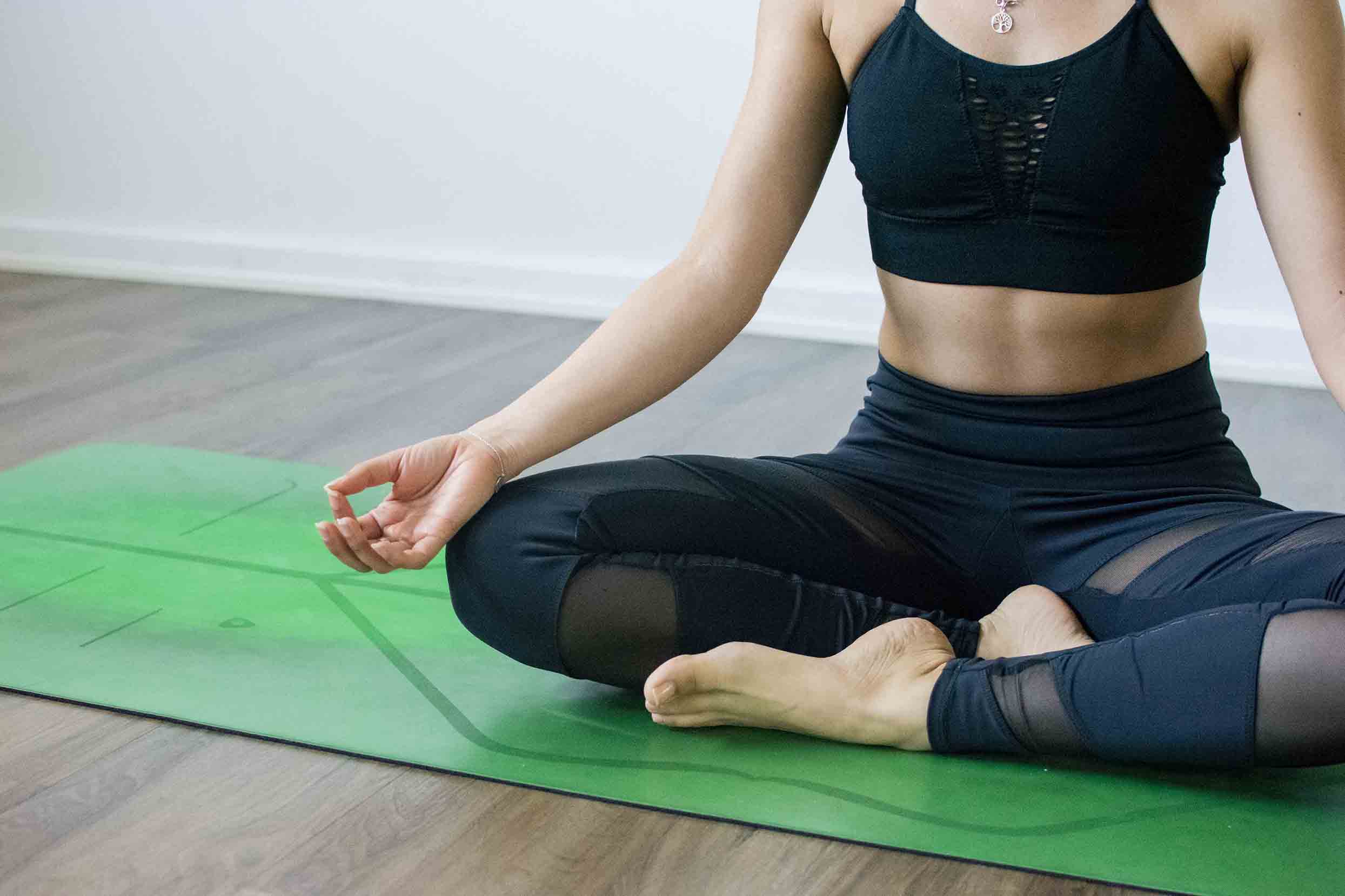
- Mudra ("seal, gesture"): a position of the hands, or of the whole body, held during breath work or meditation. Chin Mudra, with the index finger touching the thumb, is the one most people know.
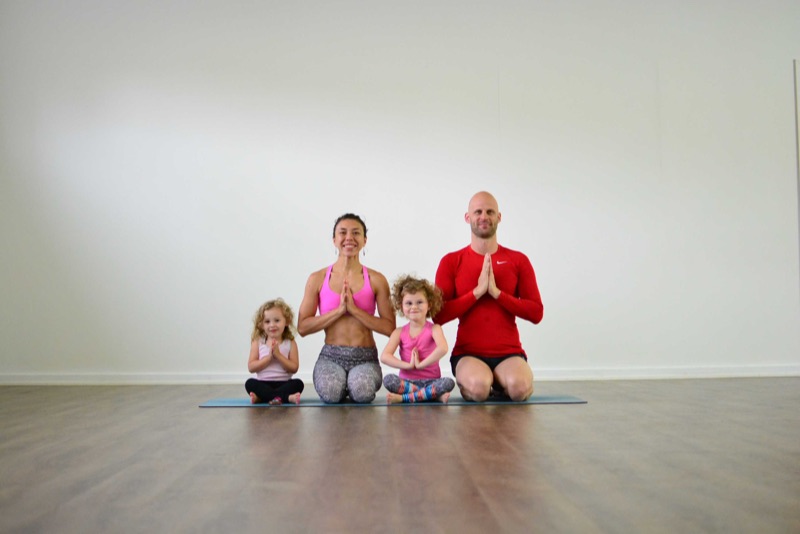
- Namaste ("I bow to you"): namah (bow) and te (to you). An everyday respectful greeting in India and Nepal, said with palms together in front of the chest. Read more on what namaste means and how to say it.
- Om (also written Aum): the sacred syllable chanted at the start or end of many classes. The Mandukya Upanishad reads it as three sounds, A, U and M, followed by silence.
- Shanti ("peace"): usually chanted three times after Om at the end of a mantra.
- Mantra ("instrument of thought"): from man, to think, and tra, a tool. A sound, word or verse repeated aloud or silently to hold the attention.
- Kriya ("action"): in Hatha yoga, a set of purification practices. The Hatha Yoga Pradipika lists six, the shatkarmas: dhauti, basti, neti, trataka, nauli and kapalabhati. In Kundalini yoga a kriya is a set sequence of postures, breath and sound.
- Sadhana ("means of reaching a goal"): your regular personal practice. A daily 20 minutes on the mat is sadhana.
The eight limbs of yoga
Patanjali's Yoga Sutras (2.29) describe yoga as eight limbs, practised together. Our overview of the 8 limbs of yoga explains how they connect.
- Ashtanga ("eight limbs"): ashta (eight) and anga (limb). Patanjali's eight-part path. The same word names Ashtanga Vinyasa, the dynamic style taught by K. Pattabhi Jois, which takes its name from this path.
- Yama ("restraint"): the first limb, five rules for how you treat others. Listed in Yoga Sutras 2.30 and explained in our post on the five yamas.
- Ahimsa ("non-harming"): a (not) and himsa (harm). The first yama. On the mat it means not forcing a pose your body is not ready for.
- Satya ("truthfulness"): from sat, what is real. The second yama.
- Asteya ("non-stealing"): not taking what is not given, including other people's time and credit.
- Brahmacharya ("conduct toward Brahman"): traditionally celibacy for the student or the monk. Many modern teachers read it as moderation of the senses.
- Aparigraha ("non-grasping"): not holding on to possessions, results or ideas about yourself.
- Niyama ("observance"): the second limb, five practices for how you treat yourself. See the five niyamas explained.
- Saucha ("cleanliness"): of the body, the space you practise in and the mind.
- Santosha ("contentment"): being at peace with what you have, including the pose you can do today.
- Tapas ("heat"): from tap, to burn. Discipline, the steady effort that keeps you practising when it is inconvenient.
- Svadhyaya ("one's own study"): study of the texts, and study of yourself.
- Ishvara pranidhana ("dedication to the Lord"): offering your practice to something larger than yourself. Ishvara in the Yoga Sutras is a special kind of self, free of suffering and karma, and readers interpret it in both religious and secular ways.
- Pranayama ("extension of the breath"): prana and ayama, extension. The fourth limb, breath regulation. In a class it means breathing exercises such as Ujjayi or Nadi Shodhana.
- Pratyahara ("drawing back"): turning the attention away from sights, sounds and other input. The fifth limb and the bridge between the outer and the inner practice.
- Dharana ("holding"): concentration on one point, such as the breath or a mantra. The sixth limb.
- Dhyana ("meditation"): from dhyai, to contemplate. Attention that stays on its object without effort. The seventh limb. The word travelled to China as chan and to Japan as zen.
- Samadhi ("putting together"): sam (together), a (toward) and dha (to place). Complete absorption, where the sense of a separate meditator falls away. The eighth limb. The Yoga Sutras describe several kinds.

Breath, energy and the subtle body
- Prana ("life, breath"): the life force in yogic physiology. The breath is its most obvious form, which is why breath work is called pranayama. Some texts divide prana into five vayus, or winds, each with its own direction of movement.
- Ujjayi ("victorious"): a breath with a slight narrowing at the back of the throat, which gives a soft ocean sound. It is the standard breath in Ashtanga and much of Vinyasa.
- Kumbhaka ("like a pot"): breath retention. Antara kumbhaka is holding after the inhale, bahya kumbhaka holding after the exhale.
- Nadi ("channel, stream"): a channel through which prana flows. The three main nadis are ida on the left, pingala on the right and sushumna in the centre, along the spine. Read our guide to nadis, ida, pingala and sushumna.
- Chakra ("wheel"): a centre along the sushumna where nadis meet. The common modern system has seven, from muladhara at the base of the spine to sahasrara at the crown. See the seven chakras for each one.
- Kundalini ("coiled one"): in Tantra and Hatha yoga, a dormant energy pictured as a serpent coiled at the base of the spine, which rises through the chakras as the practice matures.
- Granthi ("knot"): one of three blockages that, in Hatha yoga, stop kundalini from rising. The Brahma granthi sits at the base, the Vishnu granthi at the heart and the Rudra granthi between the eyebrows.
Mind and philosophy
- Yoga ("yoking, joining"): from the root yuj, to yoke, as oxen are yoked to a cart. Usually translated as union. Patanjali defines it differently: yogash chitta vritti nirodhah (1.2), yoga is the stilling of the movements of the mind. More in our post on what yoga means in Sanskrit.
- Chitta ("mind, consciousness"): the whole field of the mind, including memory and feeling. Its movements, the thoughts that come and go, are vrittis.
- Abhyasa ("practice"): steady, repeated effort over a long time. The Yoga Sutras (1.12) pair it with vairagya.
- Vairagya ("dispassion"): letting go of craving for results. Abhyasa is the effort; vairagya is not clinging to what it brings.
- Avidya ("not seeing"): a (not) and vidya (knowledge). Mistaking the temporary for the lasting. The Yoga Sutras call it the root of the other four kleshas, or afflictions.
- Duhkha ("suffering, unease"): the dissatisfaction built into ordinary life. Yoga Sutras 2.16 says suffering that has not yet come can be avoided, which is the practical aim of the whole text.
- Atman ("self"): the true self, the pure awareness under thoughts and personality. Read more about Atman in yoga philosophy.
- Brahman ("the expansive"): in the Upanishads and Vedanta, the ultimate reality behind everything. Advaita (non-dual) Vedanta teaches that Atman and Brahman are one.
- Karma ("action"): an action and its consequences. Karma yoga is the yoga of action done without attachment to the result, taught in the Bhagavad Gita.
- Guna ("strand, quality"): the three qualities of nature in Samkhya philosophy. Sattva is clarity, rajas activity and tamas heaviness. Teachers use them to describe a practice: a slow Yin class is often called tamasic, a fast flow rajasic.
Styles, texts and teachers
- Hatha ("force"): the branch of yoga built on posture, breath, bandhas and purification practices, recorded in texts from around the 11th century onward. Its classic manual is the Hatha Yoga Pradipika, compiled by Svatmarama in the 15th century.
- Sutra ("thread"): a short aphorism, and a text made of them. The Yoga Sutras are 195 or 196 of these, depending on the edition. See what a sutra is.
- Patanjali: the compiler of the Yoga Sutras. Almost nothing is known about his life, and his dates are debated. Estimates run from the 2nd century BCE to the 5th century CE, and many scholars now place the text around 400 CE.
- Guru ("heavy, weighty"): a teacher, someone with the weight of knowledge. Our post on the meaning of guru covers the popular "remover of darkness" reading.
Where the sources disagree
Most glossaries give one translation per word, as if the matter were settled. For several of the words above, it is not.
Yoga as union. "Union" is the translation you hear most. Patanjali's own definition is about stilling the mind, and his goal, kaivalya, means aloneness: pure awareness separated from the workings of nature. In that system, yoga is closer to un-joining. The union reading fits Vedanta and the Bhagavad Gita better. Both are real traditions, and they do not agree.
Hatha as sun and moon. Literally, hatha means force. You will often read that ha is the sun and tha the moon, so Hatha yoga balances two energies. That reading comes from some later yoga texts and commentaries. It is a symbolic interpretation that teachers find useful. It is not where the word comes from.
Pranayama: extension or restraint. The word can be split as prana + ayama (extension) or prana + yama (control). The long a in the Sanskrit spelling, prāṇāyāma, points to ayama, and many teachers still teach it as breath control. In practice both describe the same thing: the breath is lengthened by being held in check.
Numbers that change from text to text. The Hatha Yoga Pradipika mentions 72,000 nadis, and other texts give other totals. The seven-chakra system is one of several. Older Tantric texts count five, six, nine or more centres. The seven-chakra version most studios teach reached the West through John Woodroffe's The Serpent Power (1919), a translation of a 16th-century Sanskrit text by the Bengali author Purnananda. None of this means one count is wrong. They are maps from different schools.
"Ancient" dates. You will read that Patanjali lived 5,000 years ago, or that Hatha yoga is as old as the Vedas. The Yoga Sutras are most often dated to the early centuries CE, the Hatha texts to the 11th century and after, and most of the standing poses in a modern class to the 20th century. Some of the ideas are old. Much of the vocabulary of a studio class is younger than people expect.
Folk etymologies. Some popular meanings are word play. Duhkha as "a bad axle hole", or guru as gu (darkness) plus ru (remover), are images teachers use to explain an idea. They are part of the teaching tradition, and worth hearing, but they are not how Sanskrit dictionaries derive the words.
If you want to read these words in their original setting, our yoga philosophy classes and the introduction to the Yoga Sutras of Patanjali go through the text sutra by sutra.
Frequently asked questions
What does yoga mean in Sanskrit?
Yoga comes from the root yuj, to yoke or join, and is usually translated as union. Patanjali's Yoga Sutras define it as the stilling of the movements of the mind (chitta vritti nirodhah).
Do I need to learn Sanskrit to practise yoga?
No. You can practise well knowing only the English names. Learning a few dozen words helps you follow classes in any country, read the traditional texts and understand what a pose name describes.
What are the most common Sanskrit words in a yoga class?
Asana (posture), pranayama (breath work), vinyasa (movement linked to breath), drishti (gaze), bandha (lock), Om, namaste and shanti. Pose names ending in asana, such as Tadasana and Savasana, come up in almost every class.
What does asana mean?
Asana means seat, from the root as, to sit. In the Yoga Sutras it is the steady, comfortable seat for meditation. In Hatha yoga and in a modern class it means any yoga posture.
How do you pronounce Sanskrit yoga words?
Stress is light and syllables are fairly even, unlike English. A long a sounds like the a in "father". Ch is as in "church", and th is a t with a puff of air, as in "hothouse", not as in "the". So Hatha is close to HUT-ha.
What is the difference between Ashtanga and Ashtanga yoga?
Ashtanga means eight limbs and names Patanjali's eightfold path. Ashtanga yoga, or Ashtanga Vinyasa, is also the name of the set sequences taught by K. Pattabhi Jois in Mysore. The style takes its name from the path, but the two are not the same thing.
Is Sanskrit still spoken?
Sanskrit is a classical language, used today mostly in ritual, chanting, scholarship and some schools in India. A small number of people report it as a spoken language in the Indian census. Hindi, Nepali, Marathi and many other languages of India descend from it or borrow heavily from it.
Practise it with a teacher
Over 600 online yoga classes and programs for $4.99 a month. Cancel any time.
Become a member