Nadi: What the Nadis Are and the Three Main Channels

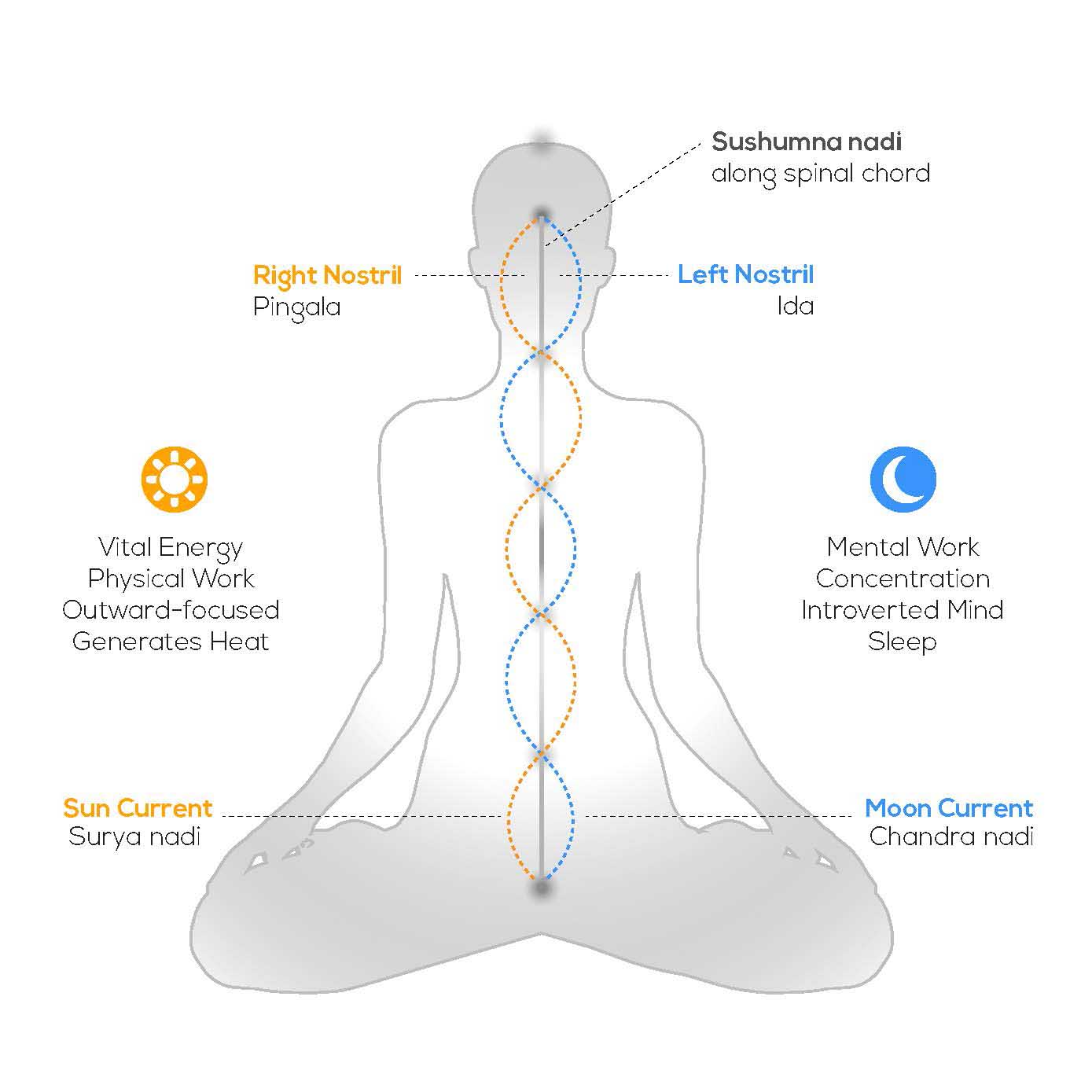
A nadi (Sanskrit: नाडी, nāḍī) is a channel in the subtle body of yoga, the pathway prana, the breath or life force, is said to travel along. The Sanskrit word means "tube", "pipe" or "channel". Hatha yoga texts describe thousands of nadis and name three as the most important: ida on the left, pingala on the right and sushumna in the centre, along the spine.
What does nadi mean?
In everyday Sanskrit, nāḍī is a hollow stalk, a tube or a pipe. The same word is used for a blood vessel, for a nerve and for the pulse at the wrist. Many yoga teachers also connect it to the root nad, "to flow" or "to sound", so a nadi becomes a stream. That link is popular, and linguists do not all agree on it. The plain meaning, a channel something moves through, is the safe one.
The plural is nadis. You will also meet the word outside yoga. In Ayurveda, nadi pariksha is pulse reading. In Tamil Nadu, nadi astrology is a practice of reading palm-leaf manuscripts. Neither has much to do with the energy channels of hatha yoga, but both use the same word.
Where the idea of nadis comes from
The oldest mentions are in the Upanishads, roughly 2,500 years old. The Brihadaranyaka Upanishad speaks of 72,000 channels that spread out from the heart. The Katha and Chandogya Upanishads describe 101 channels from the heart, and one of them leads up to the crown of the head. At that point the centre of the system is the heart.
Later, in the tantric texts and in medieval hatha yoga, the centre moves to the spine. The Hatha Yoga Pradipika (15th century) keeps the number 72,000 and makes sushumna the channel that matters most. The Shiva Samhita gives 350,000. Most texts then name ten or fourteen main nadis, and of those, three carry the whole practice.
The three main nadis: ida, pingala and sushumna
- Ida nadi, the left channel. It ends at the left nostril. The tradition calls it lunar: cooling, receptive, linked to the mind. In the Satyananda tradition ida carries manas shakti, mental energy.
- Pingala nadi, the right channel. It ends at the right nostril. Solar: warming, active, linked to the body and to action. Satyananda teachers say it carries prana shakti, vital energy.
- Sushumna nadi, the central channel. It runs inside the spine from its base up to the crown of the head. In hatha and tantric yoga, the goal of the practice is to bring prana out of ida and pingala and into sushumna. The rising of kundalini is described as happening here.
Most modern descriptions start ida and pingala at the base of the spine, at the root centre, muladhara. The popular picture has them crossing at each of the seven chakras like a double spiral. Older texts are less tidy. Some describe the two channels as arcs on either side of the spine, meeting only at the base and between the eyebrows. So if two teachers draw it differently, both have a source.
How nadis are worked with in practice
You cannot feel a nadi the way you feel a hamstring. What the tradition works with is the breath, the posture and attention. The texts say a channel can be blocked, and the practices are there to clear it.
- Breathing. Pranayama is the main tool. The Hatha Yoga Pradipika says the nadis must be purified before breath retention can do its work.
- Alternate nostril breathing. Nadi Shodhana means "channel purification". You breathe in through one nostril and out through the other, using your right hand to close each side in turn. Ida and pingala end at the nostrils, so this is the practice that addresses them most directly.
- Heating breaths. Right-nostril breathing, Bhastrika (bellows breath) and Kapalabhati are linked to pingala. Left-nostril breathing and Sitali, the cooling breath, to ida.
- Locks. The bandhas, such as Mula Bandha, the root lock, are described as sealing prana so it can enter sushumna.
- Stillness. Seated meditation after pranayama is where the texts expect sushumna to open.
A simple way to start: sit with your spine long. Close the right nostril with your thumb and breathe in through the left for a count of four. Close the left with your ring finger, open the right and breathe out for four. In on the right, switch, out on the left. That is one round. Ten rounds take about three minutes.
The nasal cycle: where tradition meets physiology
There is one place where the nadi model lines up with something you can measure. Most of the time one nostril carries more air than the other, and the dominant side switches every few hours. Physiologists call this the nasal cycle. It was described in medical literature in the 1890s, and it is driven by the autonomic nervous system swelling and shrinking the tissue inside each nostril. Hatha yogis noticed the same thing much earlier and read it as ida or pingala being active.
Try it now. Breathe out through your nose onto the back of your hand, one nostril at a time. One side will almost always feel stronger.
Are nadis real? Where the sources disagree
This is the question behind a lot of searches, and the honest answer depends on who you ask.
- The anatomist. No dissection has found 72,000 channels, and no structure matches sushumna inside the spine except the spinal cord itself. Nadis are not nerves, veins or meridians in any measurable sense.
- The writer looking for a bridge. Some compare ida and pingala to the two halves of the autonomic nervous system, one calming and one activating, and sushumna to the spinal cord. It is a useful teaching image. It is also a modern reading laid over old texts.
- The researcher. Studies on single-nostril and alternate nostril breathing report small effects on heart rate, blood pressure and attention. Most are small, short and hard to blind. Slow breathing through either nostril calms the nervous system. Whether the side matters is still an open question.
- The tradition. In yoga, the nadis are a map of experience: how the breath, attention and energy feel from the inside. A map does not have to be anatomy to help you find your way around a practice.
What we can say with confidence: the nadi system is a model from the yoga tradition, not a finding of anatomy. The practices built on it, slow and even breathing, one nostril at a time, are safe for most people and calm the breath and the mind. You do not need to believe in the channels to feel that.
If you want to practise it, the 15-minute Nadi Shodhana class for beginners takes you through alternate nostril breathing, and the eight-week Pranayama level 1 course adds a new breathing practice each week.
Frequently asked questions
What does nadis mean?
Nadis are the channels of the subtle body in yoga. The Sanskrit word nāḍī means tube, pipe or channel, and the tradition uses it for the pathways prana, the life force, is said to flow along.
What are the three main nadis?
Ida, the left and lunar channel, ending at the left nostril. Pingala, the right and solar channel, ending at the right nostril. Sushumna, the central channel inside the spine, where hatha yoga wants prana to flow.
How many nadis are there in the human body?
The number most often quoted is 72,000, from the Brihadaranyaka Upanishad and the Hatha Yoga Pradipika. Other texts give 101 or 350,000. Most name ten or fourteen as the main ones.
Are nadis the same as nerves?
No. The word nadi is also used for nerves and blood vessels, but the yogic nadis are subtle channels with no anatomical structure found for them. Some writers compare ida and pingala to the autonomic nervous system as a teaching image.
What is the difference between nadis and chakras?
Nadis are the channels, chakras are the centres where channels meet. In the usual picture, the chakras sit along sushumna, and ida and pingala meet around them on their way up the spine.
How do you balance ida and pingala?
The classic practice is Nadi Shodhana, alternate nostril breathing, with even counts on both sides. Slow, steady breathing through both nostrils and seated meditation afterwards are part of the same practice.
What does the word nadi mean in Ayurveda?
In Ayurveda, nadi is also the pulse. Nadi pariksha, pulse reading, is one of the ways an Ayurvedic practitioner assesses a person. It uses the same word as the yogic channels, but it is a separate practice.