Om (Aum) Mantra: Meaning, How to Chant It and a 10-Minute Class

Om (Sanskrit: ॐ, also written Aum) is the best-known mantra in yoga: a single syllable, chanted aloud or repeated silently, used to focus the mind before and during meditation. In the Upanishads it stands for Brahman, the whole of reality, and in the Yoga Sutras Patanjali calls it pranava, the word that expresses Ishvara. On the mat it is a long, steady sound on the exhale that ends in a hum and then silence.
What does Om mean?
Om has no dictionary meaning the way "tree" or "bow" does. It is a sacred syllable, and its meaning comes from how the texts use it.
- In the Upanishads, Om is a name for Brahman, the ground of everything. The Mandukya Upanishad opens with the line "Om is all this" and builds its whole teaching on the syllable.
- In the Yoga Sutras (1.27), Patanjali writes that the word expressing Ishvara, the special Self or inner teacher, is pranava. The next sutra (1.28) gives the practice: repeat it and reflect on its meaning.
- In the Bhagavad Gita (8.13), Krishna calls Om the one-syllable Brahman, to be remembered at the moment of death.
The word pranava comes from the Sanskrit root nu, to sound or to praise, with the prefix pra, forward. It is usually translated as "the sacred sound" or "the humming". You also hear omkara, "the syllable Om". Recitation of Om is called Pranava Japa: japa means repeating a mantra, often counted on a string of 108 beads.
Om or Aum: the three sounds and the silence
Both spellings are right. In Sanskrit, the vowels a and u merge into o when they meet, so A + U + M is written and heard as Om. Writing Aum shows the parts. Chanting slowly lets you hear them.
- A ("ahh"): the mouth open, the sound at the back of the throat.
- U ("ooh"): the lips round and the sound moves forward over the tongue.
- M ("mmm"): the lips close. You feel the hum in the lips, the teeth and the bones of the face.
- The silence after the M: the sound fades and you stay with the quiet before the next breath.
The Mandukya Upanishad gives each part a meaning. A is the waking state, U the dream state, M deep sleep without dreams. The silence is the fourth, turiya, pure awareness that holds the other three. The Upanishad calls it amatra, "without measure", because it has no sound of its own. Many modern teachers add their own readings to each syllable. Those can be useful for a meditation, but they come from the teacher, not from the text.
How to chant Om
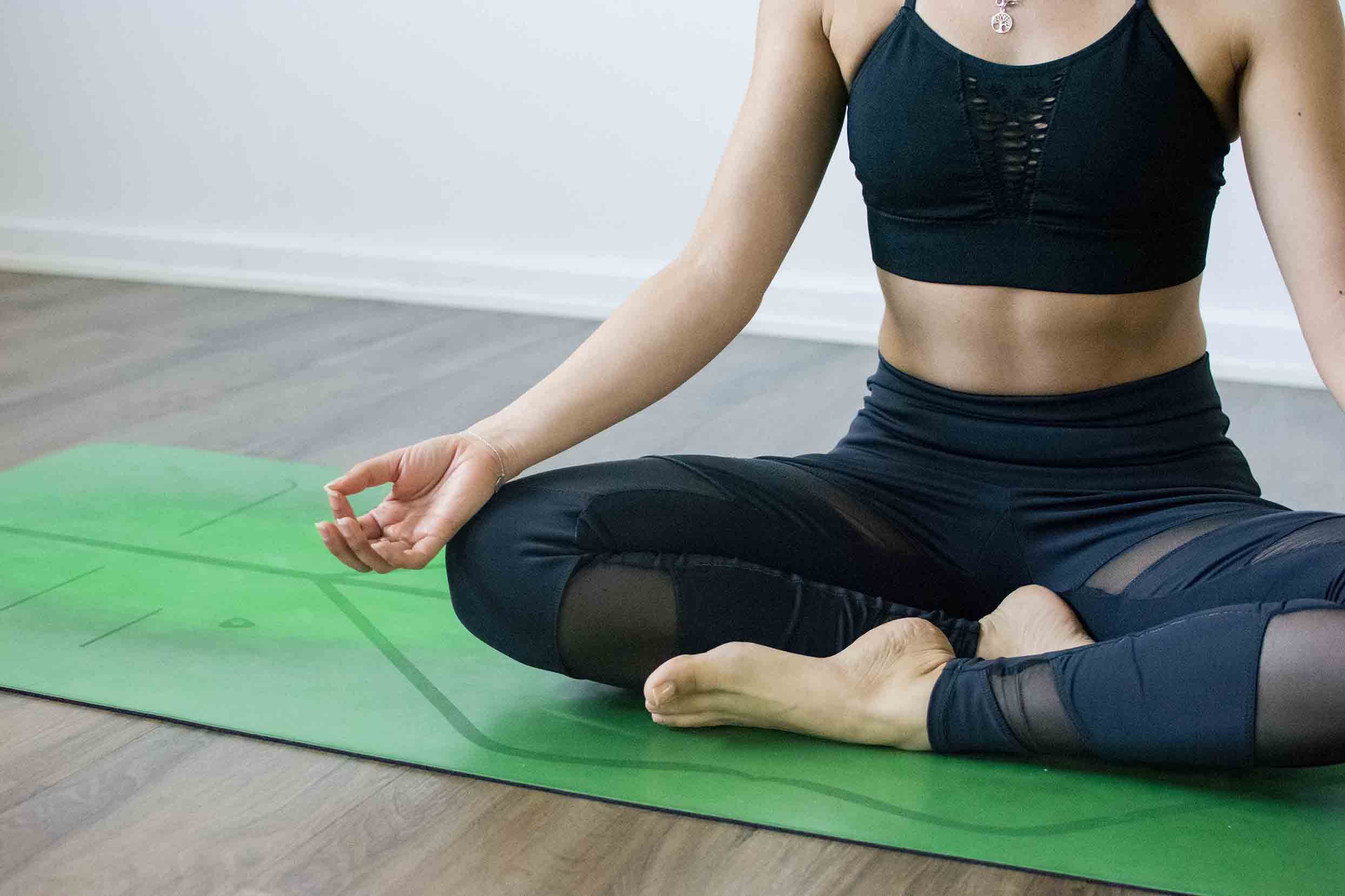
Om works best seated with a long spine. Sukhasana (Easy Pose) on a folded blanket is enough. A chair is fine too.
- Sit tall. Let your hands rest on your thighs, palms up or down, or in one of the classic yoga mudras such as Jnana Mudra.
- Close your eyes and take a few calm breaths through the nose.
- Inhale fully, without forcing.
- On the exhale, open the mouth for A, round the lips for U, close them for M. A common split is about a quarter of the breath on A, a quarter on U and half on the M.
- When the breath runs out, stop. Sit in the silence for one or two breaths.
- Repeat three times to start or close a practice, or for five to ten minutes as a meditation.
Keep the pitch comfortable and low enough that the throat stays soft. Volume does not matter. When you chant with a group, listen for the room and blend in. For silent japa, you repeat Om in the mind on each exhale, and a mala keeps count.
Om also opens other chants. The Ashtanga opening and closing mantras begin and end with it, and so does Om shanti shanti shanti, the chant for peace. In many studios the class then ends with a spoken namaste, which means "I bow to you".
What happens when you chant Om
Chanting Om slows your breathing. The exhale gets long, often ten seconds or more, and a long exhale shifts the nervous system toward rest. That part is plain physiology and you will feel it within a few rounds.
The M is a hum, and humming has one well-documented effect: a study from the Karolinska Institute in 2002 measured a large rise in nitric oxide in the nose during humming compared with quiet breathing. The same hum is the core of Bhramari, the humming bee breath.
Research on Om itself is young and small. One fMRI study from India (2011) scanned 12 people and found reduced activity in parts of the limbic system while they chanted Om, compared with making a steady "sss" sound. Other small studies report changes in heart rate variability. These results fit what practitioners describe, a quieter mind, but they are not strong enough to make medical claims. Om is a focus for attention. That is a good enough reason to practise it.
If you want to learn it with a teacher, Om is part of our pranayama classes and sits well at the start of any meditation practice.
Where the sources disagree
Om carries a lot of claims. Some come from the texts, some from studios and some from the internet.
- "Om is the sound of the universe." In the Upanishads, Om stands for all that exists. That is a philosophical and religious teaching. It is not a statement about physics. The viral story that NASA recorded the sun humming Om is false: the space agency has released sonified solar data, and none of it is Om.
- Om at 432 Hz or 7.83 Hz. Om has no fixed pitch. Every voice chants it at its own note, and the frequency claims you see on chanting videos have no basis in the tradition or in research.
- "Patanjali called Om the highest meditation." The Yoga Sutras are more modest. Om appears in the section on devotion to Ishvara (Ishvara pranidhana, 1.23-1.29), as one path to a still mind among several. Ishvara pranidhana is also one of the five niyamas.
- Is it religious? Om is sacred in Hinduism, Buddhism and Jainism, and Sikhism has a related form, Ik Onkar. In a yoga class it is often used as a sound for focus. Both are true at once. Chant it with respect for where it comes from, and feel free to stay quiet if it does not sit right with you.
What holds up: Om is among the oldest mantras we know, it slows the breath, and its sound gives the mind one thing to follow. For more of the words you hear in class, see our 50 Sanskrit yoga terms and what a sutra is.
Try it: a 10-minute Om class with Guy Powiecki
Guy teaches Pranava Japa with the focus on the vibration of the sound. It works well after pranayama or on its own. Level 1-2, no props needed.
You can also take the full class, OM Mantra: 10-min Pranava Japa, in the class library, and read the texts behind it in our introduction to the Yoga Sutras of Patanjali.
Frequently asked questions
What is the mantra Om?
Om (Aum) is a sacred Sanskrit syllable, chanted aloud or repeated silently in yoga and meditation. The Upanishads use it as a name for Brahman, the whole of reality, and the Yoga Sutras call it pranava, the word that expresses Ishvara.
What happens when you chant Om?
Your exhale gets long and slow, which moves the nervous system toward rest, and the closing hum gives your attention a sound to follow. Small studies suggest calming effects on the brain and heart rate, but the research is early.
Is it Om or Aum?
Both. In Sanskrit, a and u merge into o, so A + U + M is pronounced Om. The spelling Aum shows the three sounds you hear when you chant it slowly, followed by a silence.
What is the Om prayer?
Om is not a prayer on its own, but it opens and closes many prayers and chants. A common one in yoga is Om shanti shanti shanti, a chant for peace. The Ashtanga opening and closing mantras also begin and end with Om.
Which mantra is the most powerful mantra?
Traditions rank mantras differently, so there is no single answer. In Hindu texts Om is called the root of all mantras, and many others start with it, such as the Gayatri Mantra and Om Namah Shivaya.
How many times should you chant Om?
Three times is a common way to open or close a yoga class. For japa, people often count 108 repetitions on a mala. A few minutes of slow, steady chanting is enough to start.
Can anyone chant Om?
Yes. You need no initiation to chant Om in a yoga class. It is a sacred syllable in several religions, so chant it with care, and if it does not fit your own beliefs, you can sit in silence and follow your breath.