Bhujangasana (Cobra Pose): How to Do It Step by Step

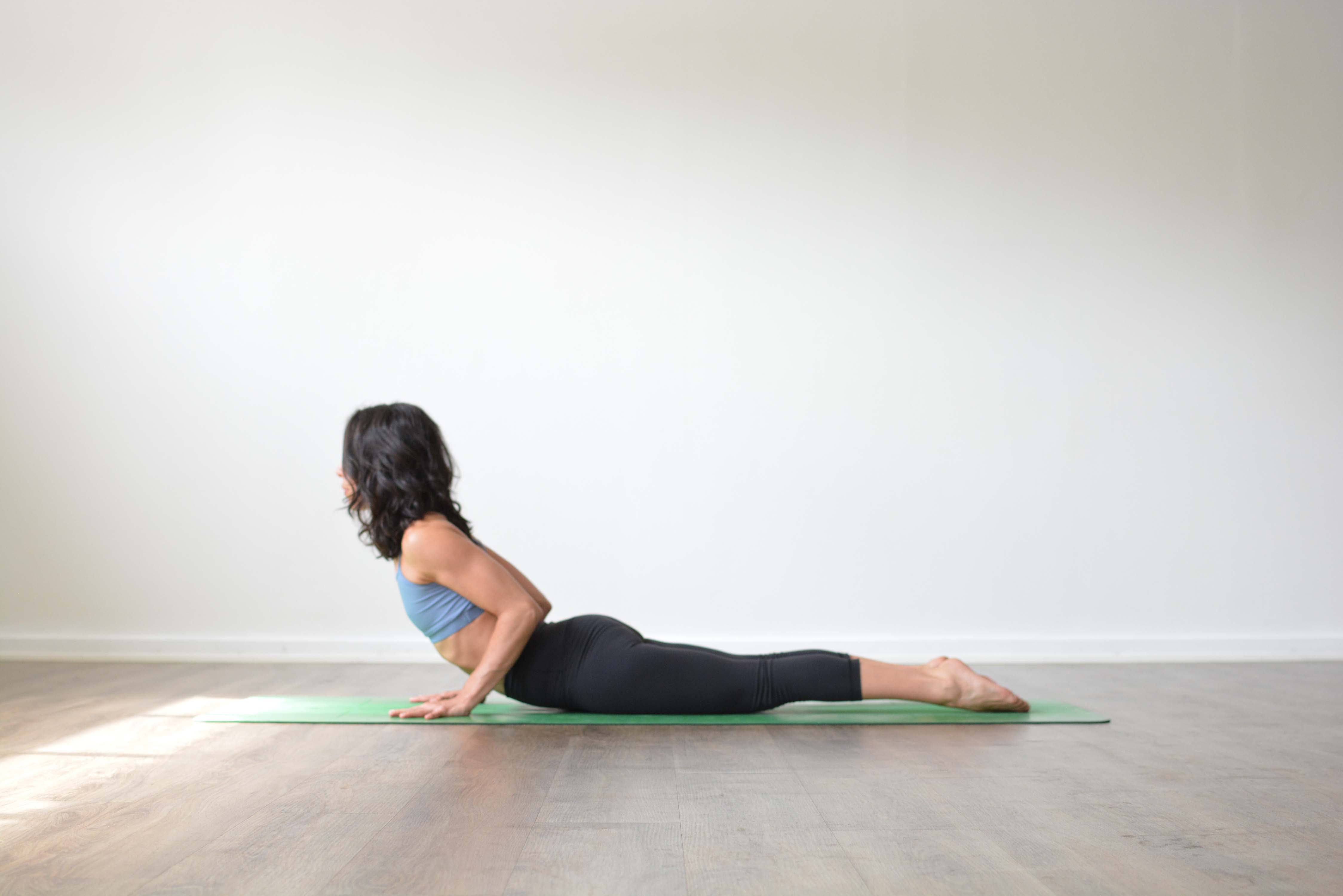
Bhujangasana (Cobra Pose) is a beginner backbend done lying on your belly: you press your hands into the floor and lift your head and chest while your hips and legs stay down. Bhujanga is Sanskrit for serpent, and the shape looks like a cobra with its hood raised. It works the muscles along the spine and stretches the front of the body, and you will meet it in Hatha classes and in many Sun Salutations.
Pose type: prone backbend. Level: beginner, new to yoga is fine. Props: none. A folded blanket under the hips if the floor is hard.
How to do Cobra Pose, step by step
- Lie on your belly with your forehead on the mat. Legs hip-width apart, tops of the feet on the floor, toes pointing straight back.
- Place your hands flat beside your lower ribs, fingers pointing forward. Bend your elbows and draw them in against your sides.
- Press the tops of the feet, the fronts of the thighs and the pubic bone into the floor. Reach back through your toes, as if someone were drawing your legs long.
- Inhale and lift your head and chest. Let the muscles of your back do most of the lifting. The hands press lightly, for support.
- Draw your shoulders back and away from your ears and widen across the collarbones. Keep the elbows bent for Low Cobra, or straighten them partway as long as the pubic bone stays on the floor.
- Keep the back of the neck long and look forward or slightly down. Stay for 3-5 slow breaths.
- Exhale and lower down with control, first the chest, then the forehead. Turn your head to one side and rest. Repeat two or three times.
A test worth doing: once you are up, lift your hands off the floor for a breath. The height you can hold without them is the height your back can make on its own. Put the hands back down and stay close to that height, pressing lightly.
Cobra Pose vs Upward-Facing Dog
The two look alike and get mixed up in class. In Cobra the legs and hips stay on the floor, the elbows usually stay bent, and the back does the work. In Urdhva Mukha Svanasana (Upward-Facing Dog) the arms are straight and the thighs and knees lift off the floor, so only the hands and the tops of the feet touch the mat.
Which one you do in a Sun Salutation depends on the style. The classic twelve-step Surya Namaskar taught in many Hatha schools uses Cobra. Surya Namaskar A in Ashtanga and Vinyasa uses Upward-Facing Dog, after Chaturanga Dandasana. Many teachers offer Cobra as the gentler option in either.
Benefits of Cobra Pose
- Works the back of the body. Lifting the chest against gravity uses the muscles that run along the spine, the erector spinae, and the muscles between the shoulder blades.
- Stretches the front. The chest, the fronts of the shoulders and the abdominal wall lengthen as the spine extends.
- A counter to sitting. After hours bent over a desk or a phone, a few rounds of Cobra move the spine in the opposite direction.
Some physiotherapists use a similar movement, the prone press-up, for certain kinds of lower back pain. Whether it helps depends on the cause of the pain, so if your back hurts, have it assessed before you use Cobra as a remedy.
You may read that Cobra massages the abdominal organs, opens the lungs or awakens energy. The oldest description of the pose, in the 17th-century Gheranda Samhita, says it raises the body's heat, destroys disease and awakens Kundalini, the serpent energy. That is where the tradition comes from. No study backs these claims, and we do not make them.
Who should skip or modify Cobra Pose
- Back pain that gets worse when you bend backward, or pain that runs down a leg: skip the pose and see a physiotherapist or doctor.
- A known back condition such as spondylolisthesis or a recent disc injury: ask your physiotherapist which backbends suit you.
- Pregnancy: once lying on your belly is uncomfortable, stop. A gentle backbend on all fours or standing works instead.
- Recent surgery on the abdomen: wait until your doctor clears you for lying on your front.
- Sore wrists: come down onto your forearms in Sphinx Pose.
- Neck problems: keep the gaze down and the neck in line with the spine.
Common mistakes
- Pushing up with straight arms. The arms lift you higher than your back can, and the bend piles up in the lower back. Bend the elbows and come down a little.
- Shoulders up by the ears. Draw them back and down before you lift.
- Throwing the head back. The neck is the most flexible part of the spine and bends first. Keep it long.
- Hips lifting off the floor. Then you are halfway to Upward-Facing Dog without the arm strength to hold it. Keep the pubic bone down.
- Elbows winging out. Keep them close to your sides.
- Holding the breath. Lift on an inhale, stay with slow, even breaths, lower on an exhale.
What to do with the buttocks is a question teachers answer differently. Some ask you to firm them to protect the lower back. Others ask you to keep them soft so the lower back does not jam. Firm legs, with the buttocks engaged but not clenched, work for most bodies. If you feel pinching in the lower back, try less.
Preparatory poses
- Sphinx Pose (Salamba Bhujangasana): the same shape on the forearms, gentler on the back and wrists.
- Salabhasana (Locust Pose): builds strength in the back muscles without help from the arms.
- Anjaneyasana (Low Lunge): opens the front of the hips, so the lower back bends less. Our article on the hip flexors and the psoas explains why that matters in backbends.
- Setu Bandha Sarvangasana (Bridge Pose): a backbend on your back, with the weight in your feet and shoulders.
Follow-up poses
- Dhanurasana (Bow Pose): the next prone backbend, holding the ankles.
- Ustrasana (Camel Pose): a deeper backbend from the knees.
- Urdhva Dhanurasana (Wheel Pose): the full backbend, once the smaller ones feel easy.
- Balasana (Child's Pose): rest here after Cobra, with the back rounded the other way.
Variations of Bhujangasana
- Sphinx Pose: forearms on the floor, elbows under the shoulders.
- Low Cobra: the chest lifts only a few centimetres. Try it with the hands hovering off the floor.
- Full Cobra: hands a little further forward, arms straighter and the chest lifted high, with the pubic bone still on the floor. Only for a back that already bends freely.
- Cobra at a chair: if lying on the floor does not work for you, stand facing a chair braced against a wall, hold its front edge and lift the chest between straight arms.
- Raja Bhujangasana (King Cobra): an advanced form in which the knees bend and the feet reach toward the head.
Gaze and bandha: some lineages look up (Urdhva Drishti) in the full pose. For most students a gaze forward, with a long neck, is safer. A light Mula Bandha, the root lock, helps you keep the lower belly engaged.
Lizette Pompa's class Move into Backbends takes you into backbends step by step, with two blocks and a focus on protecting the lower back. It is a level 1 class.
Frequently asked questions
What is the Cobra Pose good for?
Cobra Pose strengthens the muscles along the spine and stretches the chest, the fronts of the shoulders and the abdomen. It is a gentle way to bend the spine backward, and a good counter to long hours of sitting.
Who should not do Cobra Pose?
Skip or modify it if you have back pain that gets worse when you bend backward, a recent back or abdominal injury or surgery, sore wrists, or if you are pregnant and lying on your belly is uncomfortable. Sphinx Pose on the forearms is the gentler option.
Does Cobra Pose reduce belly fat?
No. No single exercise burns fat from one area of the body. Cobra works the back and stretches the front of the body, but losing belly fat depends on your overall activity and diet.
Does Cobra Pose increase height?
No. Adult height is set by your bones. Cobra and other backbends can help you stand more upright, which can make you look taller, but they do not make you grow.
How long should you hold Bhujangasana?
Hold for 3-5 slow breaths, about 15-30 seconds, then lower down and rest. Two or three rounds are better than one long hold, especially when you are new to the pose.
What is the difference between Cobra and Upward-Facing Dog?
In Cobra the hips and legs stay on the floor and the elbows are usually bent. In Upward-Facing Dog the arms are straight and the thighs lift, so only the hands and the tops of the feet touch the floor.
Practise it with a teacher
Over 600 online yoga classes and programs for $4.99 a month. Cancel any time.
Become a member