Chaturanga Dandasana (Four-Limbed Staff Pose): How to Do It Step by Step

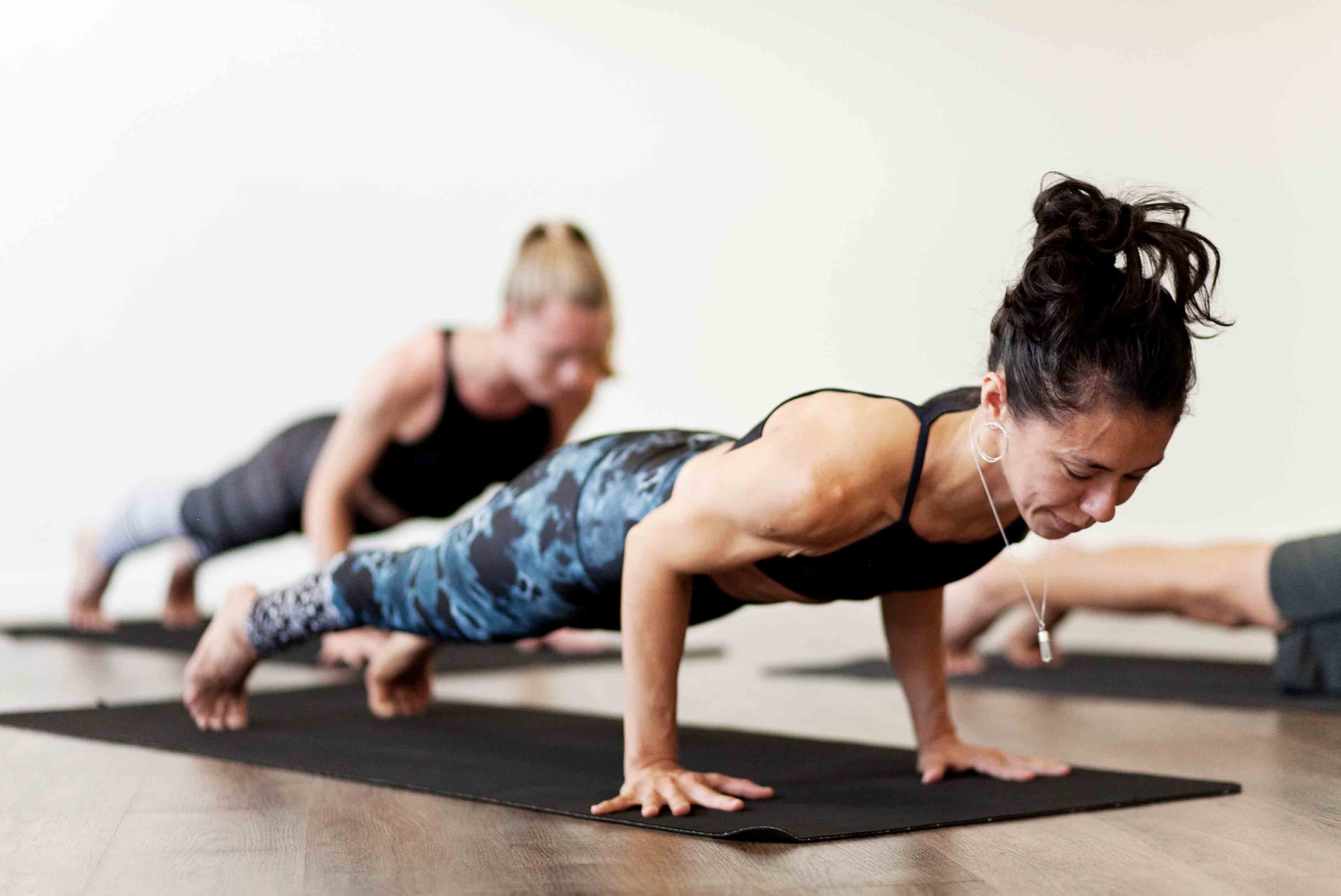
Chaturanga Dandasana (Four-Limbed Staff Pose) is a low plank: you balance on your hands and toes with the elbows bent and the body held in one straight line, a few centimetres above the floor. It is the lowering move in every Sun Salutation, between Plank Pose and Upward-Facing Dog, so in a vinyasa class you may do it twenty times or more. Done well, it builds strength in the arms, chest, shoulders and trunk. Done tired, it is one of the most common ways to strain a shoulder in yoga.
Pose type: arm-supported, strength, transition. Level: intermediate, with knees-down and wall versions for beginners. Props: none needed; two blocks or a strap help while you learn.
What Chaturanga Dandasana means
The name has four Sanskrit parts: chatur, four, anga, limb, danda, staff or stick, and asana, posture. Four limbs touch the floor, and the body between them stays as rigid as a staff. Chaturanga on its own is an old word with other lives: it named the four divisions of an ancient Indian army, and a board game built on that army, which is usually counted as an ancestor of chess.
Dandasana (Staff Pose) is a different pose. There you sit on the floor with the legs straight out in front and the spine upright. Both poses share the idea of a straight, firm staff, once sitting and once held off the floor.
How to do Chaturanga Dandasana, step by step
Learn it from Plank first. Lowering from a strong plank teaches the shape, and it is the way you will meet the pose in a flow.
- Come into Plank Pose: hands under the shoulders, fingers spread wide, weight on the base of the index finger and thumb as well as the outer hand. Heels press back, legs firm, tailbone toward the heels.
- Draw your lower belly in and keep the ribs from sagging toward the floor. The line from head to heels stays straight.
- Shift forward on your toes, so your shoulders move a few centimetres in front of your wrists. Without this shift, your forearms cannot end up vertical.
- Breathe out and bend your elbows straight back, hugging them in toward the sides of your ribs. Lower the whole body in one piece.
- Stop when your shoulders reach the height of your elbows, or a little above. Upper arms parallel to the floor is the most you need. The chest stays broad and the collarbones wide.
- Keep your gaze on the floor a little in front of your hands, so the back of the neck stays long.
- Stay for one breath in a flow, or for three to five breaths when you practise it on its own. Then roll over the toes into Upward-Facing Dog, press back to Plank, or lower all the way to the floor.
If the shoulders drop below the elbows or the hips sag, lower your knees to the mat and do the rest of the round there. A knees-down Chaturanga with good shoulders trains more than a full one that collapses.
Benefits of Chaturanga Dandasana
Chaturanga is a slow, controlled push-up held at the bottom. The work is easy to name:
- Arms and chest: the triceps and the pectoral muscles hold you up against gravity as the elbows bend.
- Shoulders: the front of the shoulder and the serratus anterior, the muscle along the side ribs, keep the shoulder blades steady on the back.
- Trunk: the abdominal muscles and the muscles along the spine hold the body straight like a plank, only harder, because the arms give less support.
- Legs: firm thighs and active feet keep the hips level with the shoulders.
That strength carries over. The bent-elbow shelf of Chaturanga is the arm position you use in Bakasana (Crow Pose) and Parsva Bakasana (Side Crow). As a weight-bearing exercise it also loads the wrists and arms, which strength training in general does for bones and muscles. That is the honest list. Claims about digestion or energy belong to the marketing, not to the pose.
Who should skip or modify Chaturanga
- Shoulder pain or a shoulder injury: repeated Chaturanga with the shoulders dipping forward loads the front of the shoulder and the rotator cuff. Practise with knees down, stop higher, or skip it and go from Plank straight to the floor, until a physiotherapist has cleared you.
- Wrist problems or carpal tunnel syndrome: the wrists bear a lot of weight at a sharp angle. Try the wall version, or come onto your fists or forearms.
- Pregnancy: in the second and third trimester most prenatal teachers leave Chaturanga out or keep the knees down, because it asks for strong abdominal work and a lowering toward the belly. Follow your midwife's or doctor's advice.
- High blood pressure and heart conditions: avoid holding the breath in long holds. Keep the breath moving and the holds short.
- New to yoga: you do not need full Chaturanga in your first months. Knees-down is a complete pose.
More on practising without injury in our 10 tips to avoid yoga injuries.
Common mistakes
- Shoulders lower than the elbows. The top of the upper arm rolls forward and the front of the shoulder takes the load. Stop higher.
- Elbows flaring out. Hug them in toward the ribs, pointing back toward the heels. A strap around the upper arms shows you where they want to go.
- Sagging hips or a lifted bottom. Either one means the trunk has let go. Firm the legs, draw the belly in, or put the knees down.
- No forward shift. If the shoulders stay over the wrists, the forearms tilt back and the lowering turns into a fall.
- Lowering all the way to the floor and calling it Chaturanga. Landing on your chest is fine as a modification. It is a different move.
- Holding the breath. Breathe out as you lower. In a flow, one exhale is the whole pose.
- Doing every round full out when you are tired. Late in a class, form goes first. Knees down for the last rounds is good practice.
Where teachers disagree
Ask five teachers about Chaturanga and you will hear two different shoulder cues. Some say to draw the shoulder blades together on the back, the older and more common cue. Others ask you to keep the shoulder blades broad and pushing the floor away, because squeezing them together can let the chest sink between the arms. Both are after the same thing: shoulders that stay at elbow height and do not roll forward. Try both and keep the one that holds your shoulders up.
The depth of the pose is argued too. The classic picture, from B.K.S. Iyengar's Light on Yoga, has the body a few centimetres above the floor. Many vinyasa teachers now teach a half-way Chaturanga, elbows bent less than 90 degrees, to protect the shoulders across dozens of repetitions. For most people who practise often, the higher version is the safer habit.
The pose itself is not old. Chaturanga Dandasana does not appear in the Hatha Yoga Pradipika or the older hatha texts. It comes to us through the 20th century, from T. Krishnamacharya's teaching in Mysore and the Ashtanga and Iyengar lineages that grew from it.
Preparatory poses
- Plank Pose: the starting position, and the place to learn a straight, firm trunk.
- Vasisthasana (Side Plank): shoulder stability on one arm at a time.
- Adho Mukha Svanasana (Downward-Facing Dog): weight in the hands and shoulders that press the floor away.
- Knees-down Chaturanga and slow push-ups against a wall: the same movement with less load.
The ten-minute class Stronger Wrists gets the wrists ready for Plank and Chaturanga.
Follow-up poses
- Urdhva Mukha Svanasana (Upward-Facing Dog): the next pose in the Sun Salutation.
- Bhujangasana (Cobra Pose): the gentler backbend after lowering to the floor.
- Downward-Facing Dog: rest for the arms after the push.
You meet all three, in order, in Surya Namaskar A and Surya Namaskar B, the base of Vinyasa Flow classes.
Chaturanga variations
- Knees down: lower from a plank on the knees. Same arms and shoulders, half the load.
- At the wall: stand facing a wall, hands a little below shoulder height, and bend the elbows back along the ribs. Good for learning the arm path, and kind to sore wrists.
- With blocks: two blocks under the shoulders, set so you stop with the shoulders at elbow height. The blocks tell you when to stop.
- With a strap: a loop around the upper arms, above the elbows, at shoulder width. It keeps the elbows in and gives you a shelf to rest on.
- One leg lifted: for the strong. Lift one leg from Plank, lower with the leg up, and change sides on the next round.
Lizette Pompa's Vinyasa Fundamentals Day 2 works on Plank, Chaturanga and Upward-Facing Dog with two blocks, and the five-minute Short Chaturanga Tutorial gives you the key cues in one go.
Frequently asked questions
How do you do Chaturanga Dandasana step by step?
Start in Plank with your hands under your shoulders. Shift forward on your toes, then breathe out and bend your elbows straight back, close to your ribs. Lower the whole body in one line and stop when your shoulders reach elbow height. Then move on to Upward-Facing Dog or press back to Plank.
Is Chaturanga Dandasana hard?
Yes, for most people it is one of the harder poses in a beginner class. It takes strength in the arms, chest and trunk, and control to stop at the right height. Start with your knees down or at a wall. Most people build a steady full Chaturanga over weeks or months of regular practice.
What is the difference between Chaturanga Dandasana and Dandasana?
Dandasana, Staff Pose, is a seated pose with the legs straight out in front of you and the spine upright. Chaturanga Dandasana, Four-Limbed Staff Pose, is a low plank held on the hands and toes. Both use the image of a straight staff: once sitting, once held off the floor.
What is the difference between Vinyasa and Chaturanga Dandasana?
Chaturanga is one pose. A vinyasa, in a class, usually means a short linking sequence, Plank to Chaturanga to Upward-Facing Dog to Downward-Facing Dog, done with the breath between other poses. Chaturanga is the lowering part of that sequence. Vinyasa is also the name of a flowing style of yoga.
How low should you go in Chaturanga?
Stop when your shoulders are level with your elbows, or a little higher. Going lower lets the shoulders roll forward and puts the load on the front of the shoulder joint. Many teachers now teach a half-way Chaturanga for people who practise vinyasa often.
Is Chaturanga bad for your shoulders?
The pose itself is not the problem. Repeating it with the shoulders dropping below the elbows is. Stop at elbow height, keep the elbows in, and lower your knees when you get tired. With shoulder pain, skip it until a physiotherapist has looked at it.
Should you do Chaturanga with knees down?
Yes, whenever you cannot keep the shoulders at elbow height and the body straight. Knees-down Chaturanga trains the same arm path and the same shoulder position with less weight, and it is the way most people build up to the full pose.
Practise it with a teacher
Over 600 online yoga classes and programs for $4.99 a month. Cancel any time.
Become a member