Padangusthasana (Big Toe Pose): How to Do It Step by Step

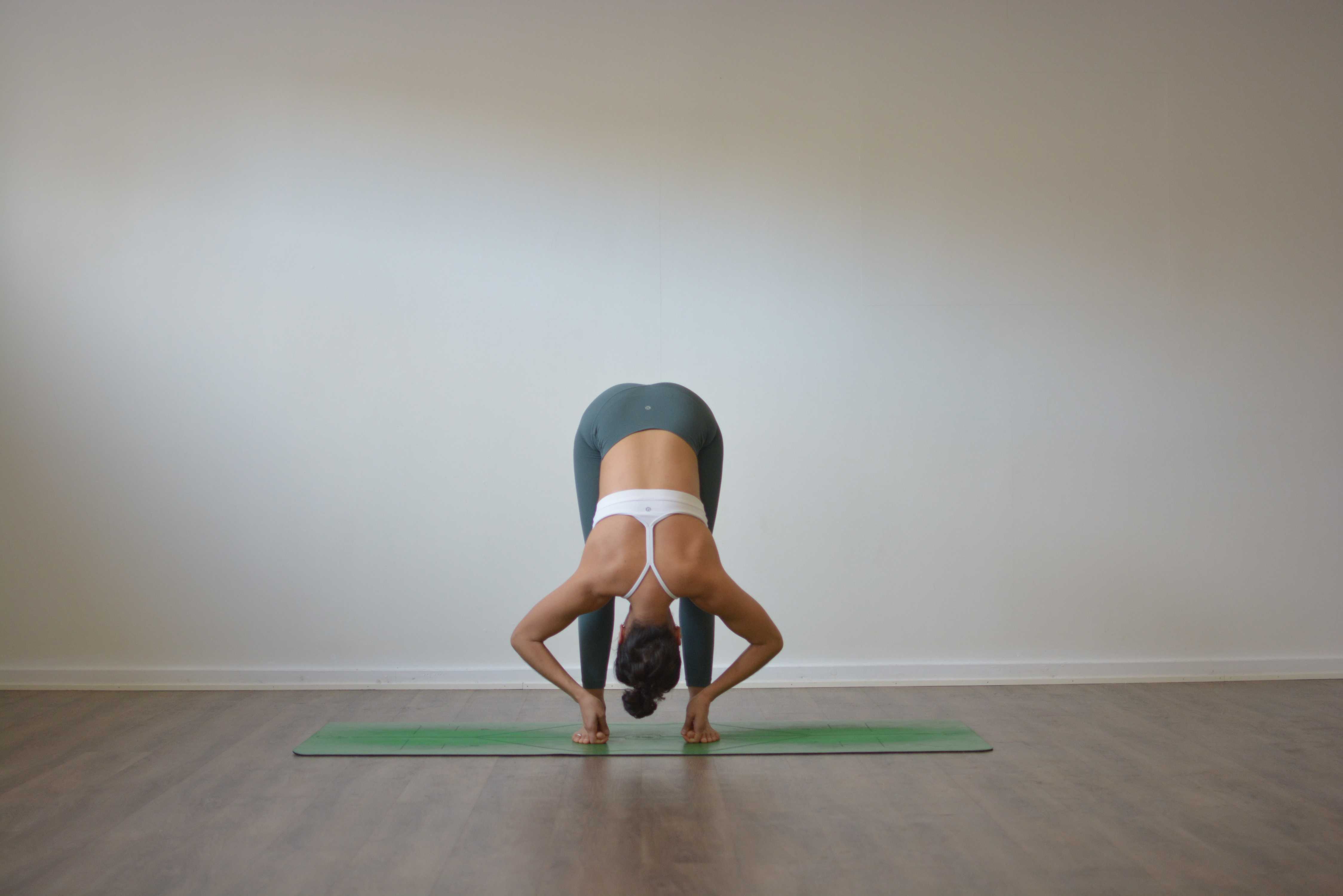
Padangusthasana (Big Toe Pose) is a standing forward bend in which you fold from the hips and hold your big toes with the first two fingers and thumb of each hand. It stretches the whole back of the legs, from the heels to the sitting bones. In Ashtanga Vinyasa it is the first standing posture after the Sun Salutations, and it comes directly before Padahastasana (Hand Under Foot Pose).
Pose type: standing forward bend. Level: beginner to intermediate. Props: a strap if you cannot reach your toes, optional blocks under the hands.
What Padangusthasana means
The name has three parts: pada, foot, angustha, big toe (the same word is used for the thumb), and asana, posture. So the name describes the grip: the foot's big toe held in the hand. You will also see it spelled Padangustasana, and that spelling causes a mix-up. In Bikram and Hot 26 classes, "Padangustasana" is the name of a balancing squat on the toes of one foot, which we cover in our guide to the Toe Stand Pose. It is a different pose.
How to do Padangusthasana, step by step
Do this after a few rounds of Surya Namaskar A or another warm-up. Cold hamstrings do not like a deep fold.
- Stand in Tadasana (Mountain Pose), then step your feet hip-width apart, outer edges parallel. Put your hands on your hips.
- Breathe out and fold forward from the hip joints, not from the waist. Think of the pelvis tipping forward over the tops of the thighs, with the front of the body long.
- Hook the index and middle fingers of each hand around your big toes from the inside, and close the thumbs over them. Press the toes down into the fingers a little so the grip is firm.
- Breathe in and lift your chest and head halfway up. Straighten your arms, lengthen the spine and look forward. The lower back flattens or curves slightly inward.
- Breathe out and fold again. Bend the elbows out to the sides, pull lightly on the toes and let the crown of the head move toward the floor. Keep the neck soft.
- Stay for five slow breaths. On each inhale, lengthen the front of the body. On each exhale, fold a little further from the hips.
- To come out, breathe in and lift halfway with straight arms. Let go of the toes, put your hands back on your hips and come up to standing with a long back.
Lift the kneecaps by firming the front thighs, but do not lock the knees back. If your legs are hypermobile, keep a micro-bend so the stretch stays in the muscles and not in the back of the knee joint.
Padangusthasana in Ashtanga
In the Ashtanga Primary Series the pose is counted in vinyasas: on the inhale you take the toes and look up, on the exhale you fold and stay for five breaths, and on the next inhale you lift halfway before moving straight into Padahastasana. The drishti, the gaze point, is the tip of the nose.
Benefits of Big Toe Pose
The main effect is a stretch along the back of the body. Folding forward with straight legs lengthens the hamstrings and the calves, and the pull on the toes lets you use the arms to move deeper instead of dropping your weight into the lower back.
- Hamstrings and calves: a long, steady stretch, stronger than in a fold with the hands on the floor, because the grip lets you draw the chest toward the legs.
- Hip hinge: it teaches you to bend from the hip joints, which is the same movement you use in every standing forward bend and when you lift something off the floor.
- Legs: the front thighs work to keep the knees straight, which helps the hamstrings let go.
B.K.S. Iyengar writes in Light on Yoga that the pose tones the abdominal organs and helps digestion. That is the tradition's view, and no study has tested it. The old version of this article also said the pose is good for flat feet. We could not find anything to support that, so it is gone.
Who should skip or modify Padangusthasana
- Lower back or disc problems: a deep fold with a rounded spine puts pressure on the front of the lumbar discs. Bend the knees generously, keep the back long, or choose half the fold with your hands on your shins or on blocks.
- Osteoporosis: loaded forward flexion of the spine is linked to a higher risk of vertebral fractures. Stay with a flat-back half fold, hands on the thighs or a chair.
- High blood pressure, glaucoma or dizziness: the head goes below the heart. Keep the head above the hips in a half fold and come up slowly.
- Hamstring injury: a strain close to the sitting bone needs rest from deep stretching. Ask your physiotherapist when you can fold again.
- Pregnancy: widen the feet so there is room for the belly, and use a half fold with a flat back.
More on this in our 10 tips to avoid yoga injuries.
Common mistakes
- Rounding from the waist. If the fold comes from the lower back, the hamstrings get less of the stretch and the spine takes the strain. Bend the knees until the pelvis can tip forward.
- Straight legs at any cost. Older instructions, including the first version of this article, say never bend the knees. Most teachers today let you bend them as much as you need to keep the back long. Straighten them over time.
- Pulling the shoulders up to the ears. Bend the elbows out to the sides and draw the shoulder blades up the back, toward the hips.
- Weight in the heels. Shift forward until the weight is over the balls of the feet. The hips stay above the heels.
- Hanging the head. A heavy head strains the neck. Keep the back of the neck long, in line with the spine.
Preparatory poses
- Adho Mukha Svanasana (Downward-Facing Dog): lengthens the calves and hamstrings with the arms taking part of the weight.
- Paschimottanasana (Seated Forward Bend): the same fold seated, without gravity pulling you down.
- Supta Padangusthasana (Reclining Hand to Big Toe Pose): one leg at a time, lying on your back with a strap. The kindest hamstring stretch there is for the lower back.
- Uttanasana (Standing Forward Bend): the same shape with the hands on the floor or on blocks.
- Prasarita Padottanasana (Wide-Legged Forward Bend): a wider base makes the fold easier to control.
Follow-up poses
- Padahastasana (Hand Under Foot Pose): the next posture in Ashtanga, with the hands slid under the feet.
- Trikonasana (Triangle Pose): the next standing pose in the Ashtanga sequence, taking the hamstring stretch to one leg.
- Utkatasana (Chair Pose): works the front of the thighs after the long stretch at the back.
Padangusthasana variations
- With a strap: loop a strap under the balls of both feet and hold it with straight arms. Walk the hands down the strap over the weeks.
- Bent knees: bend both knees until your fingers reach the toes, then lengthen the spine before you straighten the legs a little on each exhale.
- Utthita Hasta Padangusthasana (Extended Hand to Big Toe Pose): a standing balance. You hold the big toe of one foot with the hand on the same side and extend the leg forward, then out to the side. Holding the foot with the opposite hand turns it into the revolved form, Parivrtta Hasta Padangusthasana.
Padangusthasana opens the standing sequence in Complete All the Standing Postures, a 45-minute Ashtanga class at level 1-2. New to Ashtanga? Start with Sofia Soori's Ashtanga Vinyasa Intro or browse our Ashtanga classes.
Frequently asked questions
What is Padangusthasana?
Padangusthasana, or Big Toe Pose, is a standing forward bend with the feet hip-width apart, in which you hold your big toes with the first two fingers and thumbs. It stretches the hamstrings and calves, and it is the first standing posture of the Ashtanga Primary Series.
What is the difference between Padahastasana and Padangusthasana?
Both are standing forward bends with the feet hip-width apart. In Padangusthasana you hold your big toes. In Padahastasana you slide your hands under your feet, palms up, so the toes reach the wrists. The hand position pulls you deeper, which makes Padahastasana the stronger stretch. In Ashtanga they are done one after the other.
How do you do Padangusthasana step by step?
Stand with the feet hip-width apart. Fold from the hips and hold your big toes with two fingers and the thumb. Inhale and lift halfway with a long back. Exhale, bend the elbows out and fold. Stay for five breaths, then lift halfway, let go and come up.
Is Padangusthasana good for beginners?
Yes, with bent knees or a strap. Most beginners cannot reach their toes with straight legs and a long back, and that is fine. Bend the knees as much as you need, keep the fold in the hips and straighten the legs a little more over weeks of practice.
How long should you hold Big Toe Pose?
In Ashtanga you hold it for five breaths. In a slower Hatha class you can stay for 30 seconds to a minute. Longer holds give the hamstrings more time to lengthen, but come up if you feel pain behind the knee or in the lower back.
What if I cannot reach my toes?
Bend your knees until you can, or loop a strap under the balls of your feet and hold that. Pulling your back into a round shape to reach the toes moves the stretch from the hamstrings to the lower back, which is the opposite of what the pose asks for.