Yoga Poses for Beginners: 25 Essential Poses and How to Do Them


The essential yoga poses for beginners are the simple shapes most classes are built from: standing poses such as Tadasana (Mountain Pose) and the Warriors, a few poses on hands and knees such as Cat-Cow and Child's Pose, seated stretches, two gentle backbends, and Savasana (Corpse Pose) to finish. None of them needs flexibility to start. Learn 10 to 12 of them well and you can follow almost any level 1 class.
Level: new to yoga is fine. Props: a mat, two blocks (thick books work), a strap or belt and a folded blanket. Time: 20-30 minutes to try the whole list.
How to use this list
The 25 poses below are grouped the way a class usually runs: standing poses first, while you are fresh, then poses on the floor, backbends, and rest at the end. Each one has the cue that matters most for a beginner.
Go slow. A stretch should feel like a pull in the belly of the muscle. Sharp pain, pinching in a joint, or numbness means come out. Hold each pose for three to five slow breaths through the nose, and do both sides of anything that has a right and a left. Our 10 tips to avoid yoga injuries are worth reading before you start.
Standing poses
Standing poses do the most work. They build strength in the legs and teach you where your feet, hips and shoulders are, which every other pose depends on.
1. Tadasana (Mountain Pose)
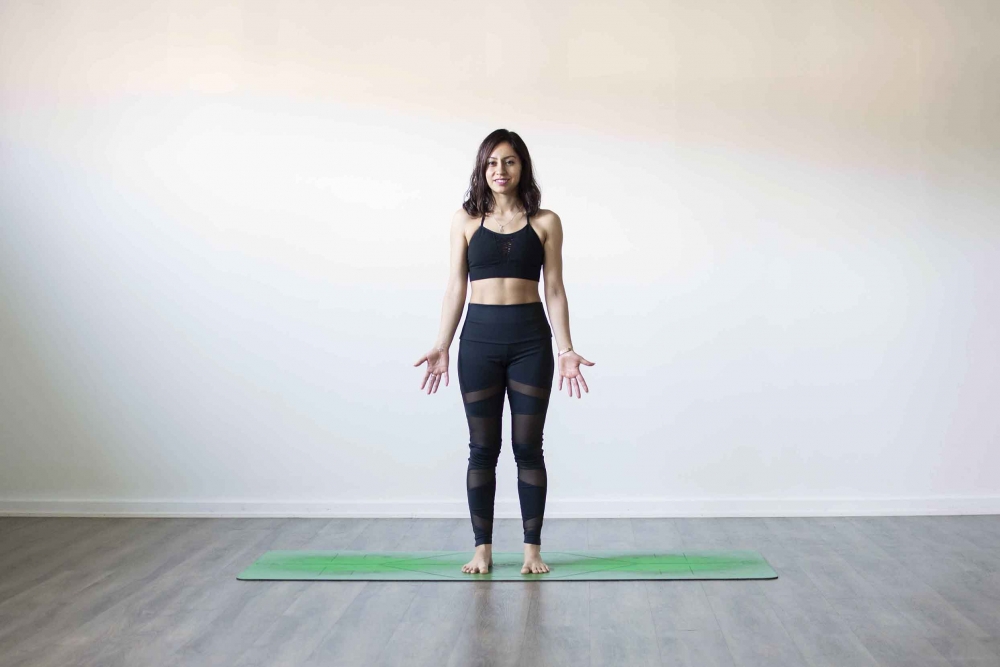
Stand with your feet hip-width apart, parallel. Spread the weight evenly between the heels and the balls of the feet. Let the pelvis rest level, neither tucked nor tipped, and lengthen up through the crown of your head with the shoulders soft. It looks like standing still. It is the base every standing pose starts from. More in our guide to Tadasana (Mountain Pose).
2. Urdhva Hastasana (Raised Hands Pose)
.jpg)
From Mountain Pose, breathe in and sweep the arms up, shoulder-width apart, palms facing each other. Keep the lower ribs soft so the lower back does not arch. It stretches the arms and the sides of the body and is the first movement of a Sun Salutation.
3. Virabhadrasana I (Warrior I)

Step one foot back about a leg's length, back heel down and the back foot turned out around 45 degrees. Bend the front knee over the ankle and reach the arms up. Point the hips roughly toward the front of the mat. If that twists your lower back, widen the stance, as if your feet were on two train tracks instead of a tightrope. Step by step in Warrior I (Virabhadrasana I).
4. Virabhadrasana II (Warrior II)

Warrior II opens to the side. Stand with the feet wide, front toes pointing forward and the back foot turned in slightly, close to parallel with the back edge of the mat. The hips and chest face the long side of the mat. Bend the front knee toward a right angle, with the knee tracking over the middle toes, and stretch the arms out at shoulder height. The thigh parallel to the floor is the goal, not the starting point. See Warrior II simplified.
5. Utthita Parsvakonasana (Extended Side Angle)

From Warrior II, rest your front forearm on the front thigh and reach the top arm over your ear. The forearm on the thigh keeps the chest open. Reaching for the floor too early usually collapses it toward the mat. A block outside the front foot is the next step.
6. Utthita Trikonasana (Triangle Pose)

Straighten the front leg, lengthen the torso forward over it, then tip down and rest the lower hand on the shin, the ankle or a block. Keep the hand off the knee joint itself. If the back of the front leg pulls hard, bend that knee a little. Variations in our guide to Trikonasana (Triangle Pose).
7. Parsvottanasana (Pyramid Pose)
.jpg)
A shorter stance than Warrior I, both legs straight, hips facing forward. Fold over the front leg with a long spine. Put a block on each side of the front foot so your hands have somewhere to land. You still get a strong stretch along the back of the front leg, without straining for the floor.
8. Anjaneyasana (Low Lunge)
.jpg)
Step one foot forward between the hands and lower the back knee to the mat, with a blanket under it if it is sensitive. Stack the front knee over the ankle. Keep the hips level and let them sink forward. The stretch is in the front of the back hip, the place that gets tight from sitting.
9. Malasana (Garland Pose)

A deep squat with the feet a little wider than the hips and the toes turned out. Bring the palms together and press the elbows gently into the inner knees. If your heels lift, sit on a block or roll a blanket under the heels. It opens the hips and stretches the ankles. Read more about Malasana (Garland Pose).
10. Ardha Uttanasana (Half Forward Bend)
.jpg)
You meet this one in every Sun Salutation, and most people rush it. From a forward fold, lift the chest halfway with the hands on the shins or on blocks. Make the back long and flat, like a tabletop, and bend the knees as much as you need to get there. Practise it on its own at home, side-on to a mirror, until the flat back feels familiar.
Poses on hands and knees
11. Plank Pose (Phalakasana)

Hands under the shoulders, legs straight back, body in one line from head to heels. Press the floor away and draw the belly in so the hips neither sag nor lift. Plank works the core, the shoulders and the arms, and it is the setup for Chaturanga. Lower the knees to the mat whenever you need to. Full guide: how to do Plank Pose.
12. Marjaryasana-Bitilasana (Cat-Cow)
.jpg)

On hands and knees, breathe in and let the belly drop and the chest move forward (Cow). Breathe out and round the back toward the ceiling, chin toward the chest (Cat). Move with the breath for six to ten rounds. It takes the spine gently through flexion and extension, which is why it is a common warm-up and a comfortable movement for many people with a stiff back.
13. Balasana (Child's Pose)

Knees wide or together, big toes touching, sit back toward your heels and rest the forehead on the mat or a block. This is the pose to take whenever you need a break in class. You rest without leaving the practice, and you join back in when your breath has settled. More in Balasana (Child's Pose).
Seated poses
Seated poses usually come later in a class, once the body is warm. If your lower back rounds when you sit on the floor, sit on the edge of a folded blanket. The height tips the pelvis forward and does more than any amount of forcing.
14. Dandasana (Staff Pose)
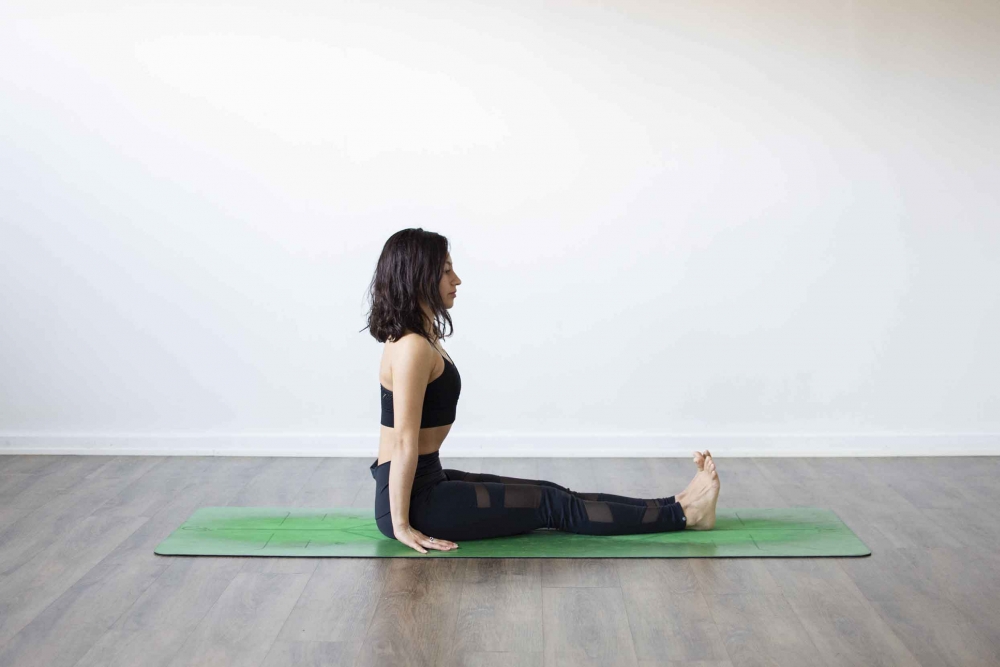
Sit with the legs straight in front of you, feet flexed, hands beside the hips. Sit up on your sitting bones and lengthen the spine. It is the seated version of Mountain Pose and usually comes right before a forward bend.
15. Sukhasana (Easy Pose)

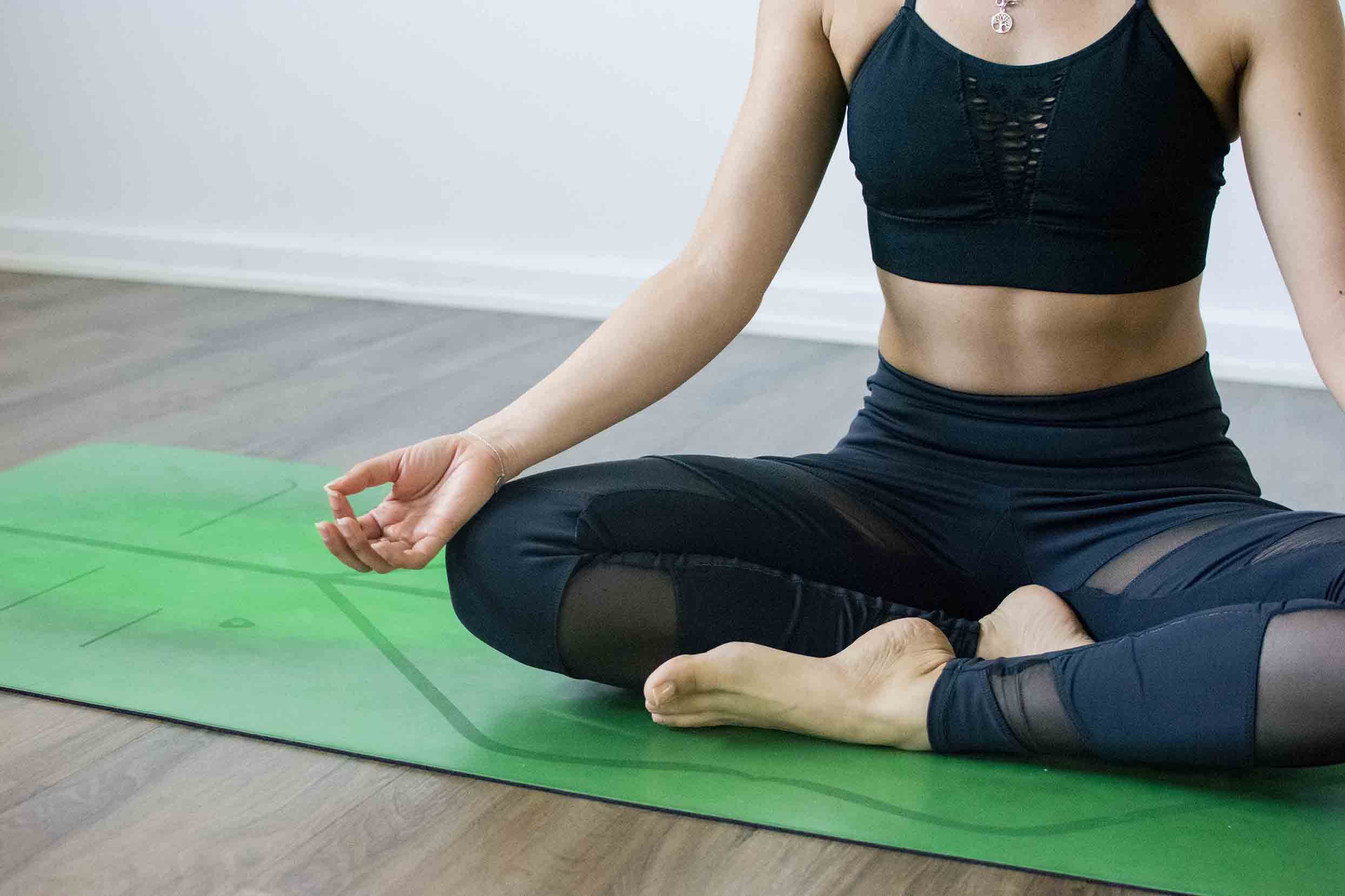
A simple cross-legged seat. Sit on a cushion or folded blanket high enough that your knees are level with or below your hips, and put blocks under the knees if they hang in the air. With enough support it is a comfortable seat for breathing exercises and meditation.
16. Baddha Konasana (Bound Angle Pose)

Also called Cobbler's Pose. Bring the soles of the feet together and let the knees fall out to the sides. Gravity does most of the work. Put a block under each knee if they stay high, so the inner thighs can let go instead of bracing. See Baddha Konasana (Bound Angle Pose).
17. Janu Sirsasana (Head-to-Knee Pose)

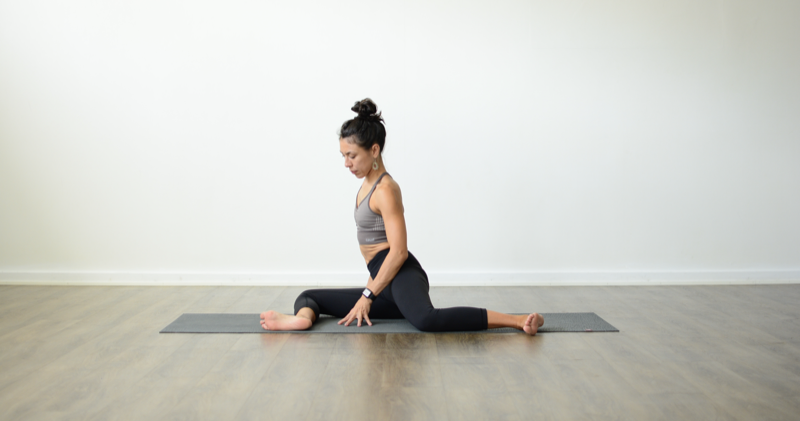
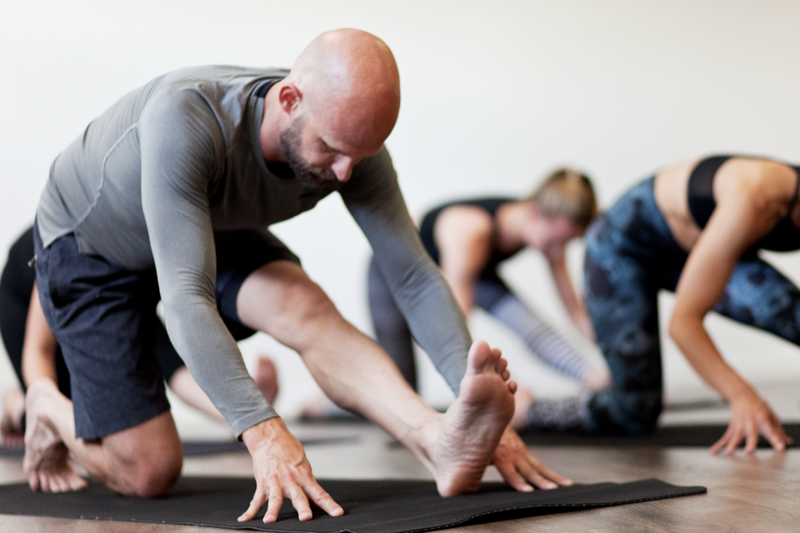
One leg straight, the other bent with the sole against the inner thigh. Turn toward the straight leg and fold over it from the hips. If you sit at a desk all day, your hamstrings are probably tight, and working one leg at a time is kinder than folding over both. A strap around the foot helps.
18. Paschimottanasana (Seated Forward Bend)
 (kopia).jpg)
From Staff Pose, breathe in to lengthen, breathe out and fold forward from the hips over both legs. Bend the knees as much as you need to keep the back long. The stretch runs along the back of the legs. Where your hands end up does not matter. More in Paschimottanasana (Seated Forward Bend).
19. Upavistha Konasana (Seated Wide-Angle Forward Bend)
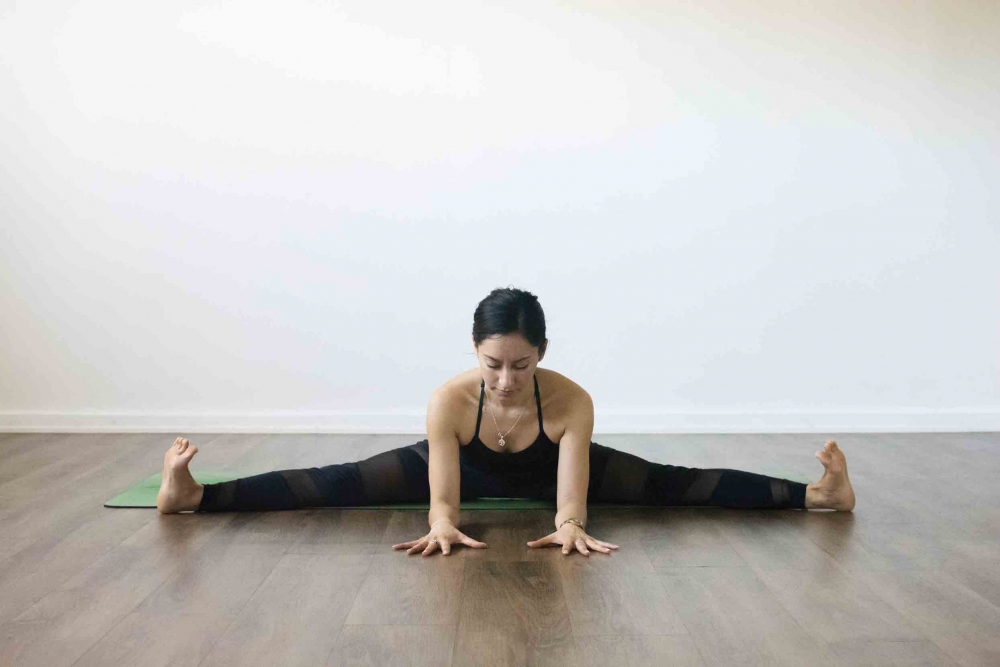
Legs wide, feet flexed and the kneecaps pointing up. Walk the hands forward and bend from the pelvis, not the spine. Chest on the floor is years away for most people, and it is not the point. A flat back and a small forward tilt do the work.
20. Ardha Matsyendrasana (Half Lord of the Fishes)
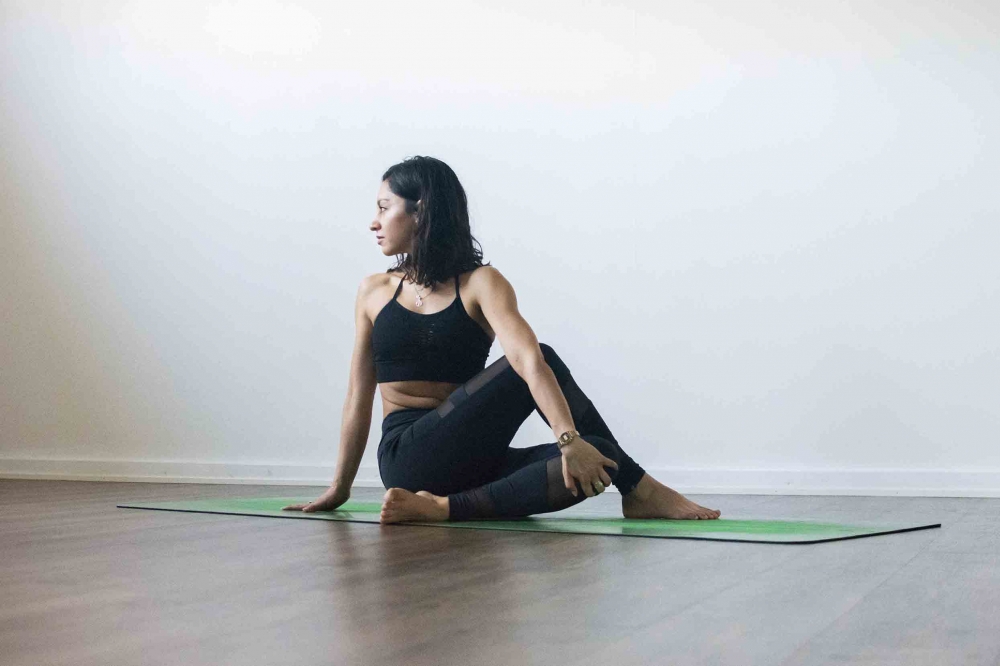
A seated twist. Bend one knee and cross that foot over the other leg, then turn toward the bent knee, lengthening up on the inhale and turning on the exhale. If tucking the lower leg under you is uncomfortable, keep it straight. The twist moves the spine and stretches the outer hip of the top leg.
Backbends
These two are the gentle ones. Warm up first, and keep the effort in the legs and upper back rather than squeezing the lower back.
21. Bhujangasana (Cobra Pose)

Lie on your belly, hands under the shoulders. Press the tops of the feet and the pelvis into the mat first, then lift the chest. In a low Cobra you barely use the hands at all, so the back muscles do the lifting. Raise higher only as far as the lower back stays comfortable. Step by step in Bhujangasana (Cobra Pose).
22. Setu Bandha Sarvangasana (Bridge Pose)

On your back, knees bent, feet flat and hip-width apart. Press into the feet and lift the hips. The glutes and the backs of the legs lift you, and the front of the hips opens, the opposite of sitting in a chair. Keep the head still once you are up. More in Setu Bandha Sarvangasana (Bridge Pose).
Lying down and resting poses
23. Ananda Balasana (Happy Baby)
.jpg)
On your back, draw the knees toward the armpits and hold the outer edges of the feet, soles facing the ceiling. Keep the sacrum and tailbone on the floor. Pull gently. It stretches the inner thighs and the lower back and often comes near the end of a class.
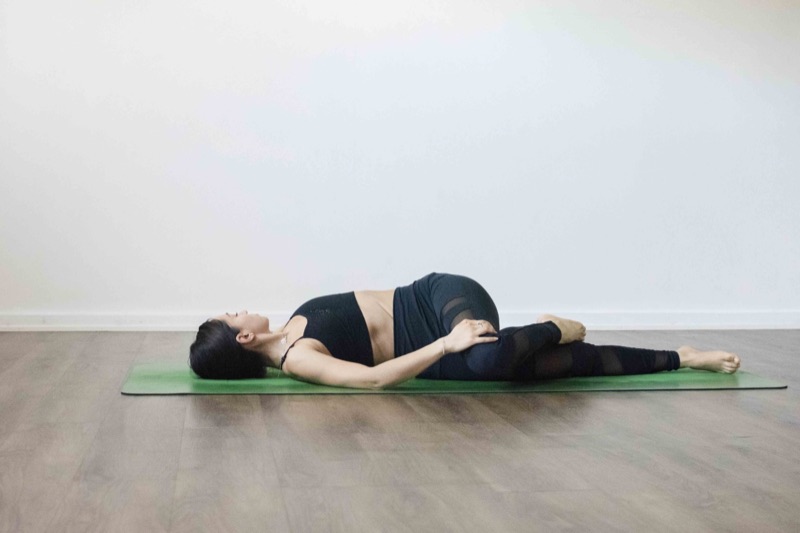
24. Supta Matsyendrasana (Supine Twist)

On your back, draw one knee across the body and let it fall to the other side while the shoulders stay down. Bend both knees and drop them together if that is easier. It works at the start of a practice as well as at the end.
25. Savasana (Corpse Pose)
.jpg)
Lie on your back, legs relaxed, arms a little away from the body, palms up. Let the breath go back to normal and stay for five to ten minutes. It is the last pose of most classes, the time when the body settles after the work. Read our guide to Savasana (Corpse Pose).
Who should modify these poses
- Knee problems: use a blanket under the knees in Low Lunge and on all fours, sit on a block in Garland Pose, and keep the front knee over the ankle in lunges and Warriors.
- Wrist pain: in Plank and Cat-Cow, spread the fingers and press through the knuckles, or come onto the forearms.
- Lower back pain: bend the knees in every forward fold, and keep Cobra low.
- High blood pressure or glaucoma: keep the head above the heart in forward folds and ask your doctor before long inversions.
- Pregnancy: skip lying on the belly (Cobra) and deep twists, and widen the knees in Child's Pose. A prenatal class is the better place to start.
- Recent surgery or injury: check with your doctor or physiotherapist first.
Common beginner mistakes
- Chasing the picture. Touching the floor is not the goal. A long spine with bent knees does more than a rounded back with straight legs.
- Holding the breath. If you cannot breathe slowly through the nose, you have gone too far. Back off a little.
- Locking the knees. In standing poses and forward bends, keep a micro-bend so the muscles, not the joint, hold you.
- Rushing the Sun Salutation. Half Forward Bend and Plank disappear when you hurry. Learn them one at a time first.
- Skipping props. Blocks and a blanket are not a sign that you are behind. Teachers use them every day.
- Skipping Savasana. The last few minutes are part of the class.
Where to go from here
Once these feel familiar, put them together. Surya Namaskar A (Sun Salutation A) links Mountain Pose, Raised Hands, the forward bends, Plank, Cobra and Downward-Facing Dog into one sequence, and it is the warm-up in most Vinyasa and Ashtanga classes.
A simple home sequence from this list: Child's Pose, Cat-Cow, Low Lunge, Mountain Pose, Warrior II, Triangle, Seated Forward Bend, Bridge, Supine Twist and Savasana. That is about 20 minutes.
Lizette Pompa's four-week program Yoga for Beginners teaches these foundations in 20-minute classes, with stops to explain each posture. You need a mat and two blocks.
Frequently asked questions
Which yoga pose is easiest for beginners?
Mountain Pose, Child's Pose and Corpse Pose ask for no strength or flexibility, so almost anyone can do them on day one. Cat-Cow and Easy Pose, with a cushion under the hips, are close behind. Easy does not mean pointless: Mountain Pose teaches the alignment every standing pose uses.
What are 12 basic yoga poses for beginners?
A good set of 12: Mountain Pose, Raised Hands, Half Forward Bend, Warrior I, Warrior II, Triangle, Low Lunge, Plank, Cat-Cow, Child's Pose, Bridge and Corpse Pose. Add Downward-Facing Dog and Cobra and you have what you need for a Sun Salutation.
What are 10 good yoga poses for beginners?
Mountain Pose, Warrior II, Triangle, Low Lunge, Cat-Cow, Child's Pose, Cobra, Seated Forward Bend, Bridge and Corpse Pose. Together they cover standing strength, the hips, the spine in both directions, the back of the legs and rest, which makes them a complete short practice.
Can I lose belly fat by yoga?
No pose burns fat from one area, and spot reduction does not work for any exercise. A gentle yoga class burns fewer calories than a brisk walk. Faster styles such as Vinyasa burn more, and regular practice builds strength in the core. Fat loss overall comes from activity, food and sleep together.
How long should a beginner hold a yoga pose?
Three to five slow breaths is a good start for most poses, which is about 15-30 seconds. Resting poses such as Child's Pose can be held longer, and Savasana for five to ten minutes. Come out as soon as your breath gets short or something hurts.
How often should a beginner do yoga?
Two or three times a week is enough to feel the poses get easier within a month or two. Short sessions count: 20 minutes three times a week teaches the body more than one long class on a Sunday.
Do I need to be flexible to start yoga?
No. Flexibility comes from practising, not the other way round. Every pose on this list has a version with bent knees, blocks or a blanket, and that version is the right one while the body adapts.